Getting more followers and engagement on your Facebook business page feels harder than it should be. You post regularly, but barely anyone sees your content. Comments are rare. Your follower count barely moves.
Here’s what’s actually happening: Facebook’s algorithm treats business pages completely differently from personal profiles. While your personal posts reach most of your friends, business pages now reach only about 5% of their followers organically.
This guide shows you what actually works for business pages in 2025. You’ll learn proven strategies based on how the algorithm works now, not outdated advice that might have worked years ago.
Contents
Do You Really Need a Specific Business Page?
Short answer: Yes, you need a business page. Using your personal profile for business violates Facebook’s Terms of Service and limits your growth potential.
Facebook offers three types of accounts, and understanding the differences matters for your strategy:
| Account Type | Best For | Key Features | Limitations |
| Personal Profile | Individual people | Connect with friends/family, join groups | Can’t run ads, no analytics, against TOS for business |
| Business Page | Companies & organizations | Ads, analytics, multiple admins, CTA buttons | Lower organic reach, can’t send friend requests |
| Creator Account | Influencers & public figures | Monetization tools, follower focus | Built for individuals, not companies |
Using your personal profile for business creates real problems. Facebook can shut down your account without warning if they detect commercial use.
You lose access to Facebook Insights, showing what content works. You can’t run ads or boost posts. Multiple team members can’t safely manage the account. It looks unprofessional to potential customers.
Business pages give you everything you need to grow strategically. You get detailed analytics, can run targeted ads, allow multiple team members different permission levels, and add call-to-action buttons for bookings or calls.
With 200 million businesses actively using Facebook business tools, according to Meta’s own data, the platform remains essential for reaching customers.
Why Is It So Hard to Grow a Business Page?
The Facebook algorithm prioritizes personal content from followers, friends, and family. Business pages now reach fewer of their followers without paid promotion.
According to recent research, the average business page reaches just 5.2% of its followers organically, which is a steep decline from 2019, when the same pages reached about 16% of Facebook followers.
The decline continues year over year. That’s why being ready with your strategy now matters.
What Facebook Actively Shows People Now
The algorithm specifically and intentionally looks for:
- Meaningful interactions like comments and shares, not just likes
- Video content, especially Reels
- Posts that keep people on Facebook longer
- Content from accounts people actively engage with
- Posts that spark genuine conversation
Content that sends people away from Facebook through external links gets less reach. Posts using engagement bait (like, “Share this with 10 friends!”) get penalized.
Setting Realistic Expectations
Growing a business page typically takes 6-12 months, or more, of consistent effort before you see meaningful results:
- Months 1-3: Building foundation, testing content, slow follower growth
- Months 4-6: Finding what resonates, engagement starts improving
- Months 7-12: Momentum builds, referrals increase, consistent results
Small, engaged audiences deliver more business value than large, inactive follower counts.
What Should You Post to Get Facebook Followers and Engagement?
Focus on helpful, entertaining, or conversation-starting content.
The 60-30-10 rule works well: 60% valuable content, 30% engagement-focused content, 10% promotional content.
Content That Performs Best for Business Pages
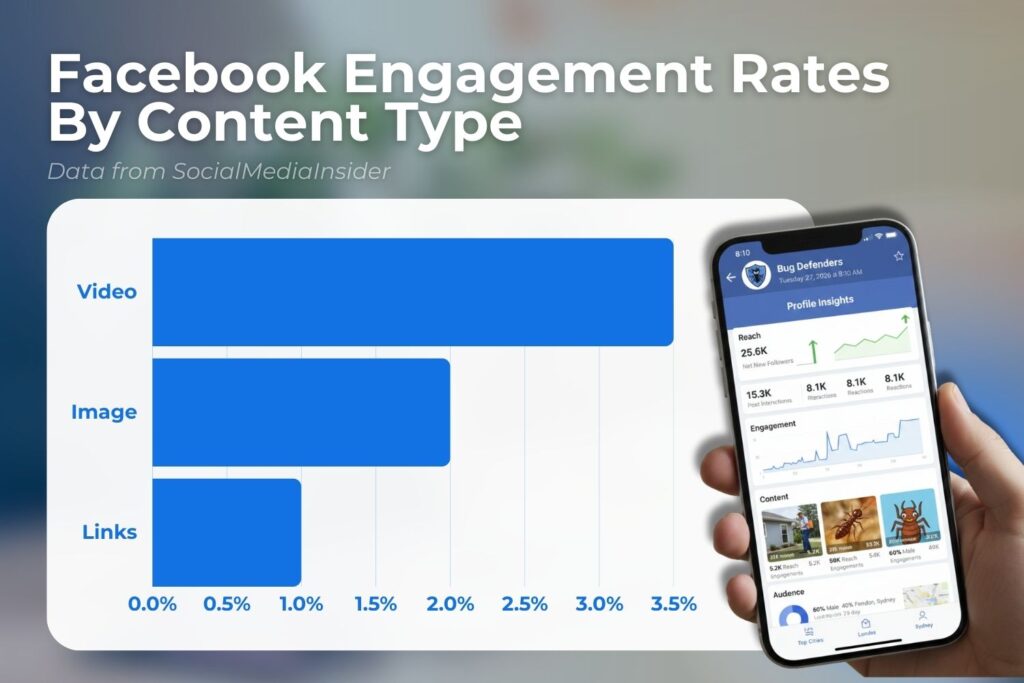
Socialinsider’s 2025 report showed clear winners:
- Short-form video and Reels: 3.6% average engagement
- Behind-the-scenes content: 2.8% average engagement
- Customer testimonials: 2.4% average engagement
- Educational tips: 2.1% average engagement
- Photo posts: 1.5% average engagement
When it’s combined with other efforts, high-quality video content generates more than every other kind of post. But flooding your profile with one kind of content can end up giving you the opposite effect.
The 60-30-10 Rule for Business Content
60% Valuable Content (not about you)
- Educational how-to guides related to your industry
- Local community news and stories
- Helpful tips that solve customer problems
30% Engagement Content
- Questions that spark conversation
- Polls about preferences or opinions
- Community spotlights and user-generated content
10% Promotional Content
- Service announcements
- Special offers or promotions
- New product launches
WolfPack has helped businesses balance promotional, engagement, and value-focused content on social media and watched performance increase notably.
What Kills Your Reach?
Avoid these engagement killers:
- Stock photos with generic captions
- External links send people off Facebook
- Overly promotional “buy now” language in every post
- Post only when you have something to sell
- Low-quality images or blurry videos
Think about what your customers actually want to see. A home services company might share quick maintenance tips or behind-the-scenes project transformations.
How Often Should You Post?
Short answer: Post 3-5 times per week as consistently as you can, but quality still matters much more than quantity for business pages.
The algorithm rewards consistency over volume. Facebook notices accounts that post regularly on a predictable schedule.
Ideal Posting Frequency for Small Businesses to Start With:
- Minimum: 3 posts per week
- Optimal: 4-5 posts per week
- Maximum: 7 posts per week (only if quality remains high)
When Should You Post?
Check your Facebook Insights to see exactly when your specific audience is online. While general research shows Tuesday through Thursday between 8-10am and 1-3pm perform best across industries, your audience might behave differently.
Local businesses often see strong engagement during lunch hours (11am-1pm) and early evenings (5-7pm) when people browse on their phones.
The First Hour Is Everything
The first 60 minutes after publishing determine whether Facebook will show your post widely. Strong early engagement signals the algorithm to show your content to more people.
This means you need to be available right after posting:
- Respond to every comment quickly
- Ask follow-up questions to extend conversations
- Like comments to show you’re reading them
Schedule your posts strategically around your availability. Your ability to respond quickly matters more than posting at the theoretically optimal time.
How Do You Actually Get People to Engage With Posts?
Ask specific questions, respond to every comment quickly, and make engagement feel natural and easy. Always aim to write captions that start conversations.
The first sentence or two determines whether someone stops scrolling. Mobile users see only about two lines before the “See More” button appears.
Conversation-Starting Techniques
1. Ask specific questions (not just “What do you think?”)
- Instead of: “What do you think about our new service?”
- Try: “Which would you tackle first: updating your kitchen or bathroom?”
2. Share relatable challenges your audience faces
- Just inspected a home where the seller tried to seal foundation cracks with caulk from the hardware store. What’s the quickest DIY fix you’ve attempted that didn’t quite work out?
3. Use fill-in-the-blank prompts
- “The best thing about living in [your city] is ____”
- “My biggest home maintenance challenge right now is ____”
4. Make Engagement Easy and Obvious
People engage more when you remove friction. So…
- Use polls and question stickers in posts
- Create multiple-choice questions in your caption
- Ask for recommendations on local topics
- Tag relevant people or businesses when appropriate
5. Keep the Conversation Going
Respond to every comment, especially in the first hour. Ask commenters follow-up questions to extend conversations. Pin your best comments to the top to encourage more engagement.
Should You Use Facebook Ads or Can You Grow Organically?
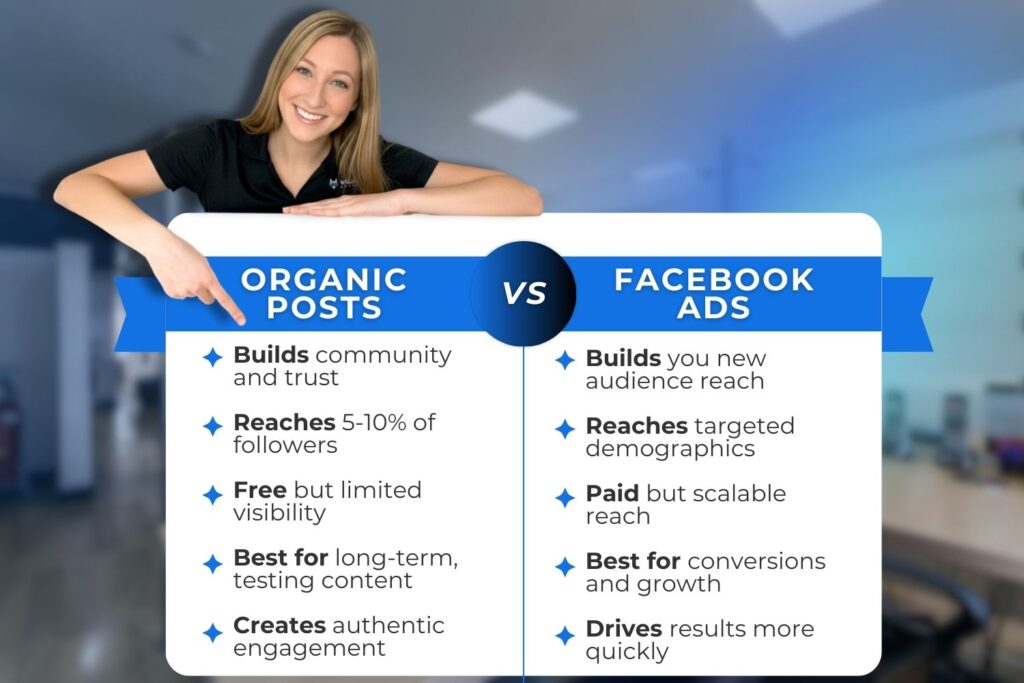
Some ad budget helps, but organic content still forms the foundation of your strategy.
Facebook is a business that generates billions through advertising. While frustrating for small businesses, this reality shapes your strategy.
When Paid Promotion Makes Sense
Use Facebook ads when you need to:
- Reach new audiences beyond your current followers
- Boost your best-performing organic posts
- Get faster results than organic growth allows
- Promote events or time-sensitive offers
According to industry research, Facebook delivers the highest ROI for local businesses among all social platforms when ads are used strategically.
How Much Should You Spend?
| Monthly Budget | What You Can Expect | Best Use |
| $150-300 | Modest reach boost, testing audiences | Boost top posts, local awareness |
| $300-500 | Consistent visibility, lead generation | Regular post boosting, conversion campaigns |
| $500+ | Significant reach, multiple campaigns | Full funnel strategy, retargeting |
Strategic Ad Allocation:
- 80% boosting high-performing content
- 20% promoting the page itself
Track actual business results like leads, calls, and sales, not just metrics like reach and impressions.
What Else Can You Do to Get More Followers?
Promote your page everywhere your customers already are, leverage existing relationships, and actively engage beyond your own page.
Promote Your Page Everywhere
Cross-Promotion Checklist:
- Add a Facebook button to your website header and footer
- Include page link in email signatures
- Share Facebook content on Instagram and other platforms
- Use QR codes on physical marketing materials
- Add Facebook link to Google Business Profile
Leverage Your Existing Relationships
The fastest way to grow uses connections you already have:
- Ask employees to follow and occasionally share page content
- Encourage happy customers to follow and review your page
- Include “Follow us on Facebook” in post-purchase emails
- Partner with complementary businesses for mutual promotion
One satisfied customer who shares your content reaches their entire network. This organic word-of-mouth marketing remains more powerful than any ad.
Engage Beyond Your Own Page
Growing your Facebook presence requires participating in the broader community:
- Like and comment on other relevant pages’ content
- Share valuable insights in Facebook Groups (don’t share spammy promos)
- Build relationships with local community pages
- Collaborate with other businesses on content
Run Contests the Right Way
Contests can accelerate growth when done correctly:
- Follow Facebook’s promotion guidelines strictly
- Keep entry simple (follow, like, comment, or share)
- Offer prizes your ideal customer actually wants
- Announce winners publicly and share their excitement
- Partner with other businesses to expand reach
A home services company giving away a free service attracts better Facebook followers than giving away an iPad. The service attracts people who need what you offer.
How Do You Know If Your Strategy Is Working?
Short answer: Track engagement rate, reach, and page actions like website clicks and calls. Follower count alone doesn’t tell the full story.
Metrics that you should actually track:
| Metric | What It Measures | Why It Matters |
| Engagement Rate | (Reactions + Comments + Shares) ÷ Followers × 100 | Shows if content resonates |
| Reach | Website visits, calls, and direction requests | Indicates visibility |
| Post Clicks | Link clicks, photo views, video views | Measures interest |
| Page Actions | Website visits, calls, direction requests | Connects to business results |
| Follower Growth | Net new followers over time | Shows audience building |
According to Rival IQ’s benchmark report, average engagement rates for business pages range from 0.07% to 0.09%.
Small businesses often see higher rates because their audiences are more targeted.
Where to Find This Information
Facebook Insights lives inside your business page under the “Insights” tab.
Check Weekly:
- Posts from the past week and their performance
- Which content types got the most engagement
- When your audience was most active
Check Monthly:
- Overall trends in reach and engagement
- Top-performing posts from the month
- Referral traffic to your website from Facebook
What’s a Good Engagement Rate?
Engagement rate benchmarks vary significantly by industry, market size, and location.
A restaurant in a small town might see different engagement patterns than a B2B software company in a major city. Use general benchmarks as a starting point, but focus on your specific industry and audience behavior.
General Engagement Benchmarks:
- Below 0.05%: Content needs improvement
- 0.05% to 0.10%: Average performance
- 0.10% to 0.50%: Good performance
- Above 0.50%: Excellent performance
Focus on improving your own numbers over time rather than comparing yourself to businesses in different industries or markets.
A local service business with 800 engaged followers outperforms a similar business with 5,000 disengaged followers every time.
What Are the Biggest Mistakes Businesses Make on Facebook?
Posting only promotional content, ignoring comments, and giving up too soon kills most business Facebook efforts.
Here’s what can self-sabotage your growth:
Engagement Killers:
- Posting only when you have something to sell
- Ignoring comments or responding days later
- Using your personal profile instead of a business page
- Buying fake followers (Facebook detects and penalizes this)
- Posting identical content across all platforms
Content Mistakes:
- Low-quality or blurry images and videos
- Stock photos that feel generic
- Overly promotional language in every post
- Inconsistent posting schedule
The Compounding Effect of Poor Content
Consistently posting low-engagement content doesn’t just fail to grow your page. It actively hurts your future reach.
Facebook’s algorithm learns that your content doesn’t resonate, making it harder to recover even when you improve. Some business pages never fully recover from months of promotional-only posts.
How to strategically support your business page:
Your personal profile can help jumpstart your page. Share your business page content from your personal profile occasionally (not every post). Add context about why it matters rather than just hitting the share button. Invite your personal connections to follow your business page, especially when you first launch.
Facebook Groups offer another strategic advantage. While your business page can’t directly participate in groups, engaging as yourself in relevant industry groups builds visibility.
Industry-specific groups like the Home Inspector Humor group can become community hubs that help professionals connect and build brand awareness beyond their business pages alone.
Why Many Businesses Give Up Too Soon
Most businesses quit Facebook before they ever see results. Organic social media growth takes 6-12 months of consistent effort. The algorithm rewards long-term consistency. Small wins compound over time into significant growth.
Your competition likely gives up too soon. Outlasting them by staying consistent gives you a significant advantage.
Related Questions
How long does it take to grow a Facebook business page?
Expect 6-12 months of consistent effort before seeing meaningful results. Most businesses see gradual growth in months 1-3, improving engagement in months 4-6, and compounding momentum in months 7-12.
Can I turn my personal profile into a business page?
No, but Facebook offers a way to convert profiles to pages. Create a new business page, invite your personal friends to follow it, and transition your business activity to the proper page.
Do Facebook Reels really help business pages grow?
Yes. Reels average more engagement compared to photo posts. Simple ideas include before-and-afters, behind-the-scenes clips, quick tips, and team introductions.
What’s the difference between boosting a post and running an ad?
Boosting takes existing organic content and shows it to more people with a simple setup. Running an ad creates dedicated advertising content in Ads Manager with advanced targeting.
Conclusion
Growing a business page on Facebook in 2026 requires more than posting regularly. Focus on creating valuable content that sparks genuine conversation. Use the 60-30-10 content rule. Respond to comments quickly, especially in the first hour.
Remember that small, engaged audiences drive more business results than large, inactive follower counts. Success takes 6-12 months of committed, aligned effort, but results compound over time.
WolfPack Advising helps businesses develop social media strategies that drive real results, not just vanity metrics. Schedule a strategy call today.