



Skip to content
New: Free AEO Grader. Score your site for AI search in 60 seconds. Try It

Digital Marketing for HVAC Companies

Anyone gets calls during a heat wave. The phone rings whether you market or not. The companies that grow have a full board in April and October, a steady stream of replacement quotes instead of $89 service calls, and enough maintenance agreements to make revenue predictable.

Lara Umali, Support CoordinatorKailey Hess, CRM SpecialistAaron Shishilla, CEO & Founder

Overview

Steady Demand in Every Season, Not Just the Heat Wave

HVAC has the most violent demand curve of any trade. The first hundred-degree week brings in more than the previous six combined. Then April and October go quiet while payroll does not. Most HVAC marketing is built entirely around the spike, which means paying peak prices for calls that were coming anyway.

The bigger money is in between. A system replacement is an $8,000 to $15,000 decision people research for weeks. A maintenance agreement turns a one-time customer into recurring revenue and first-call status when their system finally dies. Neither is won by bidding harder on "AC repair near me" in July.

HVAC technician servicing a rooftop unit

Why WolfPack

A Pipeline That Works All Twelve Months

Where you start depends on your shape. A three-truck residential shop with no maintenance base has a different first move than a company running commercial contracts alongside residential with a plan list already built. One needs enrollment campaigns from scratch. The other needs its two sides separated so the higher-margin one stops getting diluted.

We build a pipeline that works all twelve months.

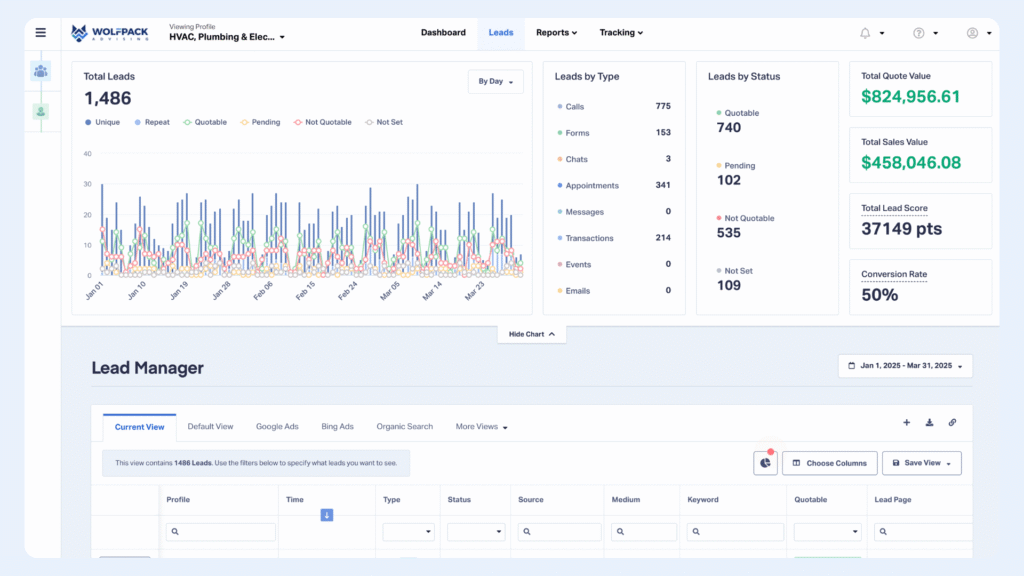
WolfPack Lead Tracking & ROI Dashboard sample

How It Works

Our Process for HVAC

  1. 1

    Audit

    We look at your seasonality, your current rankings, your ad efficiency, and how many service calls are actually converting to replacements. That last number is usually the one nobody is tracking, and it is where the money is.

  2. 2

    Build Demand for the Slow Months

    Tune-up, indoor air quality, and pre-season campaigns that fill April and October. These cost far less to advertise than emergency repair, because you are not bidding against every other company in town during the same three weeks.

  3. 3

    Capture Emergency Demand Efficiently

    Google Local Services Ads and Search campaigns structured for peak season without peak waste. Tight scheduling, geography, and service-type targeting matter more here than bid strategy, because the demand is coming either way.

  4. 4

    Reach Replacement Buyers Early

    SEO and content that put you in front of homeowners in the weeks before they call anyone. An $8,000 to $15,000 decision gets researched, so the company that shows up during the reading usually gets the first quote.

  5. 5

    Follow Up on Every Unsold Quote

    CRM automation that stays with the estimate through the comparison period instead of going cold at 48 hours. Most homeowners collect three quotes over two weeks, and most contractors stop after one voicemail.

  6. 6

    Grow Maintenance Plans With Marketing

    Enrollment and renewal campaigns, so recurring revenue is not left to whoever is in the attic. This is the line that smooths out the whole year and it almost never gets marketed directly.

Benefits

Why Choose WolfPack

April and October

Work on the Board Between the Extremes

The first hundred-degree week brings in more than the previous six combined, and every competitor bids for those same calls at the same time. Peak demand shows up whether you market or not. The months that actually decide your year are the quiet ones, when payroll runs and the board looks thin.

We build demand for April and October: tune-up drives, indoor air quality campaigns, and pre-season offers that cost a fraction of emergency clicks because nobody else is competing for them. Peak season still gets covered, structured tightly enough that you are not paying premium rates for calls already headed your way.


Quotes That Close

Your Estimate Stays in the Running for Two Weeks

A system replacement is an eight to fifteen thousand dollar decision, and homeowners gather three quotes over about two weeks before signing anything. Most contractors stop after one voicemail. The quote that stays visible through that whole comparison period wins a share of jobs the first phone call was never going to close.

Every unsold estimate goes into automation that keeps working: reminders, financing details, efficiency comparisons, and a nudge before the decision window closes. Nothing depends on a tech circling back. Quotes you already paid to produce turn into installs, which is the least expensive revenue available to an HVAC company.

Plans That Renew

Maintenance Agreements Marketed Like a Real Product

Maintenance agreements smooth out the whole year. They turn a one-time customer into recurring revenue and put you first in line when a system finally fails. In most companies that line gets sold in the attic by whoever remembers to ask, so growth depends on how rushed the tech was that afternoon.

We market the plan directly instead of leaving it to chance. Enrollment campaigns run to your service list, renewal reminders go out before cards expire, and the agreement gets a real page rather than a footnote. Recurring revenue becomes something you can forecast, and the plan base becomes where replacement quotes start.

Replacements Tracked

See Which Calls Become Installs

Call volume is a comfortable number that hides the important one. What matters is how many service calls converted to replacements, what a booked install cost to acquire, and which campaigns bring homeowners with failing systems instead of eighty-nine dollar diagnostics. Almost nobody tracks that, and it is exactly where the margin lives.

Every lead is attributed in Lead Center and the ROI Dashboard, from first click to the job on the board. Reporting covers cost per quotable lead, cost per booked job, and return on ad spend, walked through on video each month by the specialist running your account. Weekly communication comes standard.

Digital Marketing Services

Marketing Services Built for HVAC

Pricing

Packages for Your Business

Basic, Advanced, and Pro describe the level of support within a service. Choose the services you need and the package level that fits each one.

Basic

A focused starting point for the service you need most.

Your package

  • Core scope within your chosen service
  • Focus on your immediate priorities
  • Add other services as separate packages

Advanced

A broader scope for the next stage of your business.

Your package

  • Expanded scope within your chosen service
  • Build on an established foundation
  • Combine with other service packages

Pro

A comprehensive scope for more ambitious or complex needs.

Your package

  • Comprehensive scope within your chosen service
  • A plan shaped around greater complexity
  • Combine with other service packages

Packages are sold per service. Available tiers, deliverables, and pricing vary by service and are confirmed in your proposal.

Meet the Pack

Your HVAC Marketing Team

  • Sarah Bryant

    Sarah Bryant

    Advertising Team Lead

  • Claire Hughes

    Claire Hughes

    SEO Specialist

  • Emma Harvey

    Emma Harvey

    Social Media Specialist

Proof, Not Promises

Results for HVAC Businesses

Quick Questions

Frequently Asked Questions

How do I keep the phone ringing in spring and fall?

Market something other than emergency repair. Tune-ups, indoor air quality, duct work, and maintenance enrollment all sell in shoulder months, and they cost far less to advertise.

How do I get more replacement jobs instead of service calls?

Replacement is researched, not urgent. It is won with content, reviews, financing visibility, and follow-up on quotes. You have to reach people in the weeks before they call.

When should I start marketing for cooling season?

Six to eight weeks before your demand turns. Starting the week of the first heat wave means paying peak cost with an unoptimized account.

Are Google Local Services Ads worth it?

Usually yes. They sit above search ads and your review profile affects placement and Google Guaranteed status, so strong ratings make the same budget produce more calls.

Can marketing actually grow maintenance agreements?

Yes. Enrollment campaigns, renewal reminders, and plan value follow-up move agreements well past what techs can sell in person. That is the line that smooths out your whole year.

We do commercial and residential. Should those be separate?

Yes. Different buyers, different search behavior, different sales cycles. A facility manager sourcing a service contract and a homeowner with a dead condenser have nothing in common, and one campaign for both usually shortchanges the commercial side.

How long before this starts working?

Paid ads produce calls in the first week, with 30 to 60 days of tuning before cost per lead settles. Local SEO shows early movement in one to three months and real gains in three to six. Quote follow-up automation tends to show results fastest, because it is recovering estimates you already paid to generate.

Reviews

Real Results, Real People.

Save time, earn more, become alpha.

Tell us about your business goals to get a free proposal and dominate online.

Once a week. No spam ever.

One newsletter. Delivered straight to your inbox.

Your one-stop shop for

  1. Algorithm Updates
  2. Strategy Suggestions
  3. Industry-Specific Wins
  4. And More

Join the Pack

Get The Howler every week.

No spam. Unsubscribe anytime.