
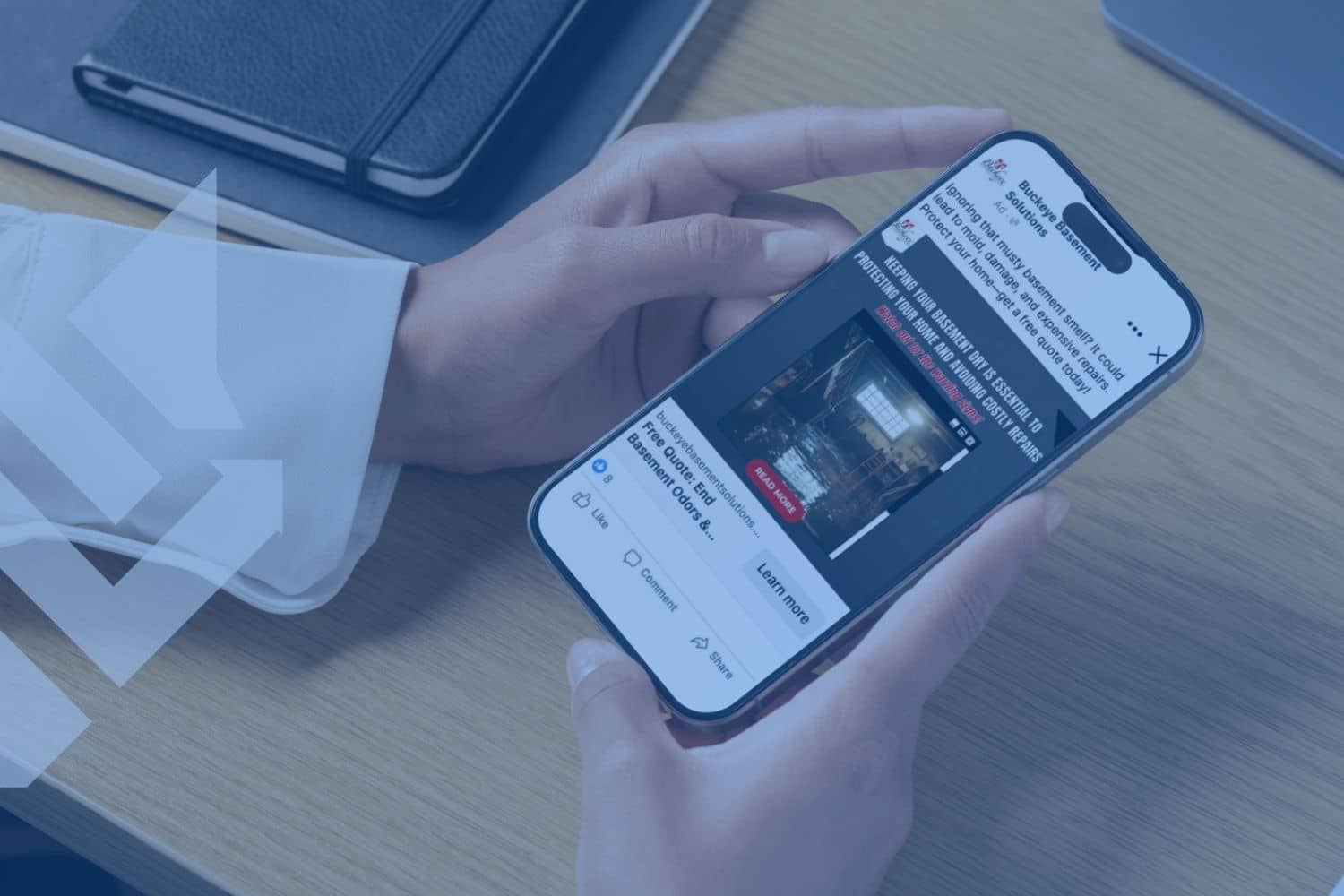
Paid social advertising is when you pay Facebook or Instagram to put your ad in front of an audience that you choose. You pick the zip codes and the budget. Your ad shows up in their feed between posts from people they follow.
Nobody needs to search for you. They were scrolling, and you showed up. At WolfPack, we run these campaigns every day for inspectors, pest control companies, roofers, septic crews, and more. Many owners tell us the same thing: they boosted a post once, got likes and no calls, and then wrote Facebook ads off.
The ad was usually fine, but the setup needed help. Here is how the whole strategy works.
What is Paid Social Advertising?
Paid social is renting space in someone’s feed. Organic social is the free posting you already do.
The difference is who sees it. Post for free and Facebook shows it to a slice of your existing followers. If you have 400 followers, maybe 30 see it, and they already know you exist. Pay, and you can reach 8,000 homeowners in three zip codes who have never heard your name.
Your customers are already there. Pew Research found 71% of US adults use Facebook, 84% use YouTube, 50% use Instagram, and 37% use TikTok. Facebook is the one to focus on. That is where users over 35 are, and they are the ones buying homes, paying for roofs, maintaining HVAC systems, and so on.
Boosting is not the same thing. That blue “Boost post” button takes something you already wrote and shows it to more people. You can’t tell Facebook you want phone calls, attach a form that collects names and numbers, or test two versions to see which works.
Real campaigns get built in Ads Manager, the free tool that comes with your business page.
The Five Parts of a Campaign
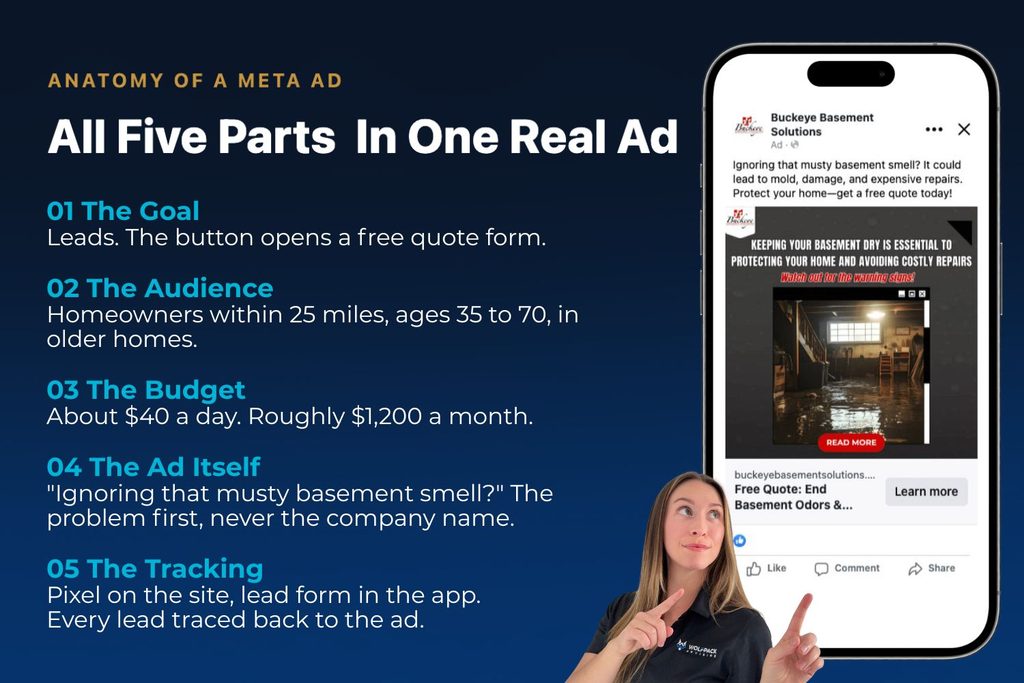
Every campaign is five decisions. Owners get the first one wrong most often.
1. The Goal
Facebook asks what you want the ad to do, and then chases exactly that. Pick “engagement,” and it finds people who like things.
They are cheap to reach, and they never call. Pick “leads,” and it finds people who have filled out forms before. Costs more per person, and those people book jobs.
For home services, you want leads (a form opens right in the app, name and phone already filled in), calls (tapping the ad dials your phone), or traffic (sends them to your site to see pricing or reviews).
2. The Audience
Start with the map. Draw a 20-mile circle around your address, or hand Facebook the zip codes you actually service. Then narrow it down: homeowners instead of renters, people who moved in the last six months, people who already visited your website.
Don’t narrow too far. An audience under about 50,000 people runs out of room fast, and your costs climb.
3. The Budget
You set a daily or monthly amount, and Facebook never goes over it. Every time someone opens the app, an instant auction decides whose ad loads. You are bidding against the dentist and the car dealer, not just other roofers.
Facebook does not just take the highest bid. It weighs your bid against how well your ad performs. An ad people stop and watch gets shown more for less money. A better ad is a cheaper ad.
We recommend a minimum budget of $1,000 a month per campaign, and most businesses running a full funnel invest $2,000 to $3,000 a month. Anything under that, and Facebook never gathers enough data to improve, so your costs stay high. Give it 2 to 3 months before you judge the results.
Watch which number you’re reading. Most prices quoted online are cost per click, what you pay when someone taps your ad. A click is not a lead. Ten people can tap, and none of them fill out the form. The number that matters is cost per lead, and the full budget picture is in social media advertising costs in 2026.
4. The Ad Itself
The photo or video and the words. This is your biggest lever, and real beats polished every time. A 20-second phone video of your crew hauling out a wrecked deck will outperform a stock photo of a smiling family.
What works: before-and-after photos side by side, vertical phone video of real work, your face explaining one thing homeowners get wrong, a customer review with their name on screen. Your first line is the hook, so lead with the problem, not your company name.
One rule before you run reviews or before-and-after ads: FTC advertising rules apply to a Facebook ad the same way they apply to a billboard. Claims have to be true, offer terms have to be visible, and reviews have to be real.
5. The Tracking
This is the step everyone skips and the reason campaigns get killed too early.
The Meta pixel is a snippet of code on your website that tells Facebook what people do after they click: did they reach your contact page, did they fill out the form, did they bounce? A lead form is the alternative if your site is not set up for it. It lives inside Facebook, so nobody has to leave the app.
You need to be able to answer one question at month’s end: which ad produced jobs. Without tracking, you are guessing, and you will shut off your best ad.
How Paid Social Differs From Search Ads
This is where most of the frustration comes from. Search ads catch demand. Paid social creates it.
Somebody typing “septic backup near me” at 6 am already has a problem and already decided to spend money. Google just decides who gets the call. Expensive to reach, easy to close.
Somebody scrolling Facebook at 9 pm was not thinking about their septic tank. You interrupted them. Cheap to reach, harder to close, and there are far more of them.
| Factor | Paid Social | Search Ads |
|---|---|---|
| How they find you | You choose who sees it | They type a problem into Google |
| How ready they are | Not thinking about it yet | Ready to book now |
| Cost per click | Lower | Higher |
| The leads | More of them, need follow-up | Fewer, close faster |
| Best fit | Planned and seasonal work | Emergencies |
So a burst pipe is a Google Search Ads job. A spring termite plan is a Facebook job.
Set expectations before you start. Facebook gives you more leads that cost less and close slower. Judge them by your Google close rate and you will kill a campaign that was making money.
We compared every channel in where to advertise your business.
Different Campaigns For Different Goals
The goal you picked in step one puts your campaign into one of two types. Facebook names them, and you will see both in Ads Manager.
Awareness campaigns get your name in front of people who do not know you. They optimize for reach or video views. Nobody fills out a form, and that is the point.
Conversion campaigns ask for the job. They optimize for leads or calls, and you measure them in booked work.
| Factor | Awareness Campaign | Conversion Campaign |
|---|---|---|
| What you pick | Reach or video views | Leads or calls |
| What the ad does | Teaches or shows your work | Names a service, makes an offer |
| How you measure it | Views, profile visits, audience size | Booked jobs |
| Example | A 45-second clip on what most inspectors miss | “Buying a home this spring? Book your inspection now.” |
Start With Awareness
Most owners jump straight to conversion ads, then watch their cost per lead climb around month two. Same small audience, same ad, and nobody books from a first handshake.
We usually run it the other way. Awareness ads come first because they do two jobs at once: homeowners start recognizing your name, and Facebook builds you an audience of everyone who watched that video or visited your page.
Then you retarget. Your conversion ads go only to people who already watched, which is a small warm audience instead of total strangers. Those are almost always the cheapest leads in the account.
It matters more than it sounds. When homeowners were asked how they find a home service pro, Facebook came in second at 32%, ahead of Google Search at 20%. They are checking you out on Facebook before they ever search.
More on that in getting cheaper local leads from paid media.
Where to Put Your Budget First: Search Ads vs Social Ads
Meta is where paid social lives, but it is not usually the first dollar a home service business should spend. Here is the order we recommend.
- Google Local Services Ads. Top of the search results, and you pay per lead instead of per click. Highest intent, least waste.
- Google Search Ads. Catches the searches LSAs do not cover. Still people actively looking, but you pay per click whether they contact you or not.
- Meta (Facebook and Instagram). This is the one that does what the other two cannot. LSAs and search ads only reach people already looking for you. Meta reaches homeowners who have not started looking yet, which is how you fill a slow season or sell planned work like a pre-listing inspection. One budget covers both apps.
- Microsoft Ads. Smallest audience, cheapest clicks, and a crowd that skews older and more likely to own a home. Add it once Google is producing.
If you can only fund one, fund LSAs. Paid social earns its spot the moment you need more volume than search alone can supply, or you are selling work nobody thinks to search for.
Your Free Posts Help Make Your Ads Cheaper
Too many business owners and operators treat organic posting and paid ads as two totally separate worlds. They should feed each other.
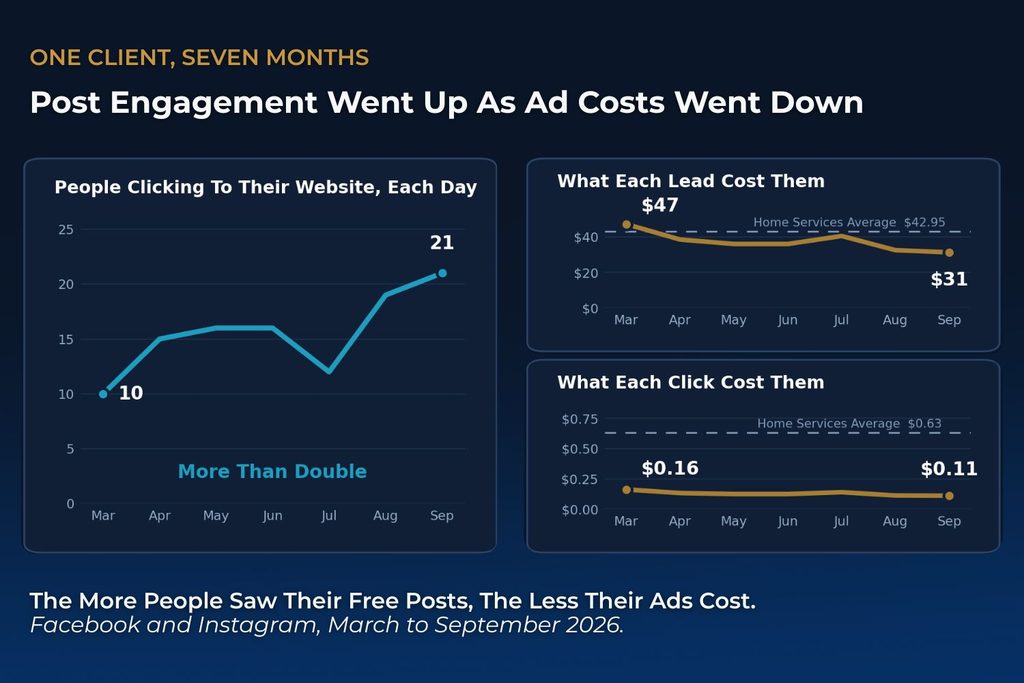
Think about what actually happens. Someone sees your ad, gets curious, and taps your business name. What loads next decides whether they call. Three posts from 2023 and no reviews? They close the app. Recent job photos, five-star reviews, and the face from the ad? They call.
There is a money angle too. Your regular social posts are free testing. The photos and offers that get real comments are the ones worth putting budget behind.
If your page needs work first, that is what our social media management service handles.
Watch our team leads break down how your organic social improves ad performance and lowers your cost per lead.
Related Questions to Explore
Is boosting a post the same as paid social advertising? No. Boosting is one small feature inside it. You cannot optimize for phone calls, attach a lead form, or test two versions against each other. Full campaigns are built in Ads Manager, which is free.
How much does paid social advertising cost?
You set the spend. Facebook charges through an auction, so your cost depends on your service area, your audience size, and how many other advertisers want the same people. Most home service businesses start around $1,000 a month per campaign. See our full breakdown of social advertising costs.
What counts as paid social? Any ad you pay a social platform to distribute. Facebook, Instagram, TikTok, YouTube, LinkedIn, sponsored posts, boosted posts. If money changed hands to get it seen, it counts.
When should I use paid social instead of search ads? When the work is planned rather than urgent: seasonal plans, preventive service, remodels, cleanouts, inspections. Also when you are new to a service area, and nobody knows your name. If your business is almost all emergency calls, start with search ads.
Should I run my own ads or hire someone? You can run your own with a few hours a week to learn Ads Manager, shoot creative, and check results. Most owners do not have those hours. The pattern we see: three months in, they cannot tell which ads produced jobs, get frustrated, and start over. If you go it alone, start with a paid social competitor analysis to see what already works in your market.
Why do my Facebook leads feel worse than my Google leads? They are not worse; they are earlier. A Google lead went looking for you. A Facebook lead was scrolling and thought, “we should probably get that done.” Call them within five minutes, and the gap mostly closes.
When to Work With a Professional
Plenty of owners run their own ads and do fine. Get help when:
- You have run ads for 60 days and still cannot say which produced paying jobs
- Your pixel or lead form was never installed, so nothing is measurable
- Your cost per lead keeps climbing, and you do not know why
- You spend enough that a 20% improvement covers the fee
- You want Facebook and Google running together without bidding against yourself
WolfPack Advising specializes in home service businesses.
We are not learning your trade from scratch. We already know what a pest control offer needs to say in February and why a roofer’s storm ad has a two-week shelf life.

Final Thoughts
Paid social puts you in front of homeowners who were not looking for you yet. That is the strength and the catch.
- Awareness first, then retarget. Running conversion ads at strangers is what makes lead costs climb.
- Match the channel to the job. Paid social sells planned work; search ads catch emergencies. You need both.
- Set up tracking first, or you will never know which ad paid for itself.
Want a straight answer on whether paid social is worth it in your market? We will look and tell you honestly. Request a free proposal and grab a time to chat about your goals.