

Most of what runs the digital advertising industry is invisible to the people it targets. That is by design.
Beneath the ad, you actually see a real-time auction, a behavioral profile built without your consent, the slow death of third-party cookies, the rise of “privacy” theater, a social media industry whose actual business is selling attention, and an AI layer making the whole machine smarter every quarter.
I have run campaigns inside that machine for more than ten years. Most of what people think they know about how ads find them is wrong.
TLDR: What is programmatic advertising? It is the automated, real-time system that decides which ads you see, when you see them, and how much an advertiser pays to reach you. Every time an ad-supported web page loads, an auction happens in roughly 100 milliseconds. Your data is what the bidders are buying.
That is the surface. The rest of this post is the part that does not fit on a homepage: and the part that explains why running ads in 2026 looks nothing like it did five years ago, and why most small businesses are quietly overpaying for the same clicks.
A Quick History: How We Got an Auction Inside Every Page Load
To understand why running ads today looks nothing like it did in 2018, you have to start with the cookie.
In 1994, two Netscape engineers (Lou Montulli and John Giannandrea) invented the cookie: a small file your browser keeps so a website can remember you between page loads. The original use case was a shopping cart. They knew at the time it could be used to track people across sites. They shipped it anyway.
Within a few years, third-party cookies became the backbone of online advertising. Networks of sites pooled their tracking cookies so a visit to one site dropped trackers from dozens of others. By the late 2000s, Google and Meta had built the two largest ad ecosystems in history on top of that plumbing.
Montulli and Giannandrea later helped start Mozilla, the nonprofit behind Firefox and some of the most aggressive consumer privacy research in the industry. Mozilla’s largest source of funding for years has been Google: the company whose ad business depends on tracking.
If that feels like a paradox, welcome to the topic. It also explains why the system is mid-transformation right now, and why most small businesses are running ads on the wrong half of the stack.
The timeline that brought us here:
- 1994: Cookie was invented for online shopping carts. Cross-site tracking potential noted, shipped anyway.
- Late 2000s: Google and Meta build ad empires on third-party cookie infrastructure.
- 2021: Apple’s App Tracking Transparency (iOS 14.5) lets users opt out of cross-app tracking. Most do.
- 2022–2024: Chrome begins phasing out third-party cookies. Platforms pivot to server-side tracking.
- 2025–2026: AI-driven campaign types (Performance Max, Advantage+) become the default. The algorithm runs the auction. Your data quality determines who wins.
Why the Targeting Feels Like Mind Reading (And How That Becomes Your Advantage)
You have probably had this moment. You have a conversation about a product you never searched for. A day later, an ad for it shows up in your feed.
Most people joke that their phone is listening. Phone-microphone surveillance would be legally radioactive and operationally pointless when the alternative is so much cheaper. The platforms already know your location patterns.
They know the apps on your phone, the people you spend physical time near, the searches your spouse just ran on a different device, the products you scrolled slowly past but did not click, and a few thousand other behavioral signals you never consented to in any way you could read. They feed all of that into models that are very good at predicting what you are about to want.
That same prediction layer is what your ad budget is paying for. The platforms you use for free are not in the social-connection business. They are in the attention-harvesting business, with you as the product and advertisers as the customer. The moment you flip the table and become the advertiser, that same machinery is the most precise customer-acquisition system ever built.
The question is whether you can feed it well enough for it to find your buyers.
Many small businesses can’t and don’t.
The Privacy Shift Quietly Moved Where Ad Money Wins
In 2021, Apple rolled out App Tracking Transparency. iOS 14.5 prompts asked you whether each app could “track you across other companies’ apps and websites.” Most people tapped no. Headlines announced the end of mobile advertising. Meta said the change cost them $10 billion in revenue.
Under the hood, the story is different.
The major platforms didn’t retreat: they rebuilt. Server-side tracking replaced the pixel as the primary data pipeline:
- Conversions API (Meta) and Enhanced Conversions (Google) moved data collection off the browser and onto your server
- Device fingerprinting and probabilistic identity matching filled gaps where cookies disappeared
- Clean rooms anonymize data in a way that still lets advertisers target the same humans
Third-party cookies are dying in Chrome, years overdue. But the replacement is not less tracking. It is tracking that happens further from your view and is harder to opt out of.
For consumers, the surveillance moved to the basement. For advertisers, it moved to a place most small businesses don’t know how to reach.
Here‘s the part that costs small businesses real money:
The tracking pixel on your website (the JavaScript snippet Google and Meta gave you back in 2015) now misses a meaningful share of the conversions it used to capture. Browsers block it. Ad blockers block it. iOS strips it. Your campaigns are still bidding, but the platform is learning from incomplete data.
The fix is server-side: send conversion events from your server, your CRM, or your scheduler directly to the ad platform’s API, with the actual sale value attached. The platforms reward businesses that do this with cheaper, more accurate targeting, because you are feeding their algorithm real revenue signal instead of pixel guesses.
Most small businesses are still pixel-only. The ones that aren’t are quietly winning.
AI Is Now on Both Sides of the Auction
The last two years quietly changed the entire advertising stack. Google’s Performance Max and Meta’s Advantage+ hand most of the targeting and bidding decisions to AI.
You upload creative assets, set a budget, define a goal, and the system decides who sees what, when, and at what price. Generative AI now writes the headlines, designs the variants, and chooses which version to show which person.
The amount of human button-pushing in a typical campaign has dropped year over year. What hasn’t dropped is the importance of what you feed the system: Creative volume. Audience signals from your own customer list. The quality of the conversion data goes back.
The advertisers who win the next decade are not the ones with the cleverest manual bid strategies. They are the ones with the cleanest closed loop.
Hear our Paid Ads team lead talk about this:
What This Actually Means for Your Business
If you run a business, the same machinery that targets you is the most powerful customer-acquisition system ever built. You can use it deliberately, with three concrete moves:
1. Own your first-party data.
Build an email list. Run a CRM. The platforms reward businesses that bring their own customer data to the auction with cheaper, more accurate targeting. Lookalike audiences built from your actual paying customers outperform broad demographic targeting by wide margins.
2. Close the conversion loop with server-side tracking.
Send conversion events (not just leads, but quoted, booked, and paid) from your server or CRM back to Google and Meta with real dollar values attached. This is the single biggest gap between small businesses running pixel-only and the ones outbidding them for the same clicks.
3. Treat creative volume as a strategic input.
Performance Max and Advantage+ need many creative variants to optimize. Two ads tested manually is no longer a strategy. The platforms want a creative library to choose from.
This is the entire game, and it is also why running ads yourself in 2026 is harder than it was five years ago. The auction is faster, the targeting is more opaque, and the levers you actually control have moved from inside the ad account to inside your own data infrastructure.
How WolfPack Closes the Loop: Lead Center
This is the gap our Lead Center was built to fill.
When someone lands on your website from a Meta ad or Google Search ad, Lead Center tracks that visit for up to 90 days. Not the third party cookie kind of tracking that is getting blocked everywhere: first-party cookies with server-side tracking you own.
If that visitor comes back two weeks later and fills out a form, calls your number, or schedules an appointment, we tie that lead back to the original ad click and the original campaign.
From there, Lead Center integrates with the scheduling and CRM systems most service businesses already use. When a lead becomes a quote, we record the quote value. When the quote becomes a booked job, we record the actual sale value.
Then we send that sale value back to Google and Meta through their Conversions APIs.
The closed loop looks like this:
First ad click → Lead fills out form or calls → Job is quoted → Job is booked → Sale value sent back to Google & Meta → Algorithm finds more buyers like that one
That last step is the one almost no small business does on its own: and it is the step that changes everything. You are no longer telling the platforms “this person filled out a form.” You are telling them, “This person paid me $4,800.”
The algorithm stops optimizing for cheap leads and starts optimizing for people who look like your highest-revenue customers.
Real Case Study: Google AI Smart Campaigns vs. WolfPack-Managed Campaigns with Enhanced Conversions
Here’s a sample of a home service company and our managed campaigns with first party tracking, enhanced conversions, and closed loop tracking versus a simple Google Smart AI Generated Campaign standalone.
It’s key to note here, this is the same time period: one month. WolfPack managed is using our closed loop, automated system. It matches leads with data in their scheduling system (in this case Jobber). Then, it reports actual good leads, quote values, and sales values.
Below, you can see the spends were roughly equal. Yet, our campaign actually shows the total quote value of all the leads vs a standard AI generated campaign without server side reporting.
Next, in actual ROI there is a clear winner. Reported conversions are nearly identical between both methods. However, the cost per conversion is slightly higher on the Google Smart AI generated campaign.
Moving forward, the actual number of captured leads is astounding. There’s a massive increase in actual reported leads in the WolfPack Managed campaign with our tied in tracking code. Finally, when it comes to cost per lead, the WolfPack generated campaign is shows $52/lead versus over $320/lead on the AI campaign.
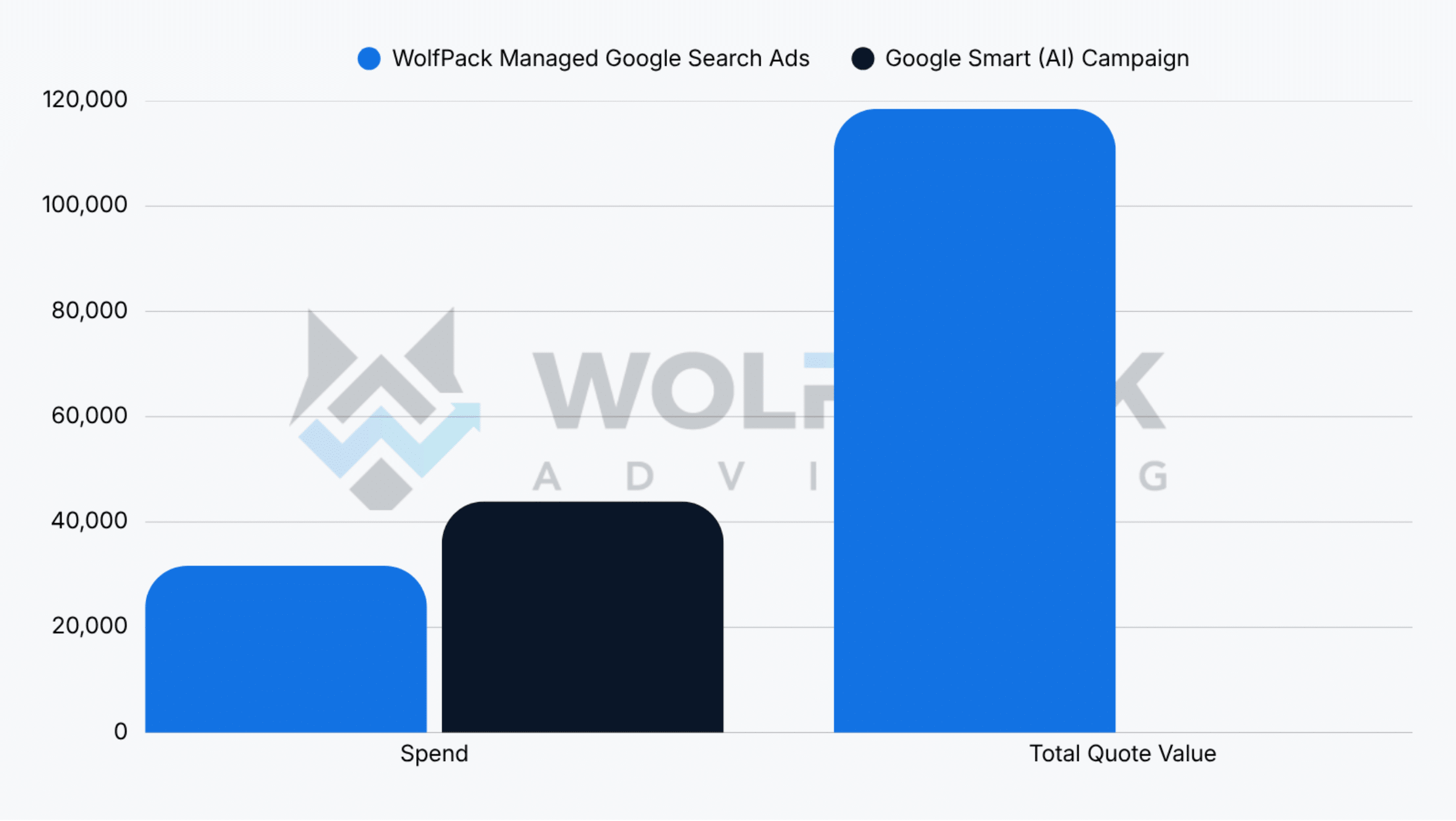
As you can see, enabling server side tracking and reporting values back to Google is a clear win for better campaign optimization. Relying on just AI optimized campaigns out of the box and Google’s simple conversion tracking is not going to give you a clear picture, nor great performance.
This feedback loop compounds even more though. The more high-value sales you send back, the better the targeting gets. The better the targeting gets, the more of your spend lands on people who actually buy, and the less of it lands on people who never were going to. You stop renting attention from the platform and start collaborating with its algorithm.
This is what we mean when we say we run ads with the curtain pulled back. The dashboard is the tip of the iceberg. The closed-loop revenue data underneath is where the money is actually made.
Related Questions to Explore
What is programmatic advertising in simple terms? The automated buying and selling of ad space in real time, based on data about who is about to see the ad. Most of Google Ads, Meta Ads, and display advertising across the web run on this system.
Is Google Ads programmatic? Yes. It uses real-time bidding, automated audience signals, and AI-driven campaign types like Performance Max. It is the largest single programmatic platform in the world.
Should I run Performance Max or manual search campaigns? We don’t like performance max campaigns in most cases. PMax campaigns generally are very broad and most businesses do not like that type of advertising because you can’t see a direct ROI. Manual search holds your brand and highest-intent keywords. PMax handles broader prospecting, and more of a very broad net. Pixel-only campaigns will underperform almost every time.
Do I really need Conversions API? If your monthly ad spend is over a few thousand dollars, yes. The data-quality gap between pixel-only and server-side tracking is the single biggest reason businesses with similar budgets get very different results.
Is programmatic worth it under $3,000 a month? Yes, it still is, but with a clean conversion loop. With small business budgets, every wasted impression hurts more, which means clean revenue data matters more, not less.
How long before I see results? Two to four weeks for learning-phase data. Two to three months for the algorithm to find your high-value buyers, assuming you are sending real sale values back to the platform.
How do I know if my campaigns are wasting money? If you are running pixel-only with no CRM-fed audiences and no sale values flowing back to the platforms, you are not behind on strategy: you are behind on infrastructure. That gap widens as the auction gets more AI-driven.
Request a proposal, and we’ll pull back the curtain on what’s actually happening with your spend.
When To Work With A Digital Marketing Agency
If you are running your own ads and feel like you are paying for traffic you do not understand, that is the system working as designed. Programmatic platforms are deliberately opaque. A good agency does not just push buttons: it pulls back the curtain on what is actually happening with your spend and ties it to revenue you can see.
You can waste a lot of money with any advertising platform if you do not know what you are doing. Good marketing agencies compound your investment, save internal team stress, and help you scale smarter.
Run This Quick Diagnostic
If any of these are true, you are behind on infrastructure, not strategy:
- You are running a tracking pixel with no server-side backup
- You have no CRM-fed audiences in your ad accounts
- You are sending form fills back to the platform, but not actual sale values
- Your campaigns have been running for 90+ days with no closed-loop revenue data
That gap will only widen as the auction gets more AI-driven and the signal advantage compounds.
At WolfPack, we run Google Search Ads and Meta Ads for small businesses with Lead Center wired in underneath, so the loop is closed from first click to booked sale. If you want a second set of eyes on whether your campaigns are doing what the dashboards say they are doing, request a proposal.
The Short Version
Programmatic advertising is not magic, and it is not surveillance theater: it is a machine that runs on data quality.
The businesses winning in 2026 are not the ones spending more. They are the ones feeding better data back into the loop. First-party audiences. Server-side conversion tracking. Actual sale values, not just form fills.
The infrastructure is not complicated to build. It is just the part most agencies skip.