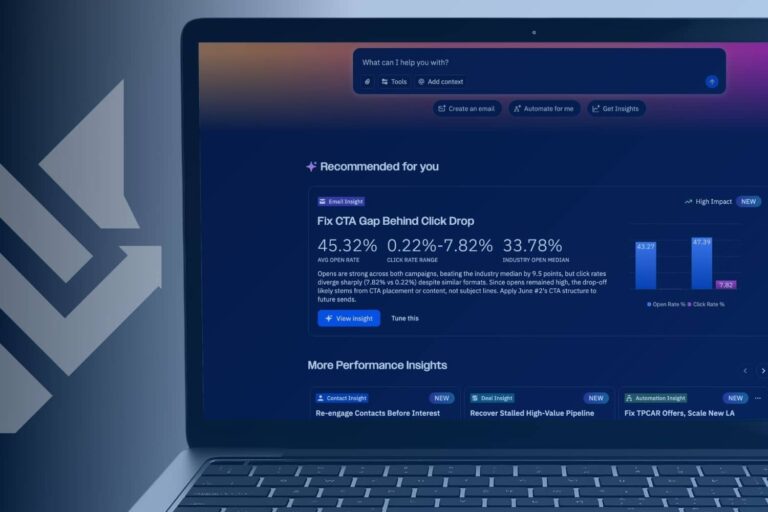


For most service businesses, ActiveCampaign is the best CRM at a fair price, HubSpot is the best platform if you are ready to invest and scale, and GoHighLevel is the fastest way to get a website plus basic follow-up live when you have no tech stack yet.
We can say that with some confidence because we have run all three. WolfPack uses HubSpot to run our own agency. We have used ActiveCampaign before that, and built GoHighLevel setups for businesses that asked for it.
Before we dive in, WolfPack is a certified ActiveCampaign partner and a HubSpot partner listed in their solutions directory. As a professional marketing agency geared towards service-based businesses, we know CRMs.
This guide breaks down how the three compare for a service business, and how to pick based on your stage, budget, and goals rather than the hype.
Table of Contents
- Your CRM Is the Brain of Your Service Business
- The Two Kinds of “CRM” Service Businesses Mix Up
- ActiveCampaign vs. HubSpot vs. GoHighLevel, Head to Head
- So Which CRM Should Your Service Business Choose?
- Related Questions to Explore
- When to Bring In a CRM Partner
- Conclusion
Your CRM Is the Brain of Your Service Business
A CRM is not a digital address book. For a service business, it is the system that decides how fast a new lead gets a response, whether a past customer hears from you again, and whether your best referral sources stay warm. Get that system right and growth compounds. Get it wrong and leads quietly leak out the bottom.
Speed and knowledge matter more than most owners think. When a homeowner fills out a form or a property manager requests a quote, the first business to respond in a useful way usually wins the job.
The U.S. Small Business Administration covers this in its guidance on managing and growing a business, where consistent follow-up and customer data are treated as core operations, not nice-to-haves. Decades of sales research point the same direction: leads contacted within minutes convert at far higher rates than leads contacted hours later.
Customer relationship management (CRM) software is what makes that speed repeatable. Instead of a person remembering to follow up, the platform does it: automated follow-up sequences, a clean sales pipeline, contact tracking, and reporting that ties marketing activity back to booked revenue. The platform you choose matters. How seriously you build it matters more.
The Two Kinds of “CRM” Service Businesses Mix Up
Before comparing platforms, clear up a common confusion. Service businesses shopping for a “CRM” are usually looking at two different categories of tool.
The first is field service software: products like Jobber, Housecall Pro, ServiceTitan, or for home inspectors, Spectora and ISN. These handle scheduling, dispatch, mobile job management, and field payments. They run the job.
The second is the sales and marketing CRM: ActiveCampaign, HubSpot, and GoHighLevel. These handle the lead before it becomes a job and the relationship after the job is done. They run the business.
ActiveCampaign, HubSpot, and GoHighLevel all live in that second category. The strongest setups do not replace your field software with a marketing CRM or the other way around. They connect the two, so a booking in the field updates the contact record, and a finished job triggers a review request and a re-engagement sequence. That integration is where most service businesses leave money on the table, and it is the lens we use for the rest of this comparison.
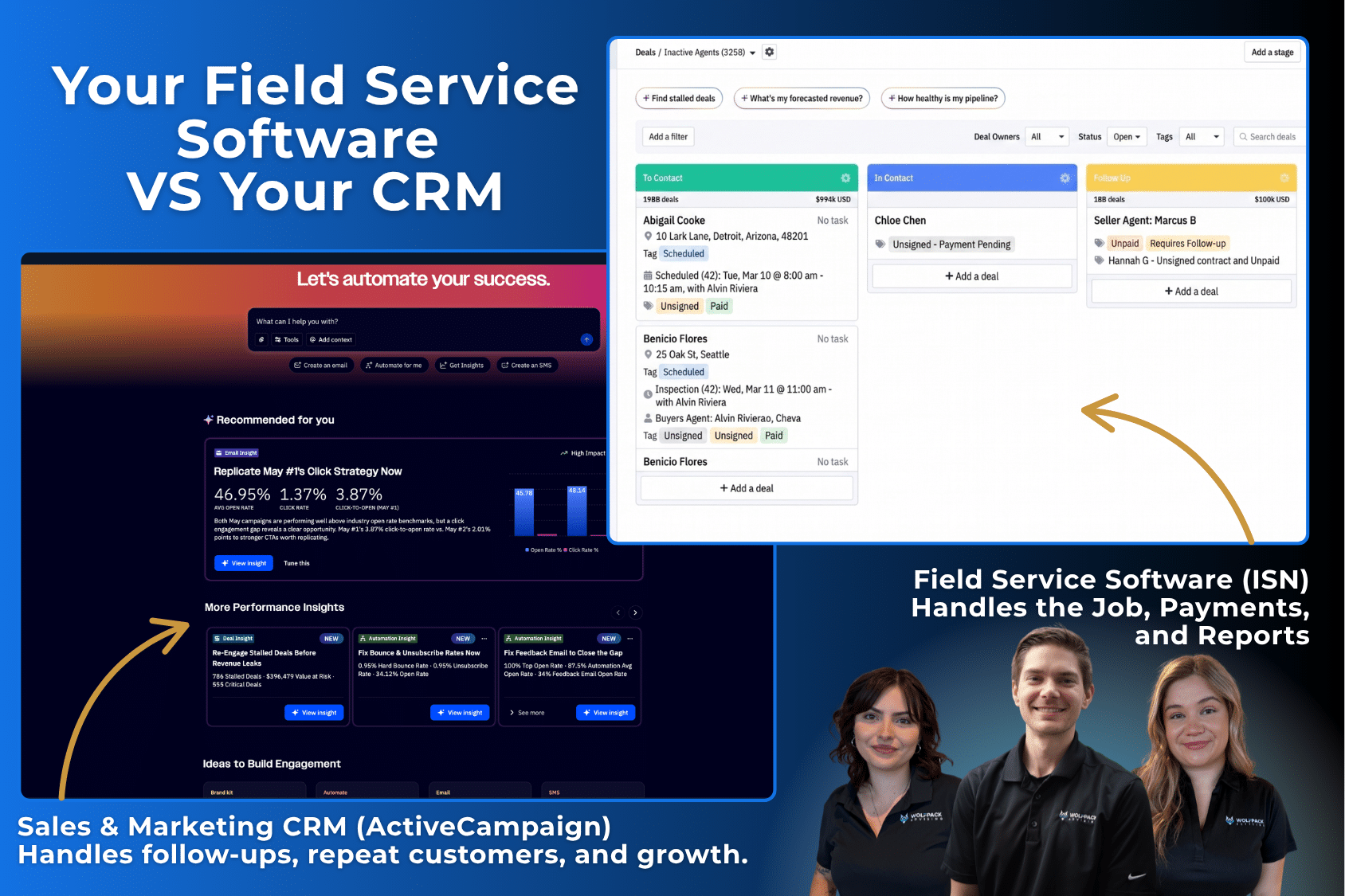
Think of it this way: your business is the CRM. It controls leads before they’re customers and nurtures customers to get more business after the initial sale. Field service software is just that, software for the field.
ActiveCampaign vs. HubSpot vs. GoHighLevel, Head to Head
Here is the short version, then the detail.
| Factor | ActiveCampaign | HubSpot | GoHighLevel |
|---|---|---|---|
| Lead follow-up automation | Best in Class | Excellent | Functional |
| Referral/repeat nurture | Best in Class | Excellent | Functional |
| Pipeline + contact tracking | Excellent | Best in Class | Functional |
| Website + funnels + booking | Landing pages only | Full CMS (paid tiers) | Built-in, fast to launch |
| Reporting + revenue attribution | Moderate | Best In Class | Not Great |
| Cost | Moderate | Expensive at High Tiers | Low, but Sticky |
| Speed + UX | Good, slightly slower | Fast, polished | Clunky & Buggy |
| Best fit | Most SMBs | Businesses Ready to Scale | First-timers with no stack |
Lead follow-up and automation
ActiveCampaign and HubSpot both build follow-up that reacts to behavior. If a lead requests a quote but does not book, they enter one path. If they open three emails but never reply, they enter another. These are decision trees that work while you are on a roof or under a house, not simple timed blasts.
GoHighLevel can send a follow-up text after a job and run basic sequences, but it is weaker at logic that adapts to what a contact does next. For pure follow-up intelligence, ActiveCampaign and HubSpot lead.
Referral and repeat-customer nurture
Service work runs on referrals and repeat business. Your agent list, your property managers, and your past customers are the asset. ActiveCampaign and HubSpot let you segment that list by referral history and engagement, so your top referrers get one campaign, cold relationships get a re-engagement sequence, and brand-new contacts get an onboarding flow, all at once.
GoHighLevel handles generic drip sequences fine, but it is not built to tell the difference between a source that sent you ten jobs last year and one that has never sent a single lead.
Pipeline and contact tracking
All three store contacts and track a pipeline. The difference is depth. HubSpot’s CRM is the cleanest and most capable: full interaction history, flexible pipelines, and a record that shows exactly what a contact has done.
ActiveCampaign has a strong native CRM with pipelines and interaction history that covers what most service businesses need.
GoHighLevel is functional for keeping names, numbers, and simple stages in one place, but it is not built for tracking a referral relationship over months and years.
Website, funnels, and booking
This is the one category where GoHighLevel wins outright. It includes a website builder, landing pages, and booking funnels, so you can get a professional-looking site with online scheduling live in a weekend without hiring a developer.
ActiveCampaign offers landing pages inside its automations but is not a full website builder, so you would host your site elsewhere.
HubSpot has a full CMS, but the strong website features sit on paid tiers. If your single most urgent need is a website and you have nothing yet, GoHighLevel saves real time and money. We cover how the marketing CRM should connect to the rest of your stack in our breakdown of ActiveCampaign integrations.
The single point I want to make here, though, is that your website is a business and marketing asset. I generally do not like your website being tied into software because if you go to move websites or refresh it, you are stuck with that software. That’s why we are big proponents of WordPress, an open-source ecosystem for modern websites.
Reporting and revenue visibility
Open rates tell you who clicked. Revenue reporting tells you what grew the business. HubSpot is best-in-class here, tying campaigns directly to deals and showing multi-touch attribution.
ActiveCampaign connects marketing activity to deals and revenue in its CRM, so you can see which campaigns influenced booked jobs, not just which got opened.
GoHighLevel gives you campaign-level metrics like opens, clicks, and replies, but it is hard to tie that engagement back to actual booked inspections or revenue.
If you want to know what is working and what is wasting your time, the gap between HubSpot or ActiveCampaign and GoHighLevel is wide. Proper attribution also depends on tracking the lead from first click to closed job, which is where lead tracking and ROI reporting earns its keep.
HubSpot just wins hands down here.
Cost, speed, and the lock-in factor
GoHighLevel is the cheapest on paper: one flat monthly fee covers the website, CRM, email, SMS, and funnels, which can replace five separate tools for an early-stage business.
ActiveCampaign is priced by contact list size and features and sits in the middle. HubSpot is the most expensive, and the price jump from its free tools to paid hubs is real.
Three things rarely show up on a feature chart. First, speed and polish: HubSpot is fast and clean, while ActiveCampaign and GoHighLevel can feel slower, and GoHighLevel in particular can feel clunky day to day. Second, the learning curve: HubSpot is so capable that it takes time to learn, and you will hit the occasional bug.
Third, lock-in: GoHighLevel can be sticky and harder to leave than it should be, so go in with eyes open. None of these should be the only factor, but they are real costs of ownership.
AI and API connectivity
This one is a new consideration, and it matters more every month. The real question: can AI tools and your other apps actually plug into the platform and do useful work?
HubSpot wins easily again here. It connects to AI assistants like Claude right out of the box, so they can pull up your data and update records for you with no special setup. If you want AI helping run your business, this is the one built for it.
ActiveCampaign can do it too, just not as far or as deep. It connects to AI tools and other software fine for what most service businesses need.
GoHighLevel is the weak link. The connection technically exists, but it is hidden behind all the white-label branding, so it is a pain to find and use.
Bottom line: HubSpot makes this easy, ActiveCampaign handles it, and GoHighLevel makes you work for it.
So Which CRM Should Your Service Business Choose?
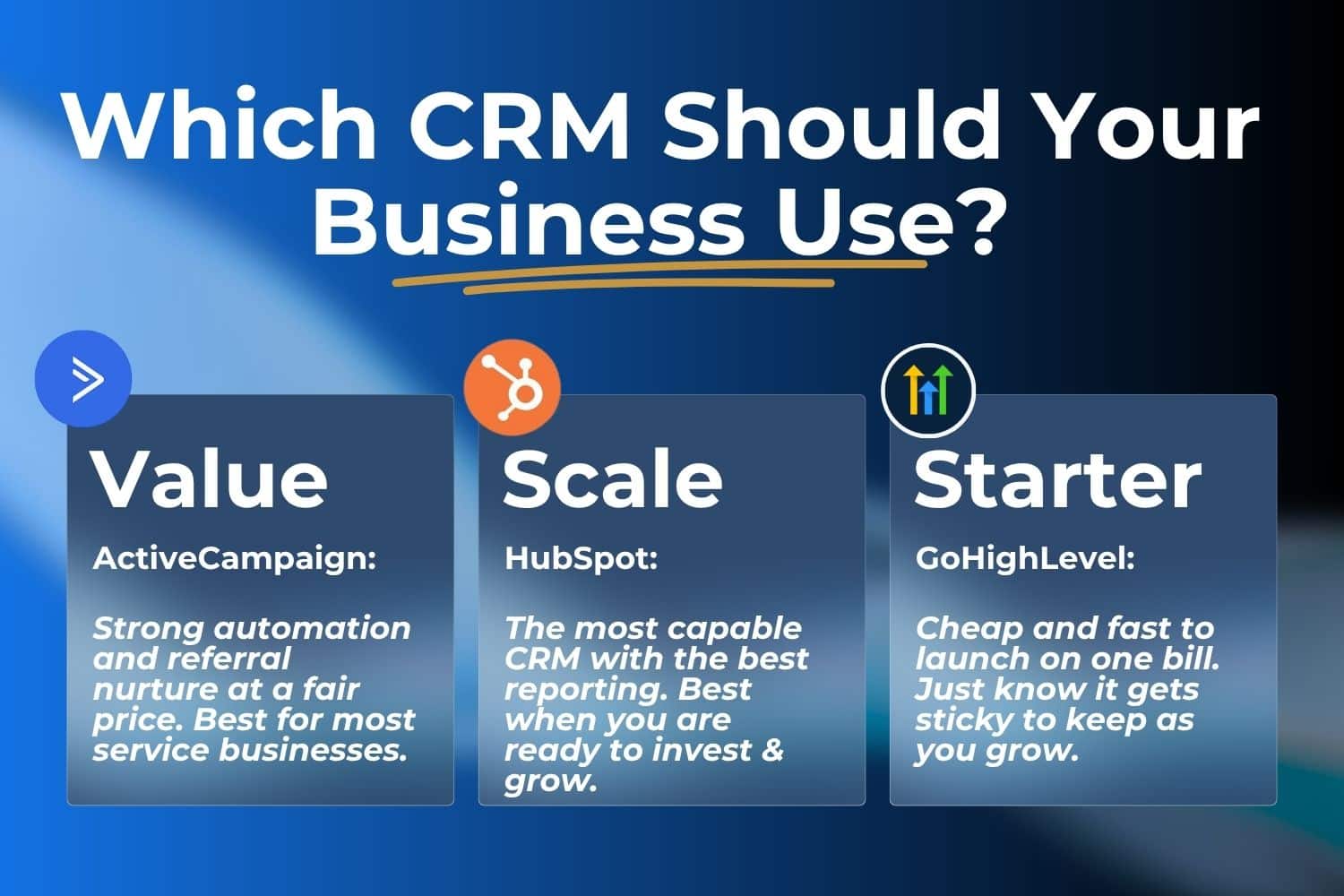
Choose ActiveCampaign if you are serious about a referral-based business, you want strong automation at a fair price, you already run field software like Spectora or ISN, and you want marketing tied to revenue. For most service businesses, this is the value pick.
Choose HubSpot if you are ready to take growth seriously and invest accordingly. The CRM is the most capable, the interface is the cleanest, and it scales as far as you will ever need. The trade-offs are cost and a learning curve that matches its power.
Choose GoHighLevel if you are just starting, have no existing stack, and your most urgent need is a website plus basic follow-up live fast on one bill. Two honest cautions: build it as it matters, and understand the contract before you sign.
Here is our take after running all three
GoHighLevel can do a lot, but it is a master of none, and because it is built for agencies to resell, a lot of “gurus” push it and a lot of the businesses we see on it never took the CRM build seriously. That is the real failure point.
Most service businesses do not stall because they picked the wrong website builder. They stall because no system consistently nurtures relationships, follows up with past customers, and converts warm leads into booked jobs. The brand on the login screen matters far less than how the system is built behind it.
Honestly, I tend to see a lot of businesses choose Go High Level because they get sold a “dream”. Low cost, built for funnels/sales, and it promises AI will do everything for them. However, when it comes to ROI and scale, the companies on GHL lag behind others.
The companies that choose ActiveCampaign are those companies who want to take CRM seriously. Some do; others still lag a little in usage.
Finally, the companies that choose HubSpot, most of them at least, take their growth and their CRM seriously. If you are ready to scale, grow, and create a marketing engine, choose your CRM wisely!
Related Questions to Explore
When does a service business actually need a CRM?
Immediately. Most CRMs are free when you are brand new. Pick one and use it. Learn it. The more you put into a CRM, the more you get out of it!
Is HubSpot CRM good for small businesses?
Yes, with a caveat. HubSpot has a genuinely useful free CRM tier and the cleanest interface of the three, which makes it friendly for small teams. The caveat is the price jump to paid hubs as you grow. For a small service business that wants room to scale and does not mind the cost curve, it is a strong choice.
Is there a free CRM for a service business?
HubSpot offers the most generous free CRM plan of the three. ActiveCampaign does not have a free plan, only a trial, though its paid plans deliver strong automation for the price. GoHighLevel is usually accessed through an agency rather than a free public tier. For a true no-cost start, HubSpot’s free tools are the place to begin.
How do you choose a CRM for a home service business?
Start with your process and needs, not the brand. List your must-have features (automated follow-up, segmentation, pipeline, reporting) versus nice-to-haves. Decide whether you need a website built in (GoHighLevel) or already have one. Confirm it connects to your field software and scheduling tools. Then test the top one or two with a real workflow before committing.
When to Bring In a CRM Partner
You can build any of these platforms yourself, and plenty of owners do. Bring in help when the cost of getting it wrong is higher than the cost of getting it right: when leads are leaking, when you are paying for a tool you only use at ten percent, or when you want the marketing CRM wired into your field software and reporting so the whole thing runs as one system.
That is the difference between a CRM that “functions” and one that drives the business. A certified partner has built these setups many times and can spot the gaps in yours quickly. Ongoing CRM support keeps it optimized as you grow, instead of letting it drift.
Conclusion
The right question is not which platform costs less. It is which one earns more once it is built well. For most service businesses, ActiveCampaign is the value pick, HubSpot is the choice when you are ready to scale, and GoHighLevel fits the early, no-stack starting point.
If you would rather not guess, talk to a team that has run all three. See how we approach CRM and marketing automation, then get a proposal or speak to a marketing expert about the right setup for your business.