

If you run a home inspection company, a pest control business, a plumbing operation, or any other home service company, you’ve probably felt it. A competitor gets bought. Then another. Then you notice your Google Ads cost per lead has quietly doubled. A polished new brand shows up in your market and seems to be everywhere at once: Google, YouTube, Connected TV, every platform you’re not quite budgeting for yet.
You’re not imagining it. Private equity has arrived in home services, and it’s playing a very different game than the one most independent operators were trained to play.
That doesn’t mean you’re losing. But it does mean the rules have changed, and pretending otherwise is the most dangerous thing you can do right now.
This post is not a private equity hit piece. There are real opportunities buried in this wave of consolidation, including for business owners who eventually want to sell. But if you want to stay independent, stay competitive, and grow your business on your own terms, you need to understand what you’re up against, why the old marketing playbook is getting you squeezed, and what a smarter path forward actually looks like.
Let’s get into it.
Why Private Equity Loves Your Industry
Private equity firms look for a specific combination of characteristics when they target an industry for consolidation: fragmented markets with thousands of small operators, predictable recurring demand, recession resilience, and room to extract efficiency through scale.
Home services checks every single one of those boxes.

Let’s Start With the Home Inspection Industry
The industry is populated by tens of thousands of independently owned, owner-operated businesses, most of them built on personal reputation and referral relationships with real estate agents.
Revenue is transactional but tied to one of the most resilient demand drivers in the economy: real estate transactions. Inspectors have licensing moats. Consumers cannot opt out (reasonably). For a consolidator looking to build a regional or national platform, the math is attractive.
But Here is the Kicker
The money PE is chasing is not always in the inspection itself. It’s increasingly in the data.
Inspection software platforms and PE-backed networks have been quietly building data businesses on top of the home inspection industry for the better part of a decade:
- Porch Group, which owns multiple home inspection software platforms, has openly discussed using home inspection report data to connect homeowners with insurance products and home services.
- Spectora recently launched Fixle, a home maintenance platform that sits on top of inspection data to capture ongoing homeowner relationships post-close.
- Keystone, the software powering InspectionGo’s platform, similarly leverages report data as a downstream revenue source.
This is not new. It’s expanding. Is it good or bad? That’s not up to me, and that’s not the point of this post either.
The home inspection is the door. The data is the business. Any PE platform that acquires home inspection companies at scale is not just buying revenue from inspection fees. They are buying access to a goldmine of homeowner data at the moment of maximum intent: when someone has just bought a house and has a list of things to fix, replace, and maintain for the next 10 to 30 years.
That context matters when you are trying to understand why PE’s interest in home inspection has grown so significantly. The real prize is the long tail.
Now, Let’s Shift to Pest Control
Pest control tells a similar consolidation story. The U.S. pest control market reached approximately $26 billion in revenue in 2025, growing at a 6.1% CAGR, and it’s populated by more than 34,000 businesses, nearly 80% of which are privately held and owner-operated.
Well-run pest control operations derive the majority of their revenue from recurring monthly or quarterly service agreements. Termites don’t take economic downturns off. Mosquitoes don’t care about interest rates.
The result: what was once a limited universe of PE buyers interested in home services has exploded. According to transaction advisory firm Cherry Bekaert, there are now three times as many private equity buyers with active investments in the home services sector compared to just five years ago.
In the lower middle market broadly, roll-up strategies accounted for over 80% of all private equity deals in 2024.
I know several pest operators personally whose entire goal is to sell to PE. They have done it once, and they want to do it again.
The PE Playbook Is Consistent Across Every Trade Category
- Identify a fragmented market
- Acquire a “platform” company
- Execute aggressive add-on acquisitions
- Centralize operations and marketing across the growing portfolio
- Run it for five to seven years, optimize for a premium exit multiple, then sell
This is not a temporary trend. It is a structural shift that is actively reshaping what your competitive landscape looks like, what your leads cost, and what it takes to grow.
Plunder, Accountability Gap, and the Friendly Face Hiding Competitive Aggression
Before we get practical, there is a conceptual point many home service owners sense intuitively but haven’t fully articulated: some PE-backed platforms in home services are especially good at positioning themselves as industry partners while quietly operating as aggressive competitors.
You may have noticed platforms showing up at industry conferences, being generous with information, framing everything as a rising-tide situation. That is not accidental. If you are building a roll-up strategy, it helps to be everyone’s friend.
Relationships get you deal flow. Trust gets you introductions to owners who might sell. The friendlier the reputation, the better the acquisition pipeline.
But the actual competitive behavior (the marketing spend, the bidding on your keywords, the systematic acquisition of your local competitors) tells a different story.
The Accountability Problem
This tension is captured well in Brendan Ballou’s book Plunder: Private Equity’s Plan to Pillage America. Ballou served as Special Counsel for Private Equity in the Department of Justice’s Antitrust Division. His core thesis: PE has systematically reshaped American industries by raising prices, reducing quality, cutting jobs, and shifting resources from productive to less productive uses.
The industries he focuses on most heavily, including healthcare, nursing homes, prisons, and retail, share a common problem that also applies to home services: there is no one truly accountable for the health of the business.
Think about what accountability looks like for an independent home service operator. A bad review hurts. A cash flow problem is existential. A home inspector who misses something reflects directly on you, because your name is on the report. The client who had a bad experience knows exactly who to call.
Now think about what accountability looks like inside a PE-backed platform:
- The fund managers are accountable to their limited partners, the institutional investors who put capital in.
- They are measured on IRR and exit multiples, not on whether a home inspection was thorough or a pest control technician showed up on time.
- The regional manager is accountable to the platform operator. The platform operator is accountable to the fund.
- At no point in that chain is anyone whose personal livelihood depends on a single customer’s satisfaction.
No one can be “written up” for a bad review. There is no one to call. The machine simply absorbs the feedback and keeps running.
You have seen this play out in retail. Toys R Us was acquired by PE, and it went bankrupt after everything went downhill. Same thing with J.Crew and Neiman Marcus. There are so many examples of this. In each case, the PE firms extracted returns. The businesses absorbed the consequences.
Home services are not retail. The dynamics are different, and the stakes are different. But the structural logic is the same: when the people making decisions are optimizing for a five to seven-year exit rather than a customer experience, something gets lost.

A Quick Personal Story to Share My Point
My air conditioning stopped working one summer. I live in Florida. It was hot, and I wasn’t thinking carefully; I just needed it fixed.
I hired the most reviewed, highest rated company I could find, with great branding and a professional website. They showed up on a Google Ad. A young technician arrived with an iPad and quoted me $500. I paid it. I found out later that the part involved cost about $20.
They were PE-owned.
Now, just last year, I needed some plumbing leaks fixed. I called a local guy recommended by a neighbor. We only had text conversations. He swung by when he was already in the neighborhood, fixed everything for $80, and I was very happy with the work.
Obviously, he was not PE-owned.
To be clear, I believe in charging premium prices for great work. I believe in nice trucks, professional branding, strong reviews, and spending money on marketing. Charging what you are worth is not predatory, and there is nothing wrong with building a profitable, premium-positioned business. But there is a line between premium pricing and extraction.
When the incentive structure disconnects the technician’s income from the customer’s actual satisfaction, and when the goal is maximizing the ticket rather than solving the problem, that line gets crossed.
The Google Ads Battlefield: How To Win Against Goliath
Imagine a room full of home service companies, all trying to buy the same jobs. There’s an auctioneer at the front. Every time a homeowner searches “home inspector near me” or “pest control near me” on Google, the auctioneer calls out the job. Paddles go up. The highest bidder gets the click.
That is Google Ads. That is precisely how it works. It is a live, real-time auction running billions of times a day, and it is the primary channel through which most home service businesses generate new leads.
Here’s How PE Changes the Game
Now imagine a new group of bidders walks into that auction room. They have essentially unlimited budgets, and they’re not worried about profitability per job. What they are worried about is market share over a five-year window. They raise their paddles on everything, not because every lead is profitable at that price, but because dominating the auction is part of their consolidation thesis.
What happens to the cost of every other paddle in the room? It goes up. For everyone. The small businesses that need profitable jobs this month get left with scraps or get priced out entirely. The PE operators can weather the pain because they are playing a completely different game with a completely different time horizon.
The numbers make this real:
| Channel | 2023 Avg Cost Per Lead | 2024 Avg Cost Per Lead | Change |
|---|---|---|---|
| Google Local Services Ads (home services) | $50.46 | $60.50 | +20% |
| Google Ads, HVAC | Baseline | Baseline +16% | +16% |
| Google Ads, electrical | Baseline | Baseline +23% | +23% |
| Google Ads, all home services | Baseline | Baseline +19% | +19% |
| Google Ads, all industries (for comparison) | $66.69 | $70.11 | +5% |
Sources: 99 Calls 2024 data, WordStream 2025 Google Ads Benchmarks, Talk24
The data is clear. Home Service Google Ad costs are outpacing other industries by far. That is just between 2023 and 2024. Imagine if we looked at the last decade.
Now, I realize we also have to consider inflation, COVID, AI, all that jazz… I get that. The simple fact is that home service costs on Google Ads have increased dramatically more than others in the last decade.
The Spending Gap Is Staggering
PE-backed platforms routinely spend $30,000 to $50,000 per month on digital advertising alone, compared to $1,000 to $5,000 for a typical independent operator. In some segments, reported monthly lead generation budgets for large PE-backed platforms reach $500,000 to $800,000. That is a 10x spending gap at minimum.
Meanwhile, Google Local Services Ads went from roughly 28% contractor adoption in 2021 to approximately 70% today. What once gave early adopters a meaningful edge is now table stakes. The auction room is packed, the paddles are going higher, and the operators with the deepest pockets are driving the price up for everyone else.
Your Opening: PE Firms Waste Spend You Can’t Afford To
Here is the critically important flip side, though:
PE firms waste spend in ways you cannot afford to, and that inefficiency is actually an opening.
A PE-backed platform needs volume across dozens of markets. It runs centralized campaigns and optimizes toward aggregate metrics.
It cannot be as surgically precise as a single-market operator who knows their local market and optimizes for it.
PE firms raise the floor for everyone in the auction. They also generate enormous amounts of waste at the top, paying for clicks that will never close, buying leads in markets where their service quality hasn’t caught up to their ad spend.
Your advantage is not a bigger budget. It is being smarter, faster, and more precise than they can afford to be at scale. Test aggressively. Iterate in days, not quarters. Feed real revenue data back into your campaigns. Cut what doesn’t work and double what does.
True Value Comes From The Marketing Assets You Own
This is the section most home service owners understand intellectually but dramatically underinvest in practically.
Website traffic, email lists built from years of customer relationships, referral networks cultivated through genuine trust, and brand awareness strong enough that homeowners search your name rather than a generic keyword: these are assets you own.
They don’t disappear when you stop feeding them money. They compound over time. And they are exceptionally hard for a roll-up brand to replicate at scale.
Across WolfPack’s home inspection client base, well-optimized clients consistently generate more than 45% of their trackable leads from organic search and Google Business Profile combined.
Paid leads, despite often receiving the most attention and budget, frequently represent less than 5% of total lead volume for those same clients. The auction gets all the attention. The organic channels do most of the work.
Local SEO: Find the Cracks in Their Armor
When a homeowner searches “home inspector near me,” “home inspection checklist [city],” or “pest control [city],” and your website appears organically in those results, you are generating a lead with no cost-per-click. That ranking is an asset that compounds over time, not a spend that evaporates when you pause your budget.
PE-backed platforms will invest in SEO, too. Their websites will accumulate domain authority faster because they have more resources and more backlinks. Their organic presence will grow over time. That is reality.
But their scale creates structural weaknesses in local search, and local search is where the jobs actually live.
The Local Relevance Advantage
Google’s algorithm for local search results weighs proximity, relevance, and prominence. A large roll-up brand operating across 40 markets struggles with the hyper-specific local relevance signals that help a single-market operator dominate searches in a specific city or neighborhood.
When a homeowner searches “home inspection [your city]” or “pest control near [specific neighborhood],” the local operator with a deeply optimized Google Business Profile, locally-relevant content, and consistent local citation signals has a genuine structural advantage over a regional brand managing hundreds of locations from a central marketing team.
Three Ways to Exploit That Advantage
- Optimize your Google Business Profile relentlessly. This is where local rankings are won or lost. Complete every field. Upload fresh photos regularly. Post updates, offers, and service announcements consistently.
- Respond to every review, including the negative ones. Keep your hours, service areas, and contact information accurate. This is the single highest-leverage action most home service businesses are underperforming on, and it costs nothing but time.
- Local social media is now being indexed. Google and AI-powered search platforms are increasingly indexing content from social media, particularly Facebook Business pages, Instagram, and Google Business Posts.
- A consistent local social media presence that mentions specific neighborhoods, local landmarks, and community events signals local relevance to search algorithms in ways that a national brand’s standardized content simply cannot replicate. PE platforms struggle here because their content is produced centrally and lacks authentic local texture.
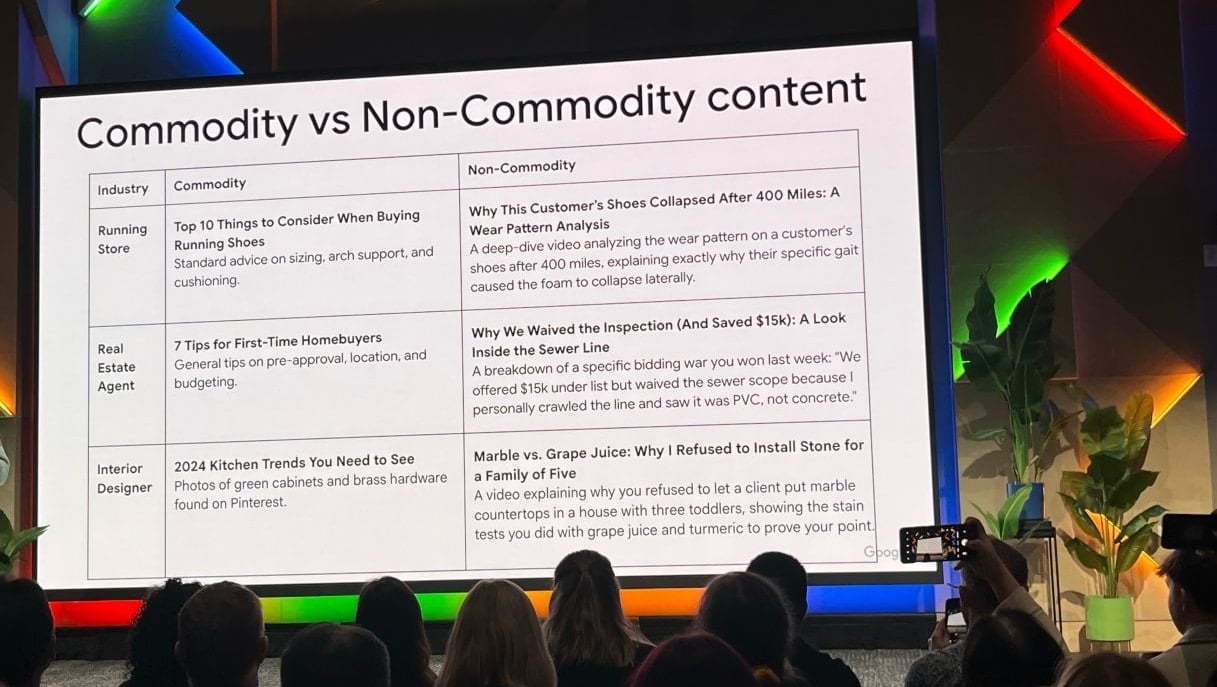
- Build content around local intent. A home inspection company that publishes articles like “What Home Buyers Need to Know About Foundation Issues in [Your City]” or “The Most Common Inspection Fails in [Specific Neighborhood]” generates organic search traffic and local authority that PE platforms don’t produce at that level of specificity.
- This content is inexpensive to create and nearly impossible for a roll-up to produce authentically at scale. It’s non-commodity content according to Google.
Reviews: Your Most Defensible Asset
Reviews deserve their own section because they are the most visible, most influential, and most mismanaged asset in home services marketing.
PE platforms will accumulate reviews faster in raw volume. A company with 200 technicians across multiple markets will, if they have any review generation system at all, build volume quickly. Within 12 to 18 months of an acquisition, a PE-backed platform can bury a smaller competitor on raw review count.
Your counter-strategy is quality, rate, and diversification.
Aim for a 20% Review Rate
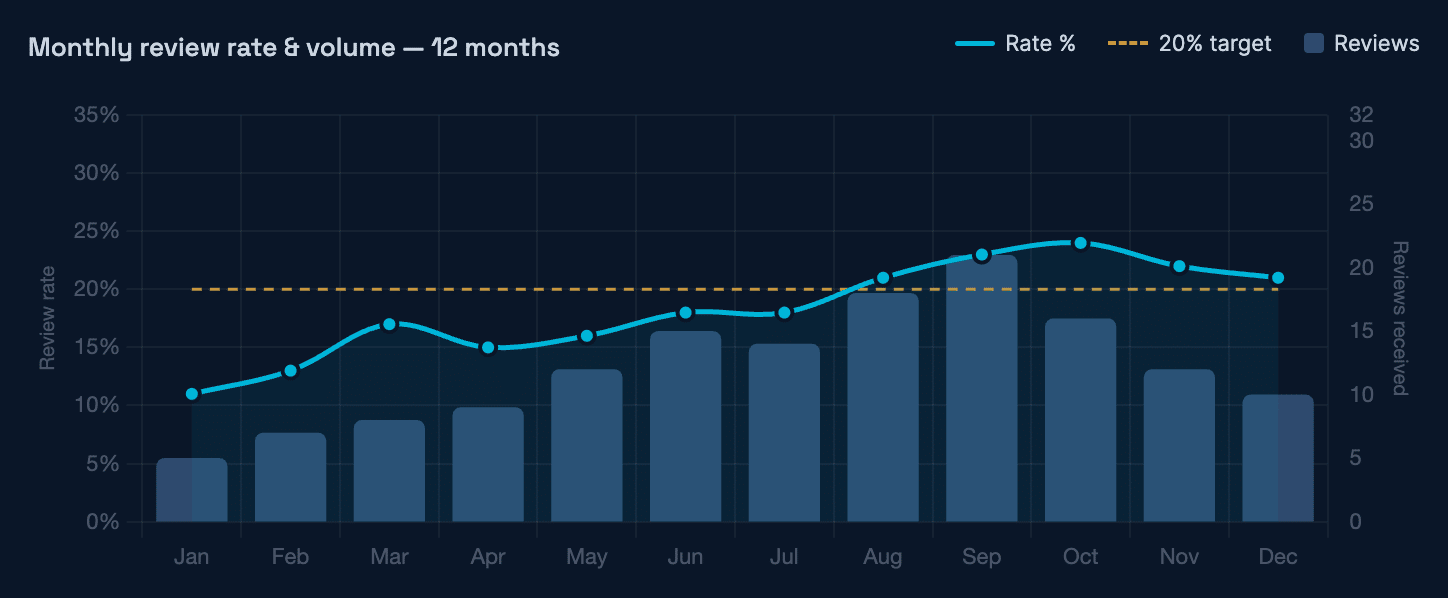
Review rate matters more than most people realize. A practical benchmark to target: 2 five-star reviews for every 10 jobs, which is a 20% review rate. Most home service businesses operate well below that.
A home inspection company completing 100 inspections per month should be generating at least 20 reviews per month consistently. If you’re not hitting that, you have a follow-up system problem, not a customer satisfaction problem.
A 4.9-star rating is the target, not 4.7 or 4.8. With AI tools now surfacing business recommendations based on review quality as well as quantity, the gap between 4.9 and 4.7 is more meaningful than it used to be. Responding to every review, especially negative ones, signals to both search algorithms and prospective customers that a real, accountable person is behind the business.
Diversify Your Review Presence
PE-backed platforms typically concentrate their review generation on Google because that’s where the ad ecosystem lives. Yelp tends to get less attention from platform operators, which creates a real opening for independent operators who invest there. The same logic applies to Nextdoor and industry-specific platforms. Build where they are not focused.
A Note on AI Search
AI-powered platforms like ChatGPT, Perplexity, and Google’s AI Overviews are increasingly surfacing local business recommendations. Market share for these platforms is still small compared to traditional Google search, but it’s growing.
The signals these platforms use increasingly include reviews across multiple platforms, not just Google. Building review breadth now is an investment in how AI search recommends local businesses in the future.
Email, SMS, and the Audience You Already Own
A home inspection company that has completed 3,000 inspections has the contact information for 3,000 homeowners who went through one of the most stressful transactions of their lives and trusted you to protect them.
A pest control company with 800 active recurring customers on email has a marketing channel that costs essentially nothing to use, is immune to auction dynamics, and reaches people who have already demonstrated trust by paying for your service.
Build these lists aggressively. Use them intentionally. Send seasonal reminders, maintenance tips, or referral requests, timed to when homeowners are most likely to recommend you. Right after a positive experience.
None of this touches Google’s auction. None of it costs per touch. It compounds with every customer you add.
Referral Ecosystems: Leads That Bypass the Auction Entirely
Deep referral relationships with complementary professionals are one of the most powerful and underutilized competitive moats available to home service companies, particularly in home inspection, where the relationship with the real estate community is foundational.
A home inspection company that is known by every active real estate agent in its market as the most thorough, most communicative, fastest-turnaround inspector has a referral engine that no PE platform can displace with a higher Google bid. Those referrals don’t go through Google’s auction. They go through a text message from an agent who trusts you.
Build PE-Resistant Referral Networks
The same logic applies in pest control: relationships with property managers, HOAs, real estate agents around WDO and termite inspection needs, and other home service trades (roofers who find moisture, plumbers who find rodent entry points) create referral flows that are genuinely PE-resistant. Build these relationships with the same intentionality you bring to your paid campaigns.
How to Compete: A Practical Playbook for Independent Operators
Once you’ve invested in owned media and reduced your auction dependency, these moves compound that advantage.
| What PE-Backed Platforms Do Well | What Independents Do Better |
|---|---|
| Raw ad spend volume | Surgical targeting and efficiency |
| Speed of brand expansion | Authentic local presence |
| Centralized tech and CRM | Genuine customer relationships |
| National keyword dominance | Hyper-local SEO and GBP optimization |
| Volume of reviews over time | Review rate and response quality |
| Cross-sell across service lines | Niche expertise and referral trust |
| Capital for fleet and equipment | Agility and speed of decision-making |
Be the Local Operator, Loudly
When PE firms acquire home service companies, local identity is one of the first casualties. The personal story of the family business gets absorbed into a branded platform. That is your opening.
Your name on the door, your face on the website, your community involvement. These are structural advantages that a roll-up brand cannot replicate authentically at scale, and that a real estate agent recommending a home inspector genuinely cares about more than any ad.
Build Recurring Revenue Wherever You Can
Annual pest control plans, home maintenance subscription programs, and pre-listing inspection packages for real estate agents. Any service that converts a one-time transaction into a continuing relationship.
Recurring revenue is what makes PE-backed businesses attractive to buyers. It also makes your business resilient when auction costs spike or a well-funded competitor moves into your market.
Run Your Business Like You Might Sell It, Even If You Never Do
Clean financials, clear customer data, documented processes, measurable recurring revenue, a review rate that proves your service quality: all of these make you more competitive as an independent operator and more valuable if you ever do entertain an offer.
The operators who benefit most from eventual exits are the ones who have been running with that discipline all along, not the ones scrambling to clean things up when a buyer asks.
What PE Actually Offers: The Benefits
It would be dishonest to write this entire post without acknowledging what PE genuinely offers to owners who are ready for an exit.
Some PE-backed acquirers have delivered meaningful liquidity events for home service founders who wanted to retire or move on. Acquisitions have provided capital for fleet expansion, technology investment, and technician training programs that were out of reach for a single-market independent. The organizational infrastructure that PE brought (professional HR, a real marketing team, scalable systems) genuinely improved some businesses.
Plunder‘s sharpest criticism applies most acutely to industries where the human stakes of financial engineering are highest: healthcare, nursing homes, and essential public services.
Home services are different in important ways. But the structural reality remains: a PE firm’s accountability runs to its investors, not to the communities its businesses serve.
So Who Wins in Home Services?
In retail, we saw what that looks like at scale. More than 55% of major retail bankruptcies since 2015 were at PE-backed chains.
Toys R Us, J.Crew, Neiman Marcus: not cautionary tales about bad luck or bad timing. Cautionary tales about what happens when debt loads are prioritized over business health, and no one in the decision chain is personally accountable for the customer experience.
- Is it the consumer who might benefit from the background-checked technician, the streamlined booking process, and the professional vehicle with polished branding? Sometimes. Until the pricing pressure of the debt load starts flowing downstream.
- Is it the investor, capturing a strong exit multiple from an industry that reliably generates cash flow? In many cases, yes. That’s what the model is designed for.
- Is it the small business owner who competed for 15 years on reputation and relationships, only to find that the cost of generating a new lead has tripled because a well-capitalized platform moved into their market? Not unless they adapt.
- Is it the community that benefits when local businesses stay local, hire locally, and reinvest locally? That’s a question worth sitting with.
The decision about whether to sell, stay independent, or adapt your model is yours to make. But now you understand what you’re navigating: the structural dynamics, the marketing economics, the accountability gaps, and the real competitive weapons available to you.
You don’t have to outspend private equity. You have to outsmart it, outserve it, and out-local it. With the right strategy, that is a fight you can win.