

Should you spend on SEO or PPC first? Short answer: if you need leads in the next 30 days, start with PPC (paid search). If you have six or more months of runway and want to build long-term business equity, start with SEO. And if you can afford both, do both, because a diversified marketing strategy beats a one-trick pony.
That is the answer most business owners want. The honest version is “it depends,” because the right call hinges on your runway, your goals, and how fast you need the phone to ring. At WolfPack Advising, we run both channels every day, and my real default is to diversify, the way a financial advisor spreads your retirement across assets.
But sometimes, budget forces a choice; below I break down exactly when to pick each, how much to budget, and how to do the math to see what is actually working.
One thing before we dive in. Too often, business owners walk into a conversation with a marketing agency carrying preconceived notions about how they should market, usually because they heard a buzzword like “geofencing” or “Answer Engine Optimization.” To get this right, you have to drop what you think you should do and stay open to learning every channel: the pros, the cons, and whether it actually fits you.
First, the Terminology Mess: SEO vs PPC vs SEM vs Paid Search
Half the confusion in this conversation is vocabulary. Marketers use four terms interchangeably, and they shouldn’t. Here is how we use them on every WolfPack engagement:
- SEO (Search Engine Optimization): Earning placement in the organic (unpaid) results on Google through content, technical fixes, and authority signals. Google’s own SEO starter guide defines this scope cleanly, and it is the foundation of our SEO services.
- PPC (Pay-Per-Click): The auction-based pricing model where you pay each time someone clicks your ad. Google Ads is the largest PPC platform, but Meta, LinkedIn, and Bing ads use the same model.
- Paid Search: A specific slice of PPC, the text ads at the top of Google or Bing search results. When someone says “paid search,” they almost always mean Google Ads search campaigns.
- SEM (Search Engine Marketing): The umbrella that covers both SEO and paid search. Confusingly, many agencies use SEM as a synonym for paid search alone. We break down the proper SEM definition here.
For the rest of this post, “paid search” and “PPC” mean Google Ads search campaigns, “SEO” means organic, and “SEM” means the combined strategy.
There are also broader terms like AEO (Answer Engine Optimization) and plain “advertising,” which includes paid placements on social platforms on top of search. With the vocabulary out of the way, let’s break it down.
The Honest Side-by-Side: SEO vs PPC
Most “SEO vs PPC” articles bury the comparison in 2,000 words of pros and cons. Here it is in one table:
| Factor | SEO (Organic) | PPC / Paid Search (Google Ads) |
|---|---|---|
| Time to first lead | 3 to 9 months | 24 to 72 hours (after campaign launch) |
| Cost model | Fixed monthly retainer (content, technical, links) | Variable. You pay per click, and it scales with budget. |
| Cost per lead | Compounds down: cost per lead drops as rankings build | Stays flat or rises as competitors bid up keywords |
| What happens if you stop paying? | Traffic decays slowly over 6 to 18 months. You lose authority and leads. | Traffic stops the same day. Leads stop that day too. |
| User trust & brand equity | Higher. Most users still skip the ads. | Lower. Users know it’s an ad, so it doesn’t build your brand. |
| Targeting precision | Keyword and intent only. You hope the algorithm does the work. | Very precise. You can target by zip code, time of day, and the exact query at once. |
| Compounds? | Yes. Content keeps ranking after you publish it. | No. Every click is rented. |
| Best for | High-LTV offers, evergreen demand, brand authority | Filling capacity or workload quickly |
The Real Question Isn’t “Which One,” It’s “Which One First”
Every other article on this topic ends with the same hedge: “use both.” That is technically correct and practically useless. If you had unlimited budget, you would already be running both. I said it up top: diversify your marketing channels the way a financial advisor diversifies your retirement.
The actual decision business owners face is sequencing. Which channel earns your first marketing dollar, and what is the trigger to add the other? Almost in the same breath, owners ask the follow-up: how much should I budget?
After running both channels for SMB clients across home services, professional services, and local retail, the pattern is consistent: paid-first wins when you need business quickly, and SEO wins first when you can wait on immediate leads and would rather invest in business equity and authority.
One Caveat Worth Flagging Here
If you are a brand-new company, do not expect SEO results at the same pace as a business with an established presence. It is a lot easier for a marketing agency to build on top of an existing brand and earn quick SEO wins than it is to start from a brand-new website and business.
New businesses, domains, and websites generally sit in a Google “sandbox” for a while. It takes time for Google to recognize the business, trust the domain, and learn what it is about. The fastest way to beat that is to get established locally or within your niche: earn backlinks from others in your space, collect online reviews quickly, and share proof of your work online. The catch is that new businesses usually don’t have that footprint yet, because they’re new.
So if you’re a new business without a lot of runway, you may want to lean on advertising and pay your way to business for a bit rather than waiting out the SEO game.
When we compared our own clients across SEO and advertising services, the split ran about 43% on SEO and 57% on advertising. I believe the lean toward advertising is simply that most owners who hire an agency want leads now. “It’s their leads, and they want it now!” Shoutout to JG Wentworth for the catchiest marketing jingle ever written.
SEO is patience. It is brand building, it’s grind, it’s easy for us to prove, and harder for an owner to feel day to day. Advertising is the opposite. It is easy for owners to grasp. You pay an agency, they make the phone ring. Shoutout to the Staples Easy Button.
With that context, here is a decision framework to answer “SEO or PPC?” for your situation.
Where to Spend Your First $1,000: A Decision Framework
Walk through these questions in order. The first “yes” tells you where to start.
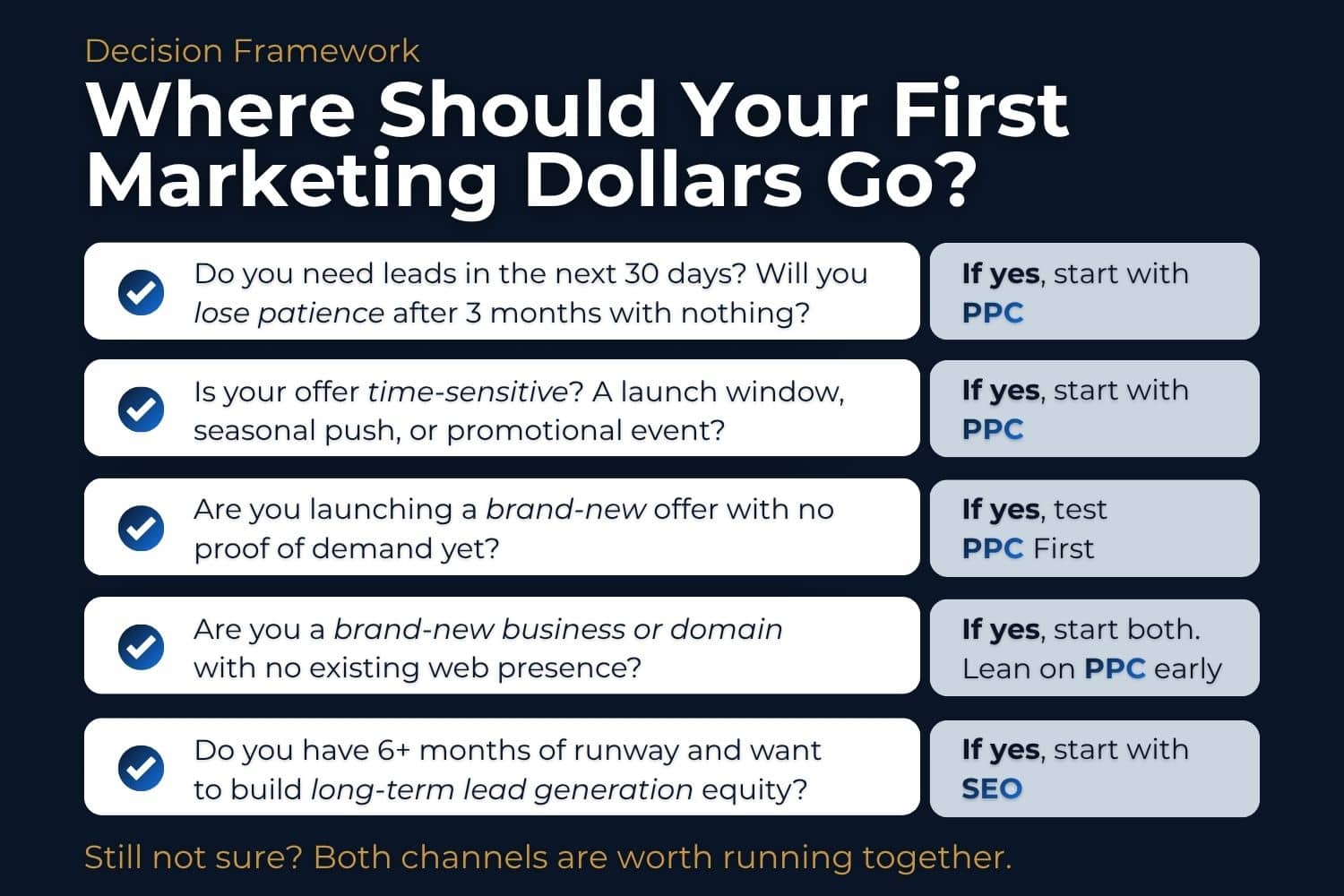
1. Do you need leads in the next 30 days, or will you get impatient after 3 months with nothing?
If yes, start with paid search. SEO does not produce leads in 30 days, no matter what anyone tells you. It might show leads within three months, but typically three months is just when we start to see signs of life, like traffic and impressions climbing.
A new Google Ads campaign, by contrast, can produce a qualified phone call within 48 hours of going live. Keep in mind it still takes our team time to build the campaigns before they launch.
2. Is your offer time-sensitive (event, season, or launch window)?
If yes, start with paid search. SEO rewards content that stays relevant for years, but a Black Friday promo, a grand-opening event, or a 30-day enrollment window will be over before SEO catches up.
This also ties into seasonality. Most owners want more leads when things slow down, and rightfully so. SEO might help, but it won’t dramatically lift leads during a slow stretch. When seasonality hits, everyone in your market feels it, and the better move is to lean into advertising and spend more to capture market share during those windows.
3. Are you launching a brand-new offer with no proof of demand?
If yes, start with paid search as a market test. Spend $1,000 to $2,000 in Google Ads against the keywords you would later target with SEO. If those clicks convert, you have validated demand and a keyword list. Then graduate to SEO with proof in hand. If they don’t convert, you just saved yourself a year of writing content for keywords that don’t sell.
How Much Should You Budget?
You are going to hate me for saying this, but it depends. I understand wanting a cheat code, or at least a ballpark. I am a planner too, so I like to know everything before I move forward. Here is how to set the expectation for each channel.
Here’s Your PPC Breakdown:
With PPC, cost depends on the auction rate for your best keywords. You can get a rough read with a quick Google search: “what is the average CPC (cost per click) for [your keyword]?” or “what is the average CPC for [your industry]?”
Once you have the CPC, estimate how many clicks you have to pay for before one converts into a lead. Typical conversion rates run between 2% (low end, broad-match keywords) and 10% (strong agency work and tight keyword match).
So if only 5% of clicks turn into a lead, you pay for 20 clicks to get one. If each click costs $3 on average, that’s $60 to get a lead.
That’s $60 per lead, not per job. You still have to close those leads. With advertising, remember, these are usually people who don’t know your business and don’t trust you yet. As the table showed, consumers trust organic results more than sponsored positions.
Now say you close 40% of leads (a good close rate). That means you need 2.5 leads, or about $150 in ad spend, to book one job.
TLDR on Advertising:
You need however much it takes to get the business you want. A solid rule of thumb is to spend at least 10% of revenue on marketing, 15% on average, and 20% if you want to grow faster. That figure covers all marketing activities, not just ads.
So what about SEO?
SEO is harder to model because you’re not paying per lead. You’re paying for a professional’s time and weighing it against the revenue they bring in. The simple question to ask: can they generate at least 5x what they charge in revenue?
So if the SEO retainer is $1,000, can you earn at least $5,000 a month after months 6 to 9? It is not an exact science like advertising, because every starting point for SEO is different, but that is the gist. The average ROI from SEO generally lands between 7x and 10x your monthly spend, and you start seeing those returns between months 6 and 12, depending on where you start.
Break-Even Math: When Does SEO Catch PPC?
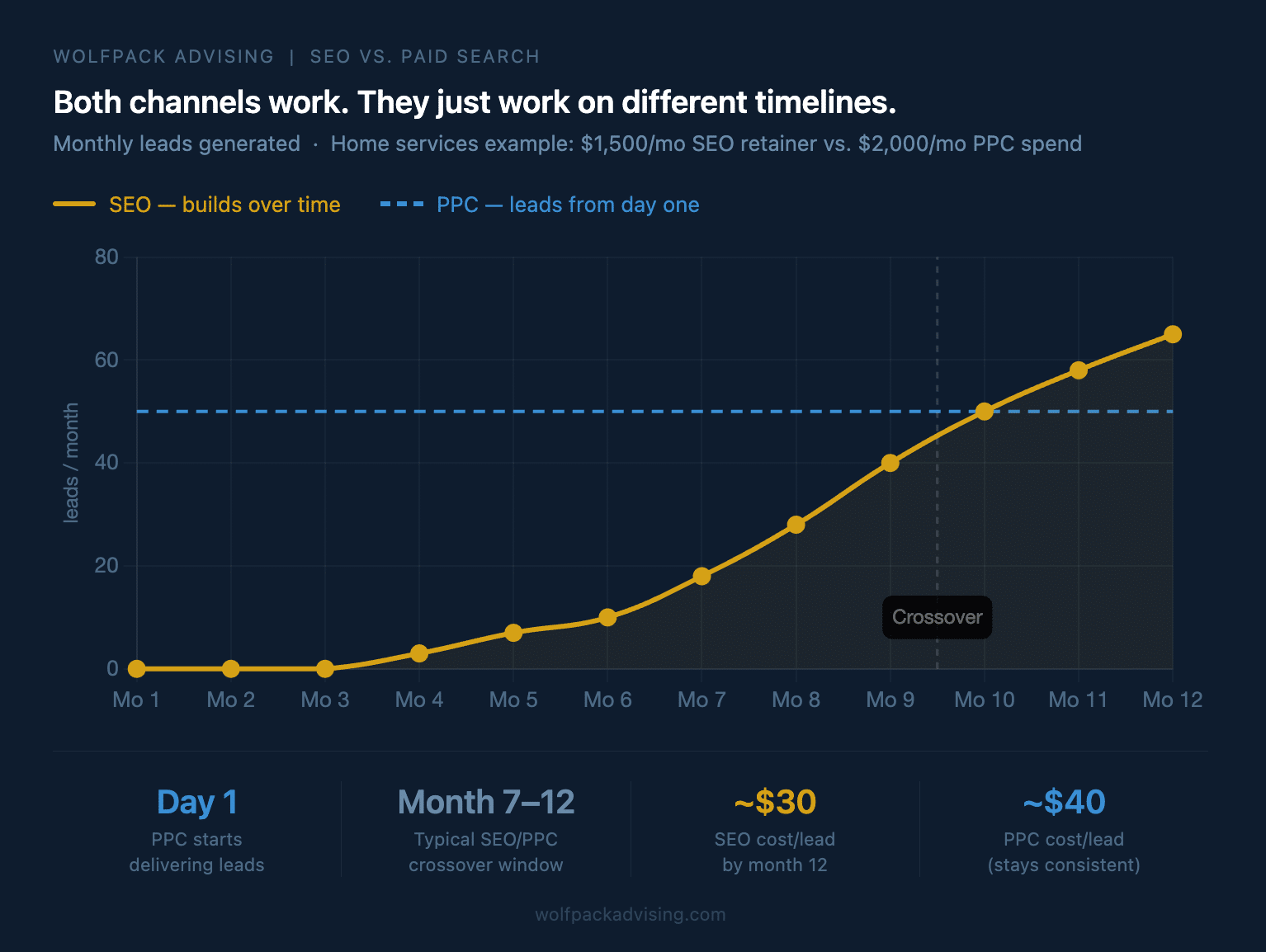
This is the number most agencies can’t tell you. Here is a realistic example for a local home services company:
- Paid search: $2,000 a month in ad spend at a $40 cost per lead is 50 leads a month. Cost stays flat as long as you keep paying.
- SEO: $1,500 a month retainer. Months 1 to 3: 0 leads. Months 4 to 6: 5 to 10 leads. Months 7 to 9: 20 to 40 leads. Month 12 and beyond: 50+ leads at an effective cost per lead under $30.
The crossover point, where SEO produces more leads per dollar than paid search, usually lands between month 7 and month 12. After that, SEO compounds or holds higher while paid search stays flat. By month 12, you have a lead-generation moat that pure advertisers don’t.
The catch: you have to survive months 1 through 6 of SEO without leads. That is exactly why paid search exists. It buys you time.
How AI Overviews Change This Math in 2026
Google’s AI Overviews, the AI-generated answer block at the top of many search results, have shifted the SEO vs PPC calculus in two ways that did not exist 18 months ago.
- Top-of-funnel SEO traffic is down. Informational queries that used to send users to a blog post now resolve inside the AI Overview. Traffic to “what is” and “how does” content has dropped 20% to 40% on most accounts we run. Ranking in the AI Overview citation list offsets some of that loss, but only some.
- Paid search now sits above the AI Overview. The ad slot is more valuable than ever for bottom-funnel commercial queries, because it’s the first thing users see, often before the AI summary even renders.
The practical effect: SEO budgets should shift toward commercial-intent, bottom-funnel pages (service pages, comparison content, local landing pages). Pure top-of-funnel blog content is harder to monetize than it used to be. Meanwhile, the case for paid search on high-intent commercial keywords has gotten stronger, not weaker.
Our own SEO strategies are shifting into deeper, expert-driven content that is hyperlocal. Put simply, we don’t write blogs titled “What Is a Roof Inspection?” anymore. We write posts like “The Top 5 Things We Find Wrong on Roofs in Tampa, FL.” This lines up with Google’s guidance on creating helpful, people-first content over thin, commodity content that an AI can summarize in a sentence.
When to Combine SEO and PPC (and How)
Once one channel produces leads consistently, the other becomes a force multiplier. We covered the three combination strategies in detail here, but the short version:
- Use paid search to test new SEO keywords. Run ads against a keyword for 30 days. If it converts, build a content cluster around it. If it doesn’t, kill the campaign and don’t waste content effort on a dud.
- Use SEO to lower paid search costs. Pages that rank organically make strong landing pages for paid traffic, which helps improve your Quality Score and lower your CPC. More on that here.
- Use paid search to defend branded terms. Even with strong SEO, competitors will bid on your brand name. A small branded campaign protects that traffic at a low CPC.
- Use both for big launches. SEO sets the long-tail foundation while paid search captures intent on day one.
If you’re wondering how to size the paid budget specifically, we broke down ad spend benchmarks by industry here.
Recent Trends We Are Seeing
Both advertising and SEO have gotten more competitive since COVID-19. Before, only the best companies had a real advertising and SEO strategy. Now more businesses are in the game, which makes everything more expensive, slower, and harder.
Here is the honest part of our job: the market reveals what consumers want and what they cost, not the agency. So if you find your cost per lead climbing too high, that is the signal to dig deeper and ask better questions. Are you priced appropriately? Are you closing at a healthy rate? Is the agency sending quotable, qualified leads?
AI is changing everything on top of that. There is more AI slop online than ever, and there are also AI tools that launch campaigns faster and cheaper. Both forces raise the bar. A few years ago you could write some articles, spin up a few pages, and call it SEO.
Today, and going forward, ranking organically is harder, and for some queries it may not happen at all.
When to Call a Professional
Both channels can be run in-house if you have the time to learn them or the budget to hire an in-house expert. The honest version: most business owners don’t. By the time you cover a salary, benefits, and the leadership it takes to retain that employee, the real cost is significant.
For most businesses, I’d recommend hiring an agency. If you have the money and staff to run it internally, great. I would still bring in an agency to help. You don’t have to hand them everything, but at a minimum, pay them to audit your team every so often. Always be testing, as they say.
If you want a second opinion before committing budget in either direction, we offer a no-obligation marketing strategy call where we look at your current channel mix and tell you honestly which one you should fund first.
The Bottom Line
SEO vs PPC is not a values debate. It is a sequencing problem. Pick the channel that solves your most immediate constraint, whether that is cash flow, runway, demand validation, or compounding growth, and add the other one once the first is producing predictable leads. The agencies that argue for one or the other categorically usually only sell one or the other.
If you are stuck between the two, book a strategy call, and we will run the numbers with you. No retainer pitch on the first call.