
Short answer: an llms.txt file will not get your website found by AI, and Google has said so directly. I can confirm it from the field, too. At WolfPack Advising we add llms.txt to nearly every site we manage, over 100 of them, and we have never seen it move AI citations on its own.
Google’s own team says Search ignores the file, and a study of 137,000 sites found 97% of llms.txt files were never even requested by a bot. So why does it keep coming up, and what actually gets a local business cited by ChatGPT, Gemini, and Google’s AI answers? Here’s the honest breakdown.
What is an llms.txt file?
An llms.txt file is a plain-text file, written in Markdown, that you place at the root of your website (for example, yourbusiness.com/llms.txt). It gives AI models a short, curated “table of contents” of your most important pages, each with a one-line summary, so a language model can find your best content without reading every page on your site.
The format was proposed by Jeremy Howard of Answer.AI in September 2024. You can read the full llms.txt spec here. The key thing to understand up front: llms.txt is a suggestion, not a rule.
It does not block any crawler, it does not grant access to anything, and no search engine is required to read it. There is also a longer variant called llms-full.txt, which bundles your actual page content into one big Markdown file sized to fit inside an AI model’s context window. Both are optional, and both are unofficial.
That single fact, “it’s a suggestion, not a rule,” is where most of the confusion starts.
llms.txt vs. robots.txt vs. sitemap.xml: what’s the difference?
The most common myth is that llms.txt is “robots.txt for AI.” It is not. The three files do completely different jobs:
| File | What it does | Is it enforced? |
|---|---|---|
| robots.txt | Tells crawlers what they are allowed to access (allow/disallow rules). | Yes, by well-behaved bots. It controls access. |
| sitemap.xml | Lists every page you want search engines to know about. | Used by Google and Bing as a discovery aid. |
| llms.txt | Suggests a curated, summarized shortlist of pages for AI models. | No. Nothing reads it by requirement, and it blocks nothing. |
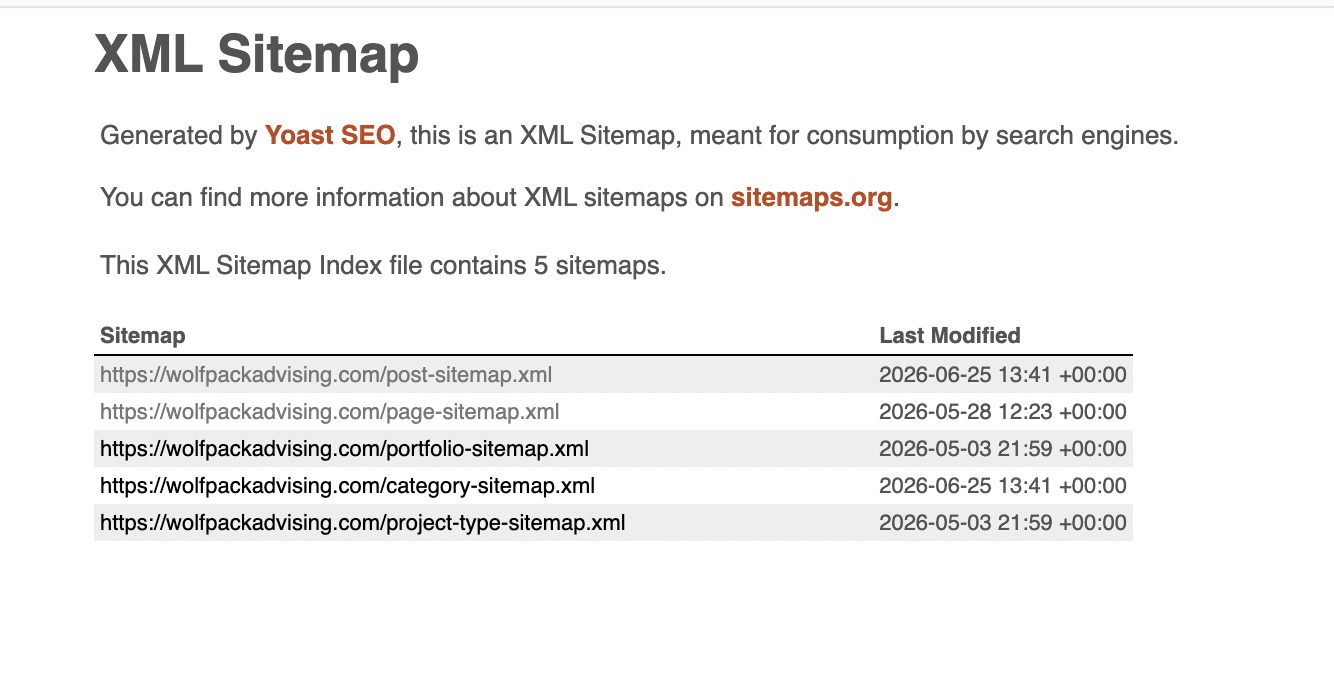
If you take one thing from this post, take this: an llms.txt file cannot stop AI from using your content, and it cannot make AI use your content. Telling an AI “here are my best pages” is not the same as that AI agreeing to read them, or rank them, or cite them. The old idea that you could write “rules” in llms.txt to keep your blog posts out of AI answers is simply incorrect. That job belongs to robots.txt and your server, not llms.txt.
What does an llms.txt file look like?
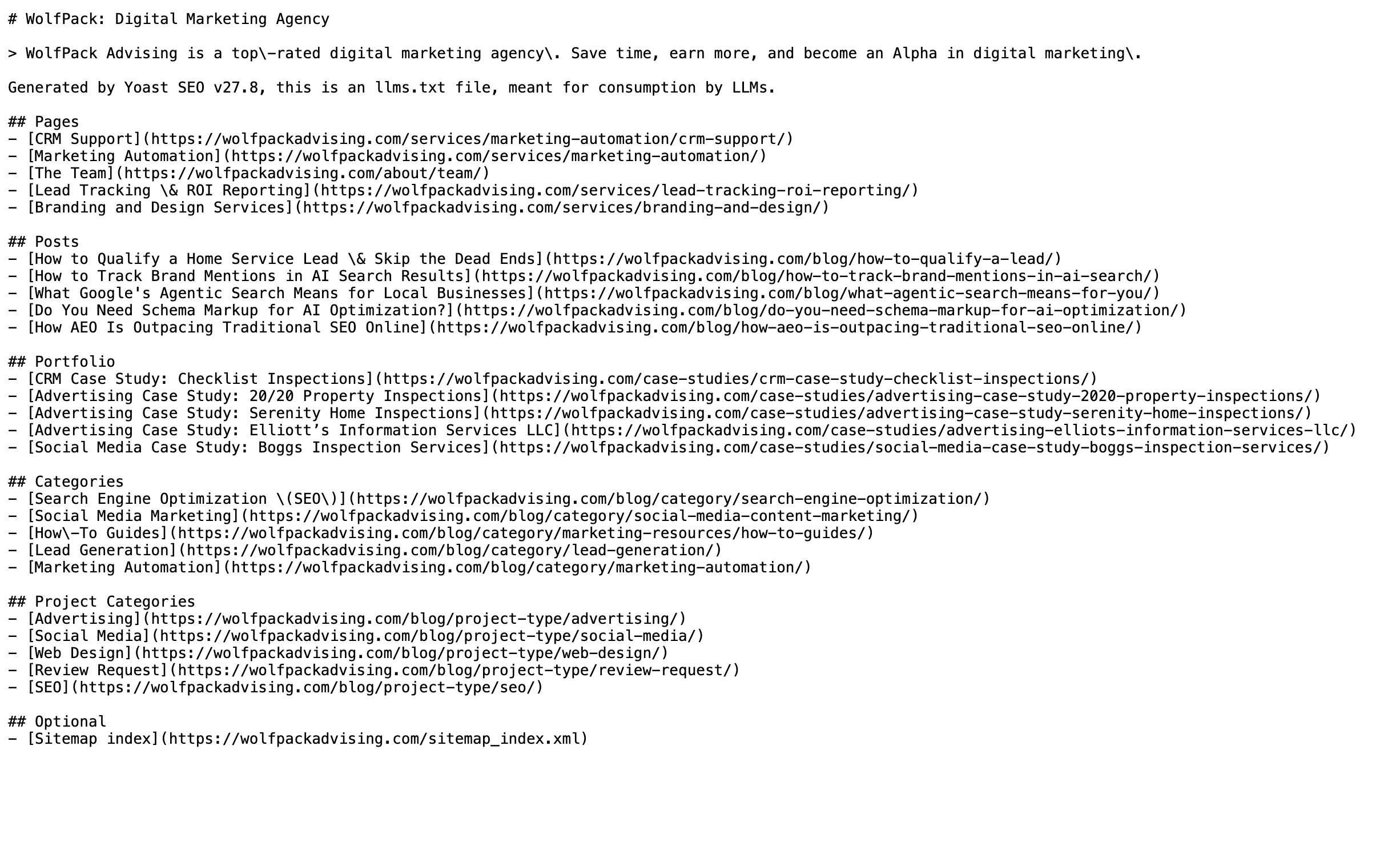
It is just Markdown. Here is what a simple one might look like for a home-service business:
# Acme Plumbing

> Licensed plumbing and drain services for the Greater Tampa area, available 24/7.

## Core Pages
- [Services](https://acmeplumbing.com/services): Drain cleaning, water heaters, repiping, and emergency repair.
- [Service Area](https://acmeplumbing.com/service-area): Cities and zip codes we cover.
- [Contact](https://acmeplumbing.com/contact): Phone, hours, and booking.

## Helpful Guides
- [How to Spot a Water Leak](https://acmeplumbing.com/blog/water-leak-signs): Early warning signs every homeowner should know.

## Optional
- [About Us](https://acmeplumbing.com/about): Our story and licensing.
An H1 with your business name, a one-line summary in a blockquote, then H2 sections of links with short descriptions. That is the whole format. Building one takes about 15 minutes. Whether it does anything for you is the real question.
Does llms.txt actually work? Here’s what Google, the data, and our own testing say
No. For getting found in Google Search or in AI answers, the evidence says llms.txt currently does nothing. This is not a hot take, it is what Google, independent studies, and our own client work all point to.
Google’s John Mueller addressed it plainly on Bluesky:
“AFAIK none of the AI services have said they’re using LLMs.TXT (and you can tell when you look at your server logs that they don’t even check for it). To me, it’s comparable to the keywords meta tag.”
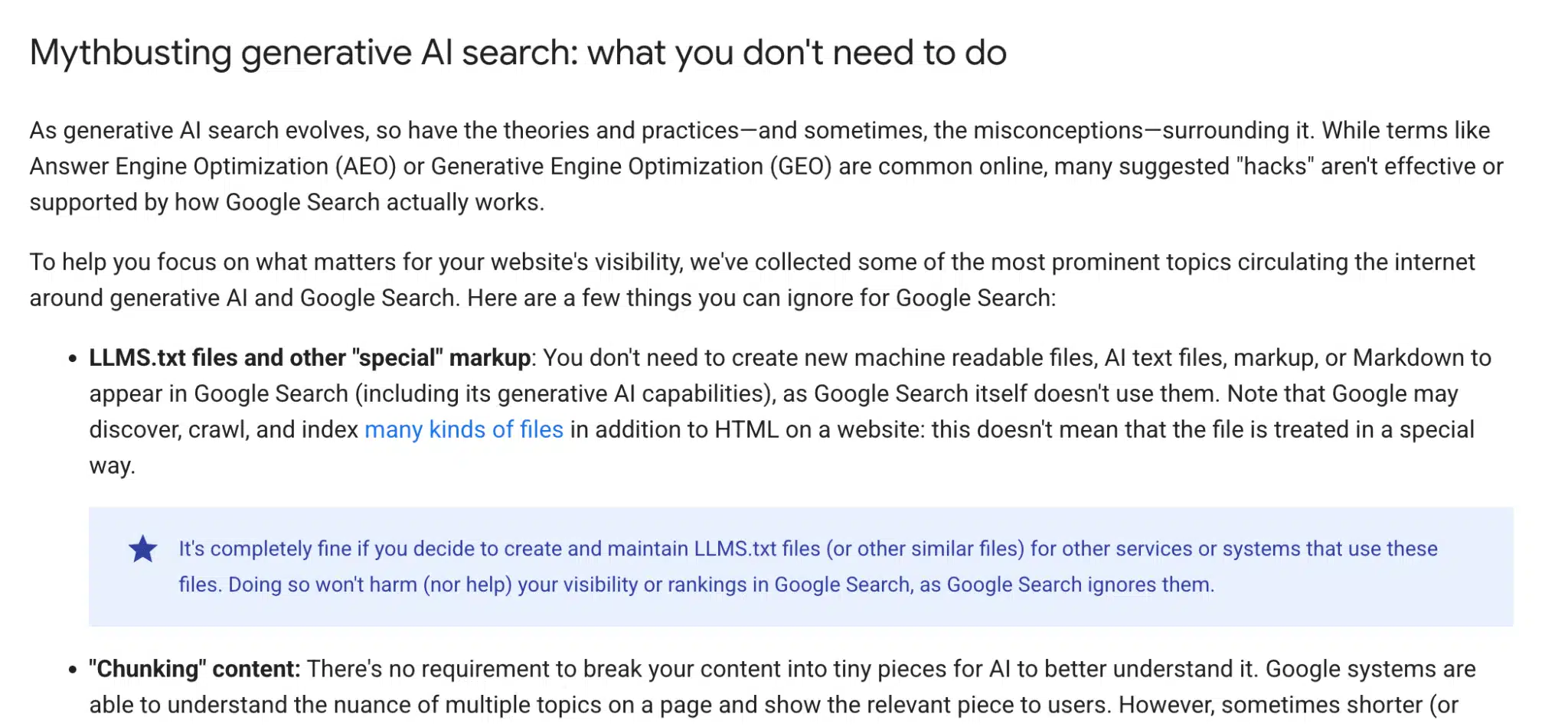
The keywords meta tag, for context, is a self-declared signal Google abandoned years ago precisely because anyone could claim anything in it. When asked whether Google’s own behavior counted as an endorsement of llms.txt, Mueller’s answer was just as direct:
“I’m tempted to say something snarky since this has come up so often, but to be direct, no.”
Google’s Gary Illyes said the same thing at Search Central Live in July 2025: Google does not support llms.txt and is not planning to. His advice for showing up in AI Overviews was refreshingly simple, that you should use normal SEO practices and skip the alphabet soup of new “optimization” acronyms. Google’s own AI-features documentation, updated in May 2026, lists llms.txt among the tactics you do not need for AI Overviews or AI Mode.
The independent data backs this up. An analysis of 137,000 websites found that 28% had published an llms.txt file, and 97% of those files were never requested by any bot. A separate study of 300,000 domains found no correlation between having an llms.txt file and being cited in AI answers.
Our own experience lines up with that. We add llms.txt to nearly every website we host and manage, and we have not noticed any meaningful change in AI references, citations, or mentions after turning it on.
What moves the needle is the same thing that always has: doing every little SEO detail right. There is more content on the internet than ever, so the bar keeps rising. You have to be more personalized, more hyper-specific, and more authoritative than your competitors to get picked. A single file does not deliver any of that.
So the file is not a ranking signal, not a citation lever, and not “robots.txt for AI.” That settles the hype. It does not, however, mean the file is pointless everywhere.
So who actually uses llms.txt?
A narrow but real group uses it: developer tools. AI coding assistants like Cursor, Claude Code, and GitHub Copilot will fetch a site’s /llms.txt or /llms-full.txt when you point them at technical documentation, because it saves them from crawling a huge docs site.
Documentation platforms such as Mintlify auto-generate the file for the sites they host, which is why the developer docs for companies like Stripe, Vercel, and Cloudflare all ship one. In that world, llms.txt is a genuinely handy entry point for an API reference.
There is one wrinkle worth knowing, because it looks like a contradiction. While Google Search ignores llms.txt, Google’s Chrome team added an experimental Lighthouse audit (under its “agentic browsing” checks) that looks for a valid llms.txt file. You can see Google’s own Lighthouse documentation here.
So the same company sends two signals: the Search team says skip it, and the Chrome team checks for it as a possible aid to browser-based AI agents. Neither of those signals affects how you rank in Google.
Should your business create an llms.txt file?
For most local and home-service businesses, an llms.txt file is optional and low priority. Here is a simple way to decide:
Skip it (for now) if:
- You run a local service business (plumbing, HVAC, home inspection, roofing, pest control) and your site is normal web pages. It will not improve your rankings or your odds of being cited by AI.
- You are choosing between building an llms.txt file and improving your actual content. The content wins every time.
Go ahead and enable it (it’s a low-risk 15 minutes) if:
- You publish developer documentation or an API that coding assistants might read.
- Your platform or SEO plugin generates one automatically. Yoast SEO and RankMath both offer this with a single click.
- You simply want a tidy, future-proof site and understand it is a small bet on what AI tools might do later.
Here is how we handle it for our own clients: we leave it on. The major SEO plugins generate it in one click, it costs nothing, and it cannot really hurt, so why not enable it? We treat it as one more checkbox on a long list, not as a strategy. We told clients early that it would not move rankings, and a year of running it across more than 100 sites has not changed that view.
One caution either way: publishing a neat list of your best content can make it marginally easier for scrapers and competitors to harvest it. That is a small risk, but worth knowing before you treat the file as a freebie.
The honest bottom line is that an llms.txt file will not hurt you, and today it will not help you get found in search or AI answers, so do not let it distract you from the work that actually moves the needle.
What actually gets your business found by AI
The things that earn citations in ChatGPT, Gemini, Perplexity, and Google’s AI answers are the same fundamentals that have always built online trust, executed well. We manage SEO for nearly 100 clients and host and optimize more than 100 websites, and we get those clients referenced by AI models all the time, from blog posts to service pages. Honestly, it is not that hard once the fundamentals are in place. The harder part is getting referenced for everything you want to show up for. Here is where your time and budget belong:
- Content that answers real questions, clearly. AI systems pull from pages that directly and accurately answer what someone asked. This discipline has a name, answer engine optimization, and it is the core of our AI/Answer Engine Optimization service. Our guide on building a winning AEO strategy for AI search walks through the playbook.
- Schema markup so machines can understand what your pages are about. We break down whether you need it in Do You Need Schema Markup for AI Optimization?
- Third-party reviews and citations beyond Google. This is one of the biggest factors we see for home-service companies. AI models lean heavily on platforms like Nextdoor, Angi, HomeAdvisor, Porch, Facebook, and Yelp, not just your Google Business Profile. A steady presence and real reviews across those sites do more for your AI visibility than any file you upload. The 300,000-domain study mentioned earlier found the same pattern: editorial mentions and citations correlate with AI visibility far more than llms.txt ever did.
- Solid local SEO and a clean, fast website. This is exactly the “normal SEO practices” Google’s Gary Illyes pointed to. Our SEO services are built on these fundamentals.
- Understanding how AI search behaves. If you want to see where this is heading, read what Google’s agentic search means for local businesses.
Want a quick read on where your site stands with AI search today? Run it through our free AEO Grader and you’ll get a clear starting point.
How to create an llms.txt file (if you decide to)
If you have weighed the trade-offs and want one, here is the whole process:
- Create a plain-text file named
llms.txt. - Add an H1 with your business name, then a one-line summary in a blockquote.
- List your key pages as Markdown links under H2 sections, each with a short description. Group lower-priority pages under an “Optional” section.
- Upload it to your site’s root so it lives at
yourbusiness.com/llms.txt. - Test it by visiting that URL in a browser. If you use Yoast or RankMath, check whether it can generate and maintain the file for you automatically.
That is it. Keep it short, keep it accurate, and do not expect it to do any heavy lifting.
Honestly though, save yourself the hassle and just use a WordPress plugin such as Yoast SEO or RankMath.
Related questions to explore
Does Google use llms.txt?
No. Google’s Search Relations team, including John Mueller and Gary Illyes, has stated that Google Search does not use llms.txt and is not planning to. Server logs from large studies confirm that Google’s crawlers do not even request the file. Google’s Chrome team added an experimental Lighthouse audit that checks for it, but that is separate from Search and does not affect rankings.
Does ChatGPT use llms.txt?
There is no evidence that ChatGPT’s live search and answer features rely on llms.txt to find or cite websites. The meaningful use of llms.txt today is by AI coding assistants reading developer documentation, not by consumer AI search products citing ordinary business websites.
What’s the difference between llms.txt and robots.txt?
robots.txt controls access: it tells crawlers what they may and may not visit, and well-behaved bots obey it. llms.txt does not control anything. It only suggests a curated list of pages for AI models, and nothing is required to read it. For a full breakdown, see the comparison table earlier in this post, and our work on AI engine optimization.
Do I need an llms.txt file for SEO?
No. llms.txt is not an SEO ranking factor. It neither helps nor hurts your Google visibility, because Search ignores it. Your time is far better spent on the content quality, schema, reviews, and local SEO fundamentals that genuinely influence both traditional and AI search.
Is llms.txt dead in 2026?
Not dead, but not the breakthrough it was marketed as. As a tool for getting found by AI search, adoption by the major AI providers has not materialized. As a tidy entry point for developer documentation read by coding assistants, it has a small, real niche. For a typical local business, it is a “nice to have” at best, not a priority.
When to call a professional
If you are weighing whether to spend an afternoon on an llms.txt file, that is usually a sign your energy belongs somewhere with a bigger payoff. The businesses winning in AI search are not the ones chasing the newest file format. They are the ones with clear, well-structured content, accurate schema, strong reviews across the web, and a healthy local presence.
That is the work we do at WolfPack Advising. We work primarily with service-based companies, and our strong suit is SMBs, mid-market businesses, and home-service franchises, though we can audit or consult on any business’s performance across AI models.
One of our favorite places to start is an AI Brand Analysis: we look at how different AI models, including ChatGPT, Gemini, and Perplexity, describe your brand compared to your competitors, then build an action plan from what we find. If you would rather invest in what moves the needle than guess at what AI might read next, reach out for a quick conversation and we’ll show you where to start.
Conclusion
The hype said llms.txt would get you found by AI. The evidence, and our own work across 100-plus sites, says otherwise:
- Google ignores llms.txt. Mueller and Illyes confirmed it, studies of 137,000 and 300,000 sites found no benefit, and we have seen no lift after adding it to nearly every site we manage.
- It has one real, narrow use: a curated guide for AI coding assistants reading developer docs. For most local businesses, it is optional. If your plugin enables it for free, leave it on and move on.
- What actually earns AI citations is clear content, schema, strong third-party reviews (Nextdoor, Angi, Yelp, and more for home services), and solid local SEO. Those are the things you can act on today.
Ready to get found and recommended by AI for the right reasons? Start with our AI Engine Optimization service or run a free AEO Grader check on your site.