Last updated on June 23rd, 2026 at 01:40 pm
Your website looks great. Your services are solid. But when you search for what you do on Google, your competitors keep showing up in search results first.
If that sounds familiar, there is a good chance your website domain authority needs work.
Domain authority is one of the clearest signals of how much trust and credibility your website has earned online. And learning how to increase domain authority the right way can be the difference between showing up on page one and getting buried where no one looks.
In this guide, we will break down what domain authority (DA) actually is, what affects your DA score, and the proven SEO strategy you can use to improve domain authority without shortcuts or gimmicks. Whether you run a local business or manage marketing for one, these are the fundamentals that lead to real SEO success.
Why Domain Authority Matters for Your Website
Domain authority (DA) is a metric developed by Moz that scores your website from 1 to 100. It predicts how likely your site is to rank on search engine result pages based on the strength and trustworthiness of your domain. The score is calculated primarily from your backlink profile, including the number of linking root domains and the quality of those links.
Here is the important part: domain authority is not a direct Google ranking factor. Google does not use Moz’s DA score in its algorithm. But DA strongly correlates with higher search rankings because it reflects many of the same trust signals search engines do care about, like high quality backlinks, relevant content, and solid technical SEO.
Think of your DA score as a report card for your site’s authority and overall SEO health. The higher your authority score, the better your chances of outranking competitors for the relevant keywords that matter to your business.
Over 70% of SEO professionals monitor authority metrics like DA on a monthly basis, according to research from Vazoola. That alone tells you how central website authority is to any serious SEO strategy.
How Is Domain Authority (DA) Scored?
Domain authority scores are measured on a logarithmic scale. That means jumping from 20 to 30 is much easier than jumping from 60 to 70. The higher you climb, the harder each point becomes.
What counts as a good domain authority score depends on your industry. For local businesses in home services, a DA in the 20 to 40 range can be very competitive. For a national media outlet, anything below 60 might be considered low. DA score ranges vary widely by niche, so context is everything.
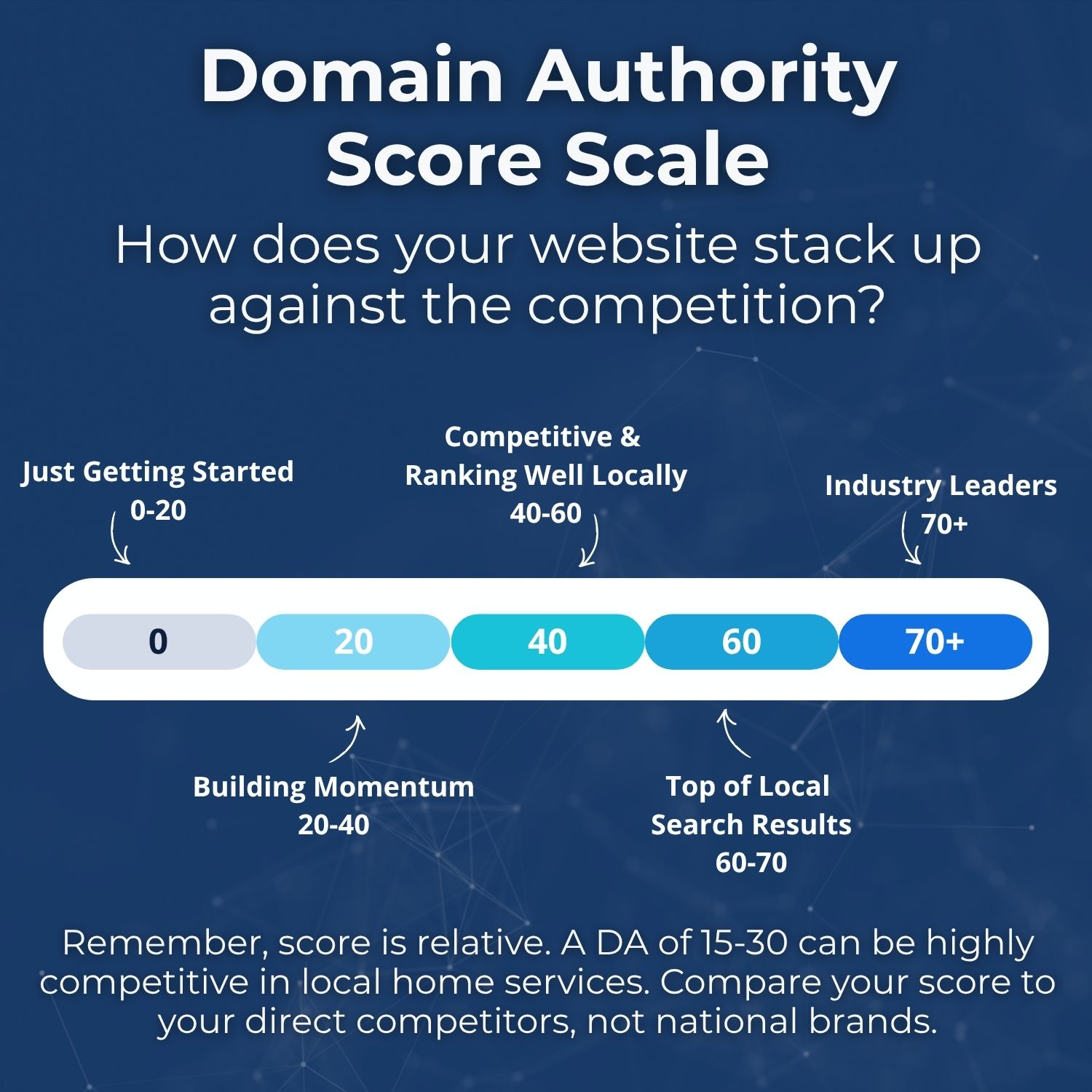
The best way to use DA is not to chase a specific number. Instead, compare your domain authority scores to your direct competitors. If the top-ranking plumber in your city has a DA of 28 and yours is 15, that gap tells you exactly where to focus your SEO efforts.
Domain Authority (DA) vs. Page Authority
Domain authority measures the strength of your entire website. Page authority (PA) measures the strength of a single page. Both are useful authority metrics, but DA gives you the big-picture view of how your site’s authority stacks up against other websites overall.
When you improve domain authority at the domain level, it creates a rising tide that can lift page authority across your most important pages too.
How to Increase Domain Authority the Right Way
Now for the part you came here for. These are the strategies that actually work to build website authority over time. No shortcuts. No tricks. Just the fundamentals done well as part of a complete SEO strategy.
Earn High Quality Backlinks From Trusted Websites
High quality backlinks are the backbone of domain authority. Every link from a reputable, authoritative website acts like a vote of confidence in your content. The more quality backlinks you earn from high authority websites, the faster your site’s domain authority will grow.
But not all backlinks are created equal. One link from a well-known industry publication or local news site is worth far more than 100 links from random directories or spam blogs. Search engines weigh the authority of the linking site, the topical relevance of the content, and how many other sites that domain links out to.
Here is how to earn more quality backlinks the right way:
- Partner with local organizations. Sponsor a community event, join your local chamber of commerce, or collaborate with complementary businesses. These partnerships often come with a link back to your site from relevant websites.
- Get listed in industry-specific directories. For home service pros, think authoritative sites like the Better Business Bureau, Angi, HomeAdvisor, or your industry’s national association.
- Try guest blogging. Write a guest post for a trade publication or local business blog. When you share real expertise, editors are happy to link back to your site. Guest blogging on authoritative websites in your niche is one of the most effective link building strategies available.
- Reach out to industry experts. Building relationships with industry experts and thought leaders in your space opens the door to natural backlinks, co-created content, and mentions on other sites.
- Use broken link building. Find broken links on other websites in your niche and offer your content as a replacement. This is a practical link building tactic that benefits both sides.
- Build relationships, not just links. The best backlinks come from genuine connections. When people know and trust your brand, they link to you naturally.
Create Link Worthy Content That Ranks
If your website only has a homepage and a few service pages, there is very little for other sites to link to. High quality content is what gives your domain depth and makes it a resource worth referencing. Content quality plays a huge role in whether other websites will link to you at all.
Focus on creating valuable content that solves real problems for your audience:
- How-to guides that answer the questions your customers actually ask, targeting relevant keywords they are searching for
- Local resource pages that serve your community (for example, “The Complete Guide to Home Maintenance in Tampa Bay”)
- Original research or case studies that showcase real results and data that other blog posts and publications will want to cite
- FAQ pages that address common questions and help your site appear in search results for voice and AI queries
When your content is genuinely helpful, backlinks tend to follow. Other websites, bloggers, and even AI search tools want to reference sources that provide clear, trustworthy answers. Publishing more articles on a consistent schedule also builds topical relevance, which signals to search engines that your site is a real authority in your niche.
The goal is to create content so useful that earning links becomes a natural result of your SEO efforts rather than something you have to chase.
Fix Technical SEO Issues Holding Your Site Back
A slow, broken, or poorly structured website quietly undermines your site’s authority. Search engines struggle to crawl and index sites with technical problems, and visitors leave within a few hours (or seconds) before they ever read your content. Technical SEO is the foundation that everything else is built on.
Here are the technical basics to get right if you want to improve domain authority:
- Improve site speed. Aim for load times under three seconds. Compress images, minimize code, and use reliable hosting. Faster site speed improves both user experience and how search engines evaluate your pages.
- Mobile-friendliness. More than half of all web traffic comes from mobile devices. Your site needs to work perfectly on every screen size.
- HTTPS security. If your site still runs on HTTP, switch to HTTPS immediately. It is a basic trust signal for both users and search engines.
- Fix broken links. Broken links waste crawl budget and frustrate visitors. Broken internal links are especially harmful because they disrupt how link equity flows through your site. Run a site audit at least once a quarter using Google Search Console or a tool like Screaming Frog.
- Clean website structure. A logical site structure and updated XML sitemap make sure search engines can find and understand every important page on your site. Good website structure also supports your internal linking strategy and helps distribute authority to other pages.
Clean Up Toxic Backlinks
Not all backlinks help you. Some can actively hurt your site’s domain authority and drag down your DA score.
Toxic backlinks usually come from spammy directories, link farms, or irrelevant foreign-language sites that link to you without any real context. Sometimes these appear because of old off page SEO tactics that are now outdated. Other times, they happen without you doing anything at all.
The fix is straightforward:
- Run a backlink audit using a tool like Moz, Ahrefs, or Semrush to review your full backlink profile.
- Identify links from low-quality or irrelevant sources, paying attention to referring domains with high spam scores.
- Try to contact the site owner and request removal.
- If that does not work, use Google Search Console’s Disavow Tool to tell search engines to ignore those links.
Cleaning up toxic backlinks removes dead weight and lets your legitimate high quality backlinks do the heavy lifting. Think of it as clearing the path so your real link equity can flow freely.
Strengthen Your Internal Linking Strategy
Internal links are the links between pages on your own website. They do not directly increase domain authority, but they help distribute the authority you have earned across your most important pages. A strong internal linking strategy is one of the most overlooked parts of any SEO strategy.
For example, if a blog post earns strong backlinks from other websites, linking from that post to your main service page passes some of that link equity along to other pages. Without internal links, that authority stays trapped on a single page and never reaches the pages that actually drive leads.
A few simple rules for better internal linking:
- Link blog posts to related service pages (and vice versa).
- Use descriptive anchor text that tells readers and search engines what the linked page is about.
- Avoid orphan pages. Every important page should be linked to from at least one other page on your site.
- Review and update internal links whenever you publish new blog posts or add new service pages.
Build Your Brand Presence With Off Page SEO
Website authority is not built in a vacuum. Your visibility across the web sends signals to search engines about how established and trustworthy your brand really is. Off page SEO covers everything you do outside your own website to increase your domain authority and build trust.
Here is where to focus:
- Google Business Profile. Keep it complete, accurate, and active. Respond to reviews and post updates regularly.
- Local citations. Make sure your business name, address, and phone number (NAP) are consistent across every directory and listing. This is especially important for local businesses trying to build strong domain authority in their service area.
- Review platforms. Sites like Yelp, Google, and industry-specific platforms build trust with both customers and search engines. Positive reviews are a ranking factor for local search and they reinforce your site’s authority.
- Social media profiles. While social links are typically “nofollow,” an active social presence supports brand recognition and drives more organic traffic to your content.
- Online communities. Participating in relevant online communities, forums, and industry groups puts your brand in front of new audiences and can lead to natural backlinks from other sites.
The stronger your brand footprint, the easier it becomes for authoritative websites to discover and link to you.
Common Mistakes That Hurt Your Search Rankings
Knowing what to do is only half the picture. These are the mistakes we see most often when businesses try to increase their domain authority the wrong way.
- Buying cheap backlinks or using link farms
This is the fastest way to damage your site’s domain authority. Search engines are very good at spotting unnatural link patterns, and the consequences can include ranking penalties that take months to recover from. There is no shortcut to earning high quality backlinks. - Ignoring technical SEO
You can earn all the quality backlinks in the world, but if your site is slow, broken, or hard to crawl, that authority gets wasted. Technical SEO is not optional if you want higher domain authority scores. - Publishing thin or duplicate content
Pages with little original value do not attract links from other websites, and they can actually dilute your content quality in the eyes of search engines. Every page on your site should serve a clear purpose and provide real value. - Neglecting mobile usability
A site that works on desktop but frustrates mobile users is leaving both organic traffic and authority on the table. With more than half of all searches happening on mobile devices, this is a gap you cannot afford. - Skipping keyword difficulty research
Targeting keywords that are far too competitive for your current DA score wastes time and resources. A smarter approach is to find relevant keywords with lower keyword difficulty where your site has a realistic chance of ranking, then build authority from there.
What Actually Affects Your Domain Authority Score?
Before you try to increase your domain authority, it helps to understand what moves the needle. Your website’s DA score is influenced by several key factors that work together.
| Factor | What It Means | Why It Matters |
| Backlink quality | Links from authoritative websites and relevant websites pointing to yours | The single biggest driver of DA growth |
| Referring domains | The number of unique root domains linking to you | More diverse sources signal broader trust to search engines |
| Content quality | Helpful, original, well-structured content on your site | Attracts organic links and keeps visitors engaged |
| Technical site health | Fast site speed, mobile-friendly design, clean website structure | Ensures search engines can crawl and index your site properly |
| Spam signals | Toxic backlinks or low-quality links in your backlink profile | Can drag your score down and hurt search rankings |
According to a study that analyzed the top 50 Google results for approximately 15,000 keywords, 99.2% of all websites ranking in the top positions had at least one external backlink. The top-ranking page on average had 3.8 times more backlinks than pages in positions two through ten (Backlinko / Moz). That tells you everything about how important a healthy link profile from authoritative sites is for building strong domain authority.
How Long Does It Take to Increase Your Domain Authority?
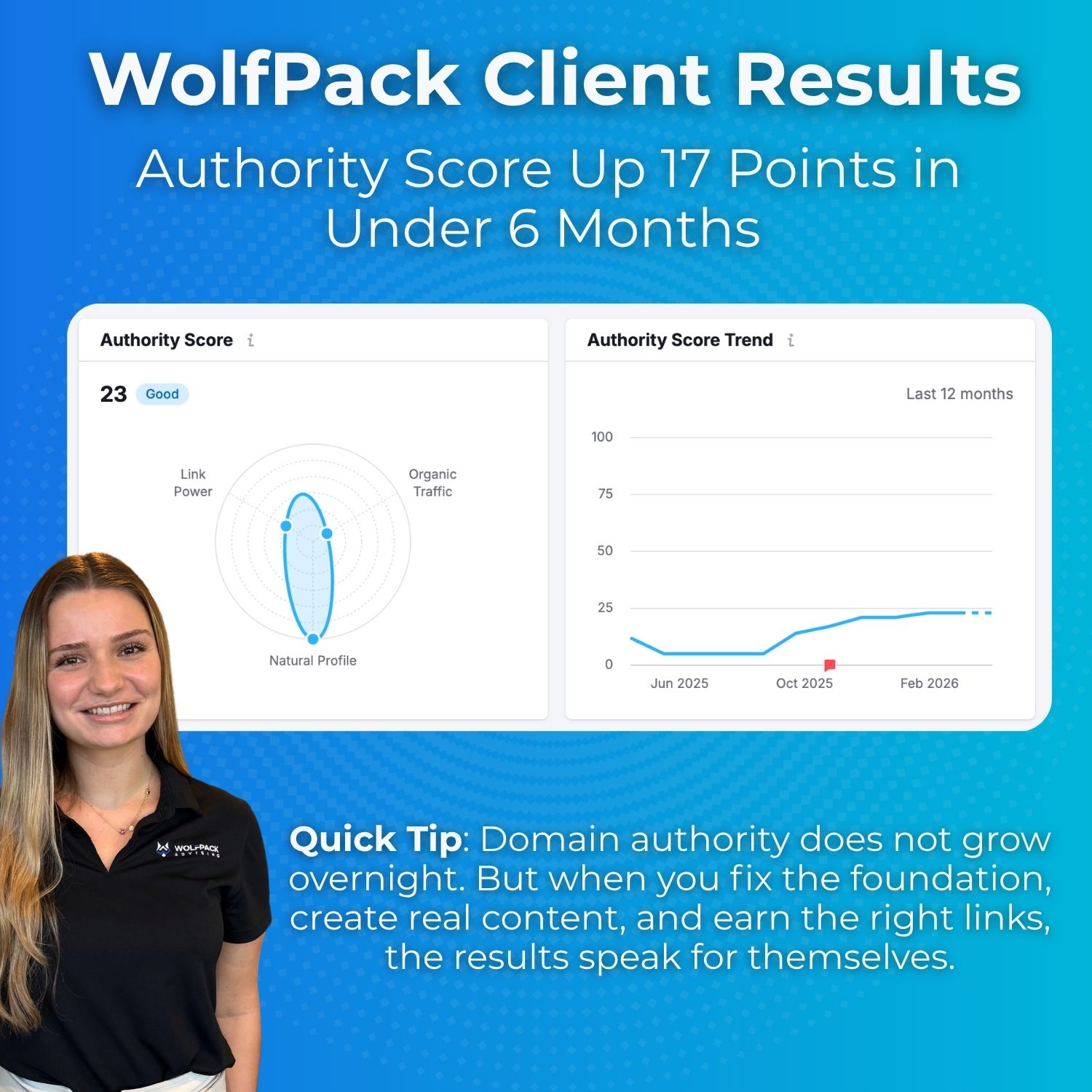
Realistically, most websites start seeing meaningful improvement in their domain authority scores within three to six months of consistent effort. But it depends on where you are starting and how competitive your market is.
Here is a general timeline:
- Month 1–2: Audit and clean up technical SEO issues, fix broken links, remove toxic backlinks, and establish a content plan targeting relevant keywords.
- Month 3–4: Publish new high quality content, begin building quality backlinks through outreach and guest blogging, and strengthen internal links across your site.
- Month 5–6: Start seeing measurable movement in your DA score, search rankings, and more organic traffic coming to your site.
Keep in mind that DA uses a logarithmic scale. Early gains come faster. If your current DA score is 10, getting to 20 is very achievable in a few months. But going from 40 to 50 takes significantly more time, more referring domains, and stronger SEO efforts.
The key is consistency. A strong domain authority rewards sustained effort, not one-time bursts. Every quality backlink you earn, every blog post you publish, and every technical fix you make compounds over time.
How to Check Your Website Domain Authority
Checking your DA is free and takes about 30 seconds. You can use any of these free tools to see where your site stands right now:
- Moz Link Explorer (moz.com/link-explorer) — The original website authority checker. Enter any URL and see its domain authority, page authority, and backlink data. Moz also offers a free toolbar extension that shows DA scores as you browse.
- Ahrefs Webmaster Tools (ahrefs.com/webmaster-tools) — Shows domain rating (DR), which is Ahrefs’ version of website authority. Also useful for analyzing referring domains and your full backlink profile.
- Semrush Authority Score (semrush.com) — Combines link data, organic traffic estimates, and spam signals into a single authority score. A good option if you want a broader view of your site’s authority beyond just links.
Each tool calculates authority metrics slightly differently, so pick one and track your progress over time using the same tool for consistency.
While you are running diagnostics, it is also worth checking how visible your brand is across AI search engines. Tools like WolfPack’s free AEO Grader can show you where your business appears (and where it does not) in AI-generated answers from platforms like ChatGPT, Gemini, and Perplexity.
Related Questions
Does Domain Authority Directly Affect Search Rankings?
Not directly. Domain authority is a metric developed by Moz, and Google does not use it as a ranking factor. However, DA reflects many of the signals that search engines do care about, like backlink quality, referring domains, and site health. A rising DA score almost always correlates with improved search rankings.
What Is a Good Domain Authority Score for a Local Business?
For most local businesses in home services, law, or healthcare, a DA between 20 and 40 is competitive. The goal is not to hit a magic number. It is to have a higher domain authority than your closest local competitors. Check where they stand using a website authority checker and use that as your benchmark.
Can You Increase Your Domain Authority Without Backlinks?
Improving content quality, fixing technical SEO issues, and strengthening internal links can all contribute to DA growth. But quality backlinks remain the strongest factor. A well-rounded SEO strategy that includes link building will always produce faster and more sustainable results than relying on on-page improvements alone.
How Does Local SEO Help Improve Domain Authority?
Local SEO builds the signals that support strong domain authority, including consistent citations, reviews on authoritative sites, and links from local sources. A strong Google Business Profile, directory listings, and community partnerships all contribute to a more authoritative online presence and can increase your domain authority over time.
What Is the Difference Between Domain Authority and Domain Rating?
Domain authority (DA) is Moz’s metric. Domain rating (DR) is the equivalent metric from Ahrefs. Both measure backlink profile strength on a scale from 0 to 100, but they use different formulas, different data sets, and weigh referring domains differently. Neither is “better.” Pick one authority score and use it consistently for tracking your progress.
Build Strong Domain Authority With an SEO Strategy That Works
Increasing domain authority is not about gaming the system. It is about building a website that earns trust from real people, authoritative websites, and search engines over time.
The right SEO strategy combines high quality backlinks, link worthy content, solid technical SEO foundations, and a strong off page SEO presence. And when those pieces work together, the results compound month after month, driving higher DA scores, better search rankings, and more organic traffic to your business.
If you are not sure where your website domain authority stands right now, that is the perfect place to start. WolfPack offers a free SEO audit that shows you exactly what is working, what needs fixing, and where the biggest opportunities are to increase your domain authority the right way.