Cheaper local leads come from better relevance, not a smaller budget. Most home service businesses see a high cost per lead and react by cutting spend. That usually makes things worse. Fewer impressions mean less conversion data, and less data means the platform gets worse at finding your buyers.
The levers that actually work are tighter targeting, stricter keyword control, better landing pages, and warmer audiences. WolfPack Advising runs paid media for home service companies around the country, and this pattern holds almost every time.
Here is what pushes your cost per lead up, and what you can fix this week.
What Are Paid Media Campaigns?
Paid media campaigns are ads you pay a platform to show to a chosen audience. If money buys the placement, it is paid media. Most people call it paid advertising.
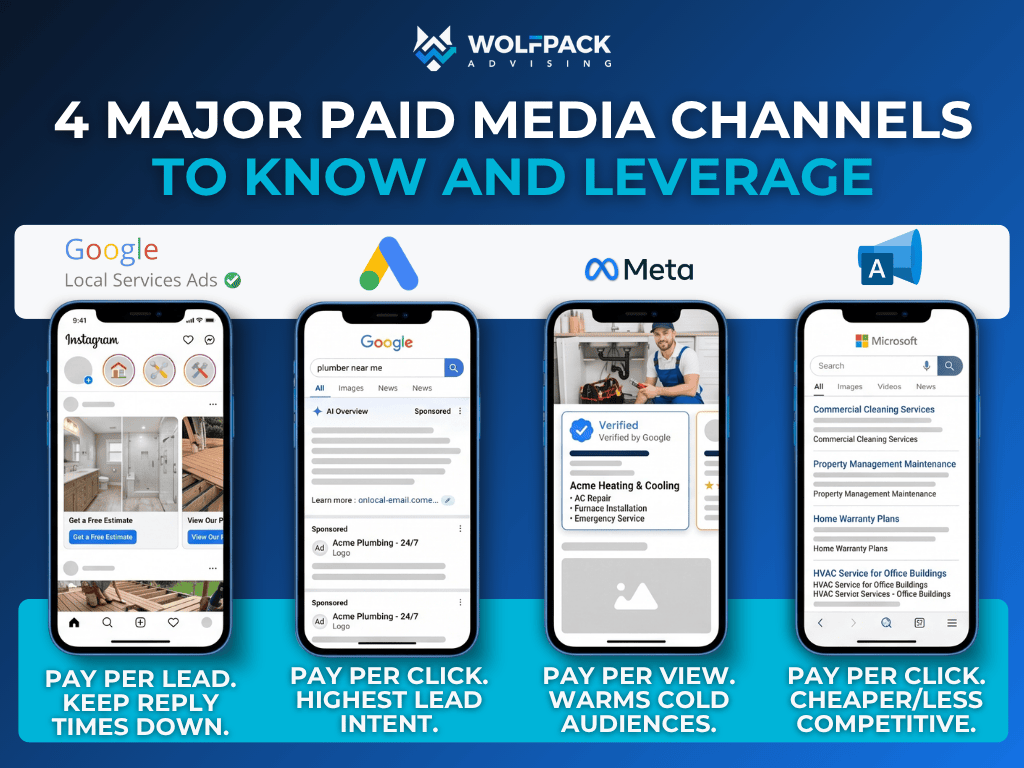
For a local service business, four channels do almost all the work:
- Local Services Ads: Google’s pay-per-lead product with the verified badge.
- Paid search (PPC): Text ads on Google and Microsoft Ads, priced per click.
- Paid social: Meta and TikTok ads, mostly used to warm up an audience.
- Retargeting: Display and YouTube ads shown to people who already visited you.
You can see how we structure all four on our advertising management page.
Why Do Paid Media Campaigns Get Expensive?
Your campaigns might cost more than they should because the platform charges you for being less relevant than the advertiser next to you. Every search triggers an auction, and your bid is only one input.
Google builds Ad Rank from your bid plus your expected click-through rate, your ad relevance, and your landing page experience. Google says plainly in its Ad Rank documentation that higher quality ads can lead to lower costs per click. You are not buying a fixed price; more like a score.
Here is what drags that score down for local businesses.
1) Your service radius is too wide. A 50-mile radius buys clicks in ZIP codes your crew will never drive to. Those clicks still cost full price.
2) You are on broad match. Broad match on an expensive service keyword pulls in searches for salaries, DIY repairs, and job openings. All billable. None bookable.
3) You have no negative keyword list. “How to fix,” “free,” “jobs,” “salary,” and “parts” are the usual budget leaks.
4) Your landing page does not match the ad. Someone clicks an ad for water heater repair and lands on your generic homepage. Conversion rate drops, and your landing page score drops with it.
5) You are paying for hours nobody answers. A paid call at 9 pm that rings out is a lead you bought and threw away.
6) Your audience has never heard of you. This is the one people miss, and it is the biggest. Expected click-through rate is scored against historical performance for that keyword, which
Google explains in its expected click-through rate documentation. A brand nobody recognizes gets fewer clicks. Fewer clicks lower the score. A lower score raises the price.
What Lowers Your Cost Per Lead the Fastest?
Start with the changes that take an hour and pay off in a week. Then work down.
| Fix | Effort | Impact | Why it works |
|---|---|---|---|
| Add negative keywords | Low | High | Stops paying for searches that never book |
| Tighten radius to real service ZIPs | Low | High | Cuts clicks from areas you will not serve |
| Move broad match to phrase and exact | Low | High | Limits spend to real service intent |
| Target presence, not interest | Low | Medium | Stops showing to people researching your city from elsewhere |
| Build one landing page per service | Medium | High | Lifts conversion rate and landing page score together |
| Add dayparting around your call hours | Low | Medium | Stops buying calls nobody answers |
| Import booked jobs as conversions | High | Very high | Teaches bidding to buy leads that close |
| Build retargeting pools from organic traffic | Medium | Very high | Warm audiences click and convert better |
Two of these deserve a closer look...
Fix the Wasted Radius First
Pull your location report and sort by spend. You will usually find a handful of ZIP codes taking real budget and producing nothing. Cut them.
Then set targeting to people physically in your service area, not people showing interest in it from three states away.
Optimize for Booked Jobs, Not Form Fills
Sounds obvious, but it’s really not once you get started. Most local accounts optimize for form fills. Form fills are not revenue. Offline conversion tracking fixes that.
You send booked jobs and job values back into the platform, and the bidding algorithm starts buying the kind of lead that turns into work.
This is the highest impact change in most accounts. It is also the one most businesses skip, because it means connecting your CRM. Worth the setup.
Before you touch any of it, get clear on what your cost per lead and conversion actually are and what inflates them. We broke that math down in a guide to cost per lead and cost per conversion.
How Does Organic Content Make Paid Ads Cheaper?
Organic content lowers paid costs because familiar brands get clicked more, and click-through rate is priced into your auction score. That is a mechanical argument, not a branding one.
Three things happen when you post consistently and rank organically.
- Your expected click-through rate improves: People who recognize your name pick your ad out of a crowded page.
- Higher click-through rate feeds back into Ad Rank, which lowers what you pay for the same position.
- Your retargeting pools fill up for free: Every organic visitor and video viewer becomes someone you can advertise to later, far cheaper than a cold prospect.
- Retargeting audiences almost always carry the lowest cost per lead in an account.
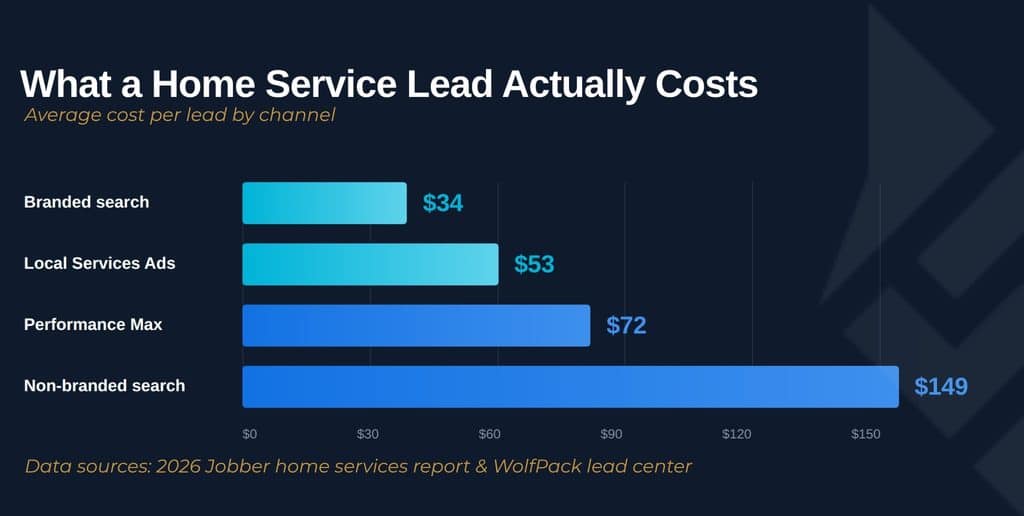
- Branded search starts working for you: When people search your business name instead of “plumber near me,” those clicks are cheap, and they convert well.
- Organic content and reviews create that search volume.
The order matters. Running cold traffic to a brand nobody knows is paying full price on purpose.
You watch our Social Media and Advertising team leads walk through exactly how this works in a free webinar, using real data and industry insights. Check it out here.
Which Channel Gets You the Cheapest Local Leads?
Local Services Ads usually produce the cheapest qualified leads, because you pay per lead instead of per click. Google Search gives you more control and catches people earlier. Most successful contractors run both and let each cover the other’s gaps.
Two things to plan around. Local Services Ads rank partly on how fast you answer the phone, so a slow-to-respond business will not get cheap leads there. And seasonality matters more locally than most owners expect.
HVAC demand and click costs spike in the first heat wave and the first freeze. Roofing spikes after storms. Load budget before the season, not after competitors have bid the auction up.
We compared the two channels in detail in Local Service Ads vs Google Ads.
How Do You Know It Is Working?
A campaign is working when your cost per booked job is low enough that the job still profits. Divide last month’s ad spend by jobs won and you have it. That is the number to hold onto.
For example, a $30 lead that never books is the expensive one. An $80 lead that turns into a $6,000 job is cheap.
Cost per lead, conversion rate, and cost per click are clues, not verdicts on their own. You use them to find what to fix:
| What you are seeing | Where the problem is | What to do first |
|---|---|---|
| Cheap leads, but almost none booking | Your ads attract the wrong people | Move broad match to phrase and exact, add qualifying questions to the form |
| Good leads that never close | Intake, not advertising | Call new leads in minutes instead of hours |
| Cost per job climbing on flat lead volume | You are paying for the wrong geography | Pull the location report, cut ZIPs with spend and no jobs |
| Cheap clicks, expensive jobs | Wasted searches | Pull the search terms report, add negatives |
| Leads and clicks fine, nothing books | Your landing page or your offer | One page per service, with a call-first CTA |
Before you blame the ads, check your response time. Jobber surveyed 1,050 home service business owners for its 2026 Home Service Trends Report and found that 60% of pros reply to leads the same day, but only 20% respond within the hour. If your leads look fine and still do not book, speed is the cheaper problem to fix.
That same report found top-performing businesses run three to five lead sources, not one. Referrals and repeat customers still lead at 59%, then Facebook at 32%, Google Search at 20%, and Local Services Ads at 19%. If you are running a single channel, your cost per booked job has nowhere to go but up.
For help setting the budget these numbers depend on, see how much you should spend on Google Ads.
Related Questions to Explore
What is the difference between paid media, paid search, and paid social?
Paid media is the umbrella term for all advertising you pay for. Paid search covers text ads on Google and Microsoft Ads. Social covers ads on Meta, TikTok, and LinkedIn. Search catches people actively looking for your service. Paid social catches them before they start looking.
Why is my cost per lead so high?
Usually one of five things. A radius wider than your actual coverage. Broad match keywords pulling irrelevant searches. A missing negative keyword list. A landing page that does not match the ad. Or a cold audience that has never seen your brand. Check them in that order.
How much do paid media campaigns cost for a home service business?
It depends on your market and how competitive your service area is. Rather than anchoring on a national average, work backward from what a booked job is worth to you and what close rate you can hold. We show that calculation in how much you should spend on Google Ads.
Are Local Services Ads cheaper than Google Ads?
Often, and they are priced differently. Local Services Ads charge per lead rather than per click, so you are not paying for browsing. But ranking depends partly on your response time and reviews. A business that answers slowly will not get cheap leads from it.
When to Partner With Experts
Handle the basics yourself. Negative keywords, a tighter radius, and match type changes are things an owner can do in an afternoon, and they produce the fastest wins.
Bring in help when you hit one of these:
- You need offline conversion tracking: Connecting your CRM to your ad accounts is the highest-impact change available and genuinely technical.
- Your cost per lead is fine, but your close rate is not: That is a lead quality problem, and diagnosing it means looking at results by campaign, keyword, and audience.
- You are scaling: Cost per lead climbs as you spend more. Managing that curve takes account structure work.
- You have run the same campaigns for a year: Accounts drift. Auctions change. Old campaigns quietly get expensive.
WolfPack Advising manages paid media for home service businesses nationwide, and we report on cost per booked job rather than clicks.
The Bottom Line
- Cost per lead drops when relevance goes up, not when budget goes down.
- The fastest wins are negatives, a tighter radius, and stricter match types. The biggest win is importing booked jobs as conversions.
- Organic content makes paid cheaper through better click-through rate, free retargeting pools, and branded search.
Pull your location and search terms reports this week. Cut what is not producing, then start warming the audience so the auction stops charging you a stranger’s price.
If you want a look at where your account is leaking, request a free, custom proposal, and we will walk through it with you.