
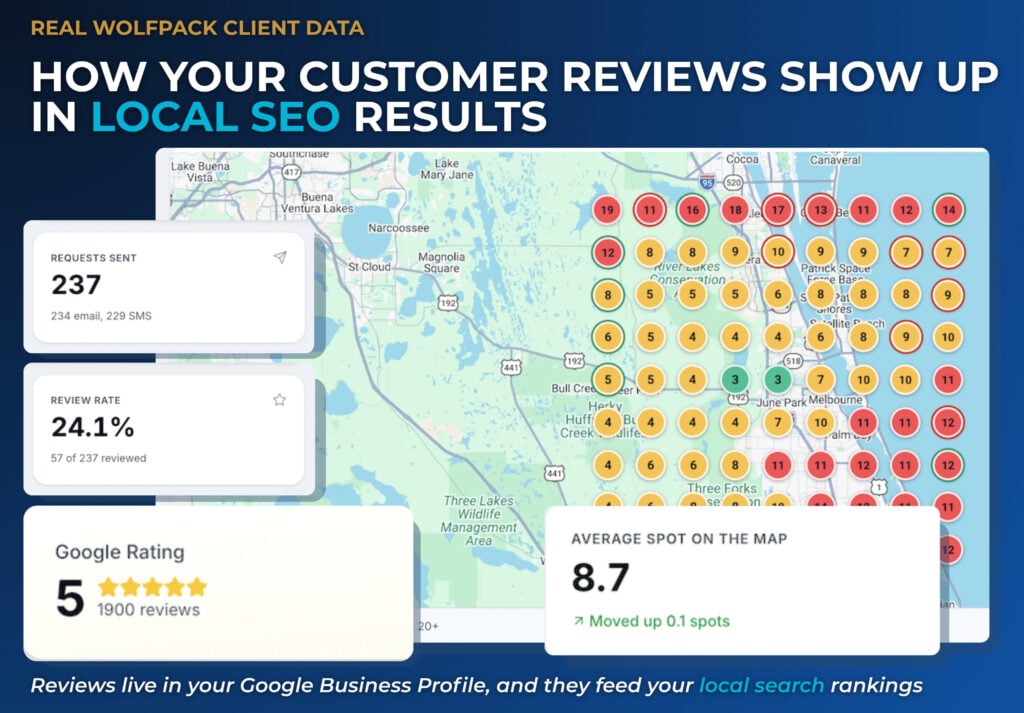
Google reviews help your SEO, but only in one specific place: your local rankings. Google confirms that review count and rating feed the “prominence” signal behind Google Maps and the local pack. What reviews do not do is push a page of your website up the standard organic results on their own.
That difference matters. It decides whether you build a review process into your job-close workflow or keep treating reviews as nice-to-have. At WolfPack, we manage reviews and other digital strategy for hundreds of home service businesses. The ones who win locally treat reviews as a weekly operation, not an occasional favor.
Here is what Google actually counts, what it ignores, and which review habits quietly work against you.
Do Google Reviews Actually Help SEO?
Yes, for local searches. Reviews are one of the inputs Google uses to decide which businesses appear in the map pack, the three-business box that shows up above the blue links when someone searches for a service near them.
Reviews live on your Google Business Profile, not on your website. So a stack of five-star reviews will not lift a blog post or a service page in the standard organic results.
What it can do is help you show up in the map pack, get more clicks, and earn more branded searches, all of which support your site over time.
Two different result sets, two different systems:
- Local pack and Google Maps: reviews are a confirmed input.
- Standard organic results: reviews help indirectly, through clicks, brand searches, and trust.
Both matter for a home service business. The local pack is usually where the phone calls come from.
What Does Google Say About Reviews and Local Rankings?
Google publishes its local ranking criteria, and it is short. In its guide to improving your local ranking, Google explains that local results are based mainly on relevance, distance, and prominence.
Prominence is the one reviews feed. Google’s own wording: “This factor’s also based on info like how many websites link to your business and how many reviews you have. More reviews and positive ratings can help your business’s local ranking.”
Two things worth pulling out of that sentence:
- It says more reviews and positive ratings, not one or the other. Volume without a decent rating does not help you.
- It says it can help, not that it’s guaranteed to. Reviews are one input among several.
Google also states plainly that there is no way to request or pay for a better local ranking. Anyone selling you placement instead of strategy is selling something that just doesn’t exist.
The Parts of Your Review Profile That Matter
Not all review activity carries the same weight. Five areas do the work.
1) Star Rating
Your average rating is what searchers judge first. A 4.2 next to a competitor’s 4.9 costs you clicks even when you rank above them.
A perfect 5.0 with eight reviews often reads as less trustworthy than a 4.7 with two hundred.
2) Review Volume
Volume is relative, not absolute. There is no magic number. What matters is your count compared to the other businesses competing for the same searches in your area.
Forty reviews might dominate a rural county and mean nothing in a metro suburb.
3) Recency and Velocity
A profile with 300 reviews where the newest one is from 2023 reads as a business that stopped operating. Steady, ongoing reviews signal an active company.
This is why review velocity, the rate at which new reviews come in, tends to matter more than the total.
4) What the Reviews Say
Review text is real user-generated content tied to your business. Customers naturally mention services and neighborhoods, which reinforces what you do and where you do it.
One caution: do not coach customers to include specific keywords. Controlled testing on this has not shown a local ranking benefit, and scripted reviews read as fake to the people you are trying to convince.
5) Owner Responses
Google encourages responding to reviews, and it is good practice. Be careful with the claim, though. Google has never said responses are a ranking factor.
What responses reliably do is affect whether a searcher reading your profile decides to call you.
Why Reviews Matter More for Service Area Businesses
Most home service companies are service area businesses. You hide your address on Google and serve a radius instead of a storefront. That changes the math.
Distance is a ranking factor you cannot control. A pest control company twelve miles from a searcher starts at a disadvantage against one that is two miles away. Prominence is the lever you can actually pull, and reviews are the biggest part of prominence you have direct influence over.
Practically, that means reviews expand the radius you can compete in. They will not let you beat a well-reviewed competitor two blocks from the customer. They can absolutely help you win the suburb where you and three others are all ten minutes out.
A few things service area businesses get wrong:
- Reviews attach to a profile, not a company. Add a second location or a second brand, and it starts at zero.
- Crews in outer territories generate the fewest reviews, and those are usually the exact areas you are trying to grow.
- Listing accuracy still gates everything. Reviews cannot fix a profile with the wrong categories or service areas.
Our breakdown of how listing management boosts your local SEO rankings covers that side of it.
How Many Reviews Do You Need?
Enough to beat the businesses you are competing against, which is a different number in every market.
Here is the check that actually tells you something. Search your main service plus your city on a phone, look at the three businesses in the map pack, and write down their review counts and ratings. That is your target. If they average 120 reviews at 4.8 and you have 31 at 4.6, you know exactly what the gap is.
Then work out a cadence instead of a goal. A company closing 60 jobs a month that converts one in five requests into a review adds roughly 12 reviews a month. Now the gap has a timeline.
We go deeper on this in how many Google reviews your business needs.
Review Habits That Quietly Hurt You
Some common advice is worse than doing nothing.
- Review gating: Surveying customers first and only sending the happy ones to Google violates Google’s review policies. It also runs into the Federal Trade Commission’s rule banning fake reviews and testimonials, which covers review suppression.
- Offering incentives: Google prohibits offering payment, discounts, or free services in exchange for a review. Asking every customer is allowed and encouraged. Paying for the answer is not.
- Buying reviews: Prohibited by Google and now federally illegal, with civil penalties attached.
- Only asking after great jobs: Cherry-picking creates a slow trickle and an unnaturally perfect profile. Ask everyone.
- Ignoring negative reviews: A bad review sitting without a reply does more damage than the review itself. Respond, keep it short, and move the conversation offline.
- Asking a week later: The further you get from the job, the lower the response rate. Same-day beats next-week every time.
How Home Service Businesses Actually Get Reviews Consistently
The businesses with the best profiles are not the ones with the happiest customers. They are the ones who ask every single time, without relying on anyone remembering.
What works:
- Trigger the request off job completion, not off a manual list. If your scheduling software marks a job complete, that is your trigger.
- Text beats email for field work. Text open rates are dramatically higher, and the phone is already in the customer’s hand.
- Send it same day, while the tech’s name and the work are still fresh.
- Personalize it. Job address and technician name lift response rates more than any clever wording
- Route unhappy customers to you first. Sending a private feedback form to someone who had a bad experience is not gating, as long as everyone gets the same public review link too.
- Track the rate, not the total. Requests sent versus reviews received tells you whether the process works.
This is the whole reason we built review request automation into our service. It connects to scheduling systems like ISN, Spectora, and Jobber, and sends the request automatically after each job. Businesses running this clear a 20% review rate, against an industry average closer to 15%.
If you would rather build it yourself, our guide on why, when, and how to request a customer review walks through the manual version.
Related Questions to Explore
How do Google reviews affect SEO?
They feed the prominence signal Google uses to rank businesses in the local pack and on Google Maps. They do not directly rank pages on your website. The indirect benefit to your site comes from higher click-through rates and more branded searches.
Do keywords in Google reviews affect local SEO ranking?
There is no reliable evidence that they do. Keyword phrases from reviews sometimes appear as justifications under a business listing, but that is a display feature, not proof of a ranking effect. Controlled testing has not found a lift. Coaching customers on wording is not worth the risk.
Does responding to Google reviews help SEO?
Google recommends responding, and it clearly affects how searchers judge your business, but Google has never confirmed responses as a ranking factor. Treat replies as a conversion and reputation practice that is worth doing regardless.
How many Google reviews do you need to rank in the map pack?
There is no threshold. Google has never published one, and any specific number you see quoted is invented. The useful benchmark is the review count and rating of the three businesses currently in the map pack for your service and city.
Do Google reviews affect organic rankings?
Not directly. Reviews sit on your Business Profile, not your website. They influence organic performance indirectly by driving clicks and brand searches, and by making your listing the one people choose.
Does deleting a Google review affect SEO?
Removing a legitimate review is not something you can do, and a removed fake review has no lasting effect. Your rating recalculates, and your count drops by one. Neither is worth worrying about. Focus on adding new reviews instead of fighting old ones.
Signs Your Business Needs Help With Reviews
Handle reviews in-house as long as the process is running. Bring in support when you see these:
- Your review count has not moved in three months
- Your rating is below the business’s ranking above you in the map pack
- Requests go out only when someone remembers to send one
- You are in the map pack in your home city and invisible in every surrounding town
- Negative reviews sit for weeks without a response
- You added a location or a crew and the new profile has almost nothing on it
Any two of those together usually means the problem is the process, not the customers. WolfPack builds and runs review management programs for home service businesses across the country, from single-truck operations to multi-location franchises.
See it in practice: an Illinois inspection company’s review request success story.
Conclusion
Reviews move the needle on SEO, as long as you are clear about where.
- Reviews help your local rankings through Google’s prominence signal. They do not directly move your website in organic results.
- Rating, volume, recency, and review content all matter, and volume only matters relative to your local competitors.
- Gating, incentives, and purchased reviews break Google’s policies and federal rules, and they are not worth the exposure.
- Consistency beats intensity. A process that asks after every job outperforms a push once a quarter.
Ready to stop chasing reviews by hand? Talk to WolfPack Advising about putting your review requests on autopilot.