

Something happened this week, April 2026, that I don’t think most people know about.
Anthropic, the AI safety company behind Claude, accidentally leaked details of their next flagship model. A misconfigured system exposed a draft blog post and thousands of unpublished assets. Two independent security researchers found it before it was pulled down. The model is called Claude Mythos, and Anthropic’s own description called it “by far the most powerful AI model we’ve ever developed.”
Since then, Mythos has moved into a research preview and is available to specific companies working directly with Anthropic and the U.S. government. The rollout is deliberately staged. Anthropic is working with government agencies to ensure critical infrastructure and cybersecurity defenses are prepared before broader public access, because once adversaries get their hands on this level of capability, the threat landscape changes dramatically.
There are already reports that state actors are creating fake accounts across AI platforms to train their own models and weaponize the technology.
Here’s the full video from Anthropic about Mythos and Project Glassway:
This isn’t just a product launch. It’s a signal about how fast AI is moving – and how seriously the people building it are taking the implications.
Why should you, a business owner or marketing leader, care about an AI model being staged through government review? Because the leak isn’t the story. The signal is. And signals like this tell you exactly where the ground is shifting beneath your business.
I’ve spent years advising small and mid-size businesses on digital marketing, and I speak nationally on how technology is reshaping how businesses grow. Here’s my read on what’s happening, what it means for your business, and what you should actually do about it.
The AI Landscape Right Now: More Has Changed Than You Think
Claude Mythos doesn’t exist in a vacuum. The 15 months leading up to this moment have been the most consequential period in the history of commercial AI, and most businesses are only starting to feel the impact.
Here’s a quick snapshot of what’s dropped since early 2025:
- Anthropic released Claude Opus 4, 4.5, and 4.6 – each a significant jump in autonomous capability, coding accuracy, and real-world workflow automation.
- OpenAI launched GPT-5 – immediately available to all 700 million ChatGPT users, with dramatically lower hallucination rates.
- Google shipped Gemini 3, integrated it across Search, Maps, Docs, Sheets, and Drive, and launched Antigravity – their platform for building autonomous AI agents.
- Meta partnered with Manus AI to build autonomous agent systems that execute complex, multi-step tasks across the web – moving beyond open-source models into the autonomous workforce layer.
The consistent theme? Every major AI lab has stopped building chatbots and started building agents – AI systems that don’t just answer questions, but take actions, run multi-step workflows, and operate entire processes with minimal human input.
That is the shift. Not smarter chatbots. Autonomous systems that work.
What This Means for Digital Marketing
Virtually every discipline in digital marketing is being affected by AI right now. Let me walk through the major ones.
Search & SEO: The Game Has Changed, Not Ended
Here’s a framing I use when I speak on this topic: search isn’t dead – it’s bifurcating. Transactional searches (“plumber near me,” “buy running shoes”) still flow heavily through Google. But informational, middle-of-funnel searches – the research queries, the comparisons – are increasingly going to AI models first.
Google’s AI Overviews now trigger on roughly 16% of all queries. A new discipline has emerged called Answer Engine Optimization (AEO) – optimizing your content not just for search rankings, but for whether AI models cite and surface your business in their responses. Gartner predicts traditional search volume will drop 25% by 2026 due to AI chatbots – and brands are rapidly shifting budget toward AI search optimization as a result.
But here’s what I believe strongly: real human expertise and authentic, locally-specific content will outperform generic AI-generated content. 74% of new webpages now contain AI-generated content. But Google’s guidance is clear – quality, originality, and “people-first” usefulness win. As AI floods the internet with average content, distinctiveness and trust become more valuable, not less.
For local service businesses especially: your specific knowledge of your market, your service area, your clients – that is something AI cannot replicate. The business owner who is actively involved in their SEO and AEO strategy will have a meaningful edge over anyone relying purely on AI to generate content for them.
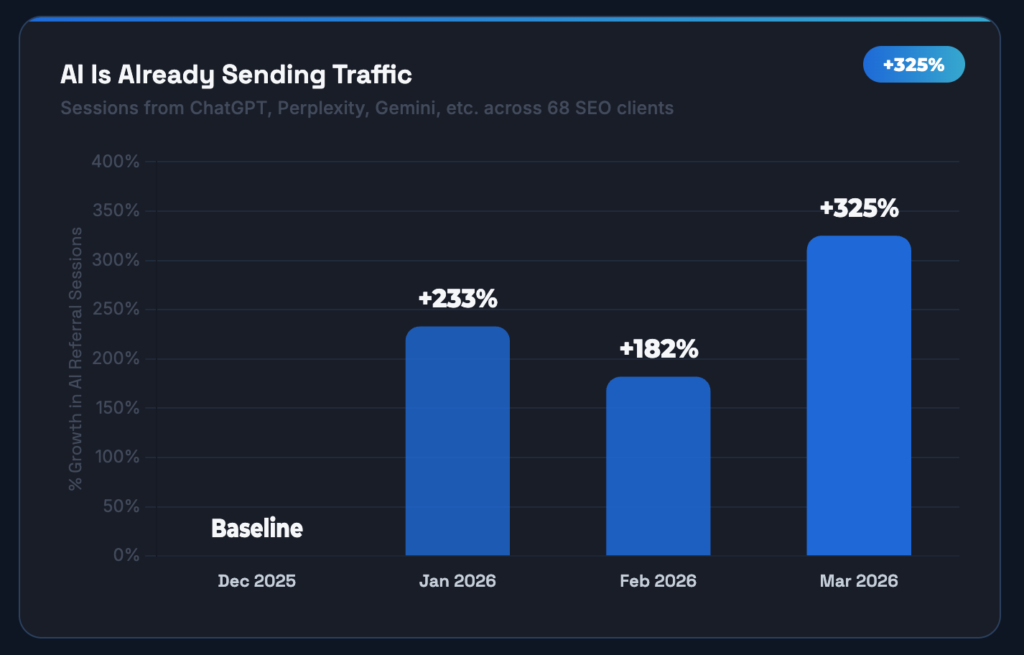
Our client’s traffic from AI models is already up 325% so far this year – outpacing 2025 AI traffic growth significantly.
Paid Advertising: AI Runs the Auction, But Strategy Still Runs the Show
Let me be blunt: Google’s Performance Max (PMax) campaigns still suck for most advertisers. I know Google is pushing them hard. I know they claim PMax manages over 80% of total ad spend for the median enterprise advertiser.
But here’s what we see in practice at WolfPack: we still run most of our campaigns with exact and phrase match keywords in expert-created campaigns with highly restricted settings. Why? Because Google’s incentive is to spend your budget as fast as possible. PMax gives Google maximum control over where your money goes. Optmyzr’s analysis of 24,000+ PMax campaigns found they consistently underperform when not paired with intelligent human management.
AI is the engine. Strategy is the steering wheel. Google wants to drive your car for you – and they don’t care if they drive it off a cliff, as long as they collected the toll.
At WolfPack, we use AI for what it’s good at – bid optimization within tightly controlled campaign structures – and human expertise for what it’s essential for: keyword architecture, negative keyword management, audience signal quality, and making sure Google isn’t wasting your money.
Branding & Web Design: AI-Powered Research, Human-Directed Strategy
The speed at which AI can now support branding and web design work is remarkable. At WolfPack, we use tools like Perplexity’s deep research to run comprehensive competitive market analysis for specific industries and service areas – surfacing positioning gaps, customer language, trust signals, and differentiation opportunities.
We recently ran this exact process for WolfPack’s own brand refresh. You can see the full AI-assisted brand guideline development here: WolfPack Advising Brand Guidelines by Perplexity Computer.
Check out our applications for AI Brand Analysis and AI Brand Guideline documentation
And here’s an example of how we use AI models to run deep local market analysis for our clients’ brands – helping build more impactful businesses that are easier to scale and grow in their markets:
This kind of work used to require a significant agency retainer and weeks of turnaround. AI has compressed it dramatically. But the quality of the output depends entirely on the strategic thinking that directs it. We use AI to gather intelligence and accelerate execution. The brand decisions are still made by humans who understand marketing.
Email Marketing & CRM: Personalization Has Exploded
Email’s ROI story hasn’t changed – $36 for every $1 spent – but what’s happening with personalization and CRM automation has genuinely exploded.
AI can now personalize every element of an email – subject line, body copy, CTA, send time, follow-up sequence – and optimize in real time. Salesforce’s State of Marketing report found AI-driven hyper-personalization increases email revenue by 41%. Personalized CTAs convert 202% better than generic ones. And omnichannel campaigns using email plus LinkedIn plus phone see purchase rates 287% higher than single-channel outreach.
Below is aggregated email marketing performance data for WolfPack clients versus Mailchimp’s published averages. The difference is stark – and it compounds when paired with AI-powered personalization and a team that knows how to use it.
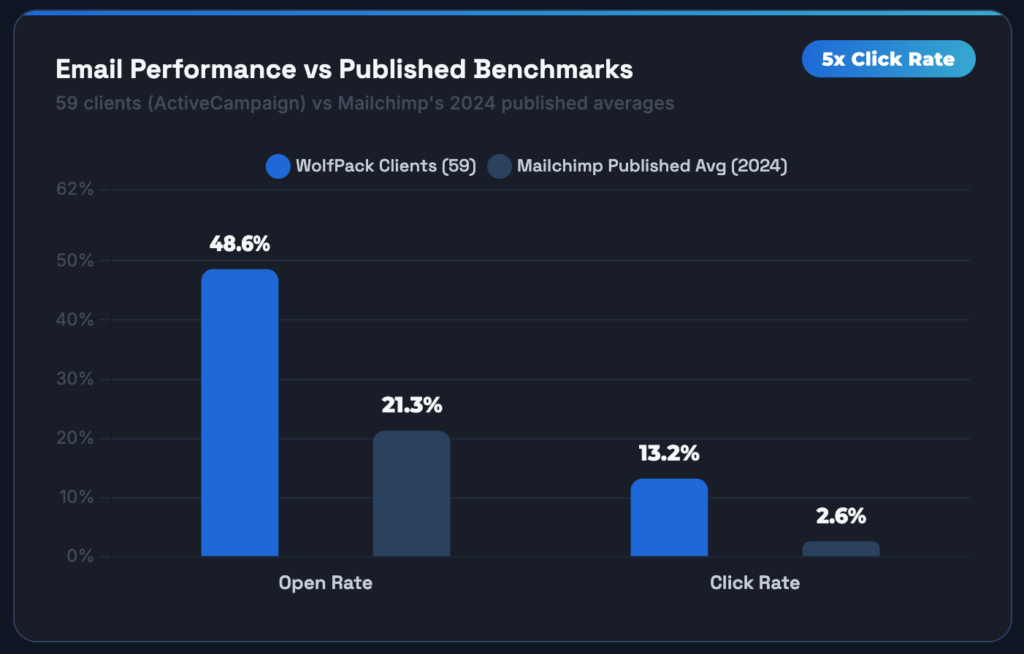
CRMs like ActiveCampaign and HubSpot are baking AI directly into their platforms. The shift is from segmentation (grouping people into buckets) to true individualization – each person’s browsing history, purchase behavior, engagement patterns, and optimal send window, analyzed in real time. Your CRM is no longer a contact database. With the right strategy, it becomes a revenue engine.
If you want proof of how seriously the industry is taking this shift, look at HubSpot. The company that coined “inbound marketing” has introduced Loop Marketing – an AI-powered framework that replaces the traditional funnel. And they just renamed their flagship conference from INBOUND to UNBOUND after 15 years. When the company that wrote the book on inbound says “that era is over,” you should pay attention.
Content Marketing: Volume Is Worthless, Strategy Is Priceless
AI has dramatically lowered the cost of content production. 85% of marketers now use AI tools for content creation. When everyone can produce the same volume at the same cost, the premium shifts to original research, proprietary data, strong editorial voice, and thought leadership that AI cannot replicate.
The winning content strategy for 2026 is not “use AI to create more” – it’s “use AI to create better.” Faster testing, sharper differentiation, more relevant targeting. Anchored always by a genuine brand point of view.
Social Media: The Most Human Channel
Here’s my honest take: social media has been the least disrupted channel by AI – and I think that’s going to hold. The reason is simple: people follow people. They engage with authenticity, personality, and real behind-the-scenes moments. AI can help you repurpose content, schedule posts, and analyze performance. But the core of what makes social work – genuine connection and human storytelling – is exactly what AI can’t fake.
That said, AI agents are handling the operational side: extracting content from webinars, reformatting for each platform, writing copy variations for testing, monitoring performance. The humans still need to be the face and the voice. The AI handles the infrastructure around them.
Our social media performance for clients is significantly higher than industry benchmarks – and I believe it’s because we keep social media human-focused. Clients who are actively engaged with their content strategy see the most engagement by far.
Just take a look below – our Facebook engagement rate alone is 68 times higher than Hootsuite’s 2025 benchmarks across our client base. That translates directly into more followers, shares, and brand awareness.
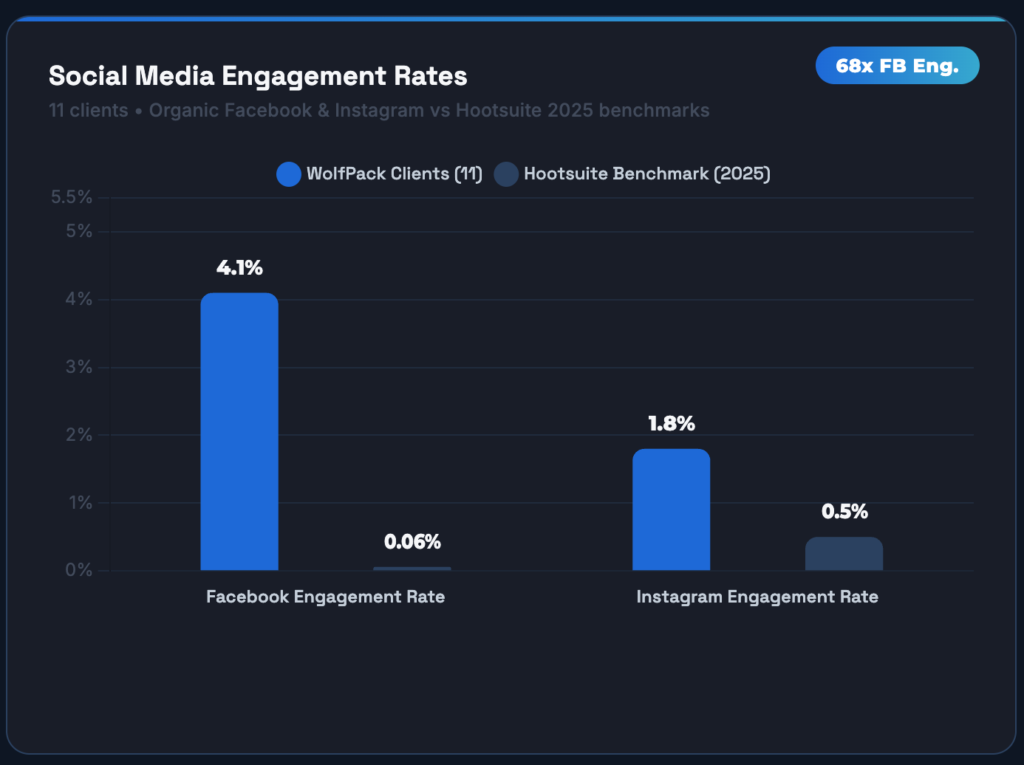
I believe social media will become even more crucial to digital marketing over time, because it may be the last online space that remains truly human. (Assuming the platforms keep AI bots from creating accounts.)
The WordPress Analogy: Why Experts Still Matter
I use this analogy when I speak to business owners and it always lands: think about WordPress.
When WordPress came along, it lowered the floor for website creation. A savvy business owner could build their own site. But did it eliminate the need for web designers? Absolutely not. It changed what they do – but WordPress experts are still in high demand.
AI in digital marketing is the same. It lowers the floor. The savvy business owner who leans in and learns the tools can access capabilities that used to require an agency retainer. That’s genuinely exciting, and I say that as someone who runs an agency.
But the best outcomes – the ones that move the needle on revenue – still require someone who deeply understands the strategy behind the tools. AI makes great marketers faster. It doesn’t replace them.
What This Means By Business Size
Small Businesses (Under ~25 Employees)
The opportunity is real. AI tools have dropped to a price point where small businesses can access capabilities that required enterprise budgets two years ago. Thryv’s 2025 survey found that 66% of small businesses using AI save $500-$2,000 per month and 20+ hours per month.
My advice for small business owners:
1. Use AI every single day. Not dabbling – 30 minutes minimum. Make it part of every workflow: research, writing, planning, analysis, customer follow-up. My top picks are Perplexity for research and Claude for writing and analysis. If you’re not building this habit, you’re already falling behind.
2. Get involved in your own content. If you’re a WolfPack client using our SEO and AEO services, this means sharing your expertise with us. Review blog drafts. Record quick videos answering customer questions. Work directly with your specialist. The companies that actively collaborate with us see the best results – it’s not even close. Your local expertise is your moat against AI-generated competitor content.
3. Put real, authentic information about your business online. Not generic FAQs – the actual questions your customers ask on the phone. Talk about how local conditions affect your work. Explain why you started your business in your market. Those hyper-specific, human details are exactly what AI models and Google’s algorithms reward – because they can’t be generated by a prompt.
4. Move now. The early adoption window is open. The businesses that move in the next 12 months will build advantages that are genuinely hard to close later.
Mid-Market Businesses ($1M-$50M Revenue)
Here’s a counterintuitive truth: mid-market organizations are often better positioned to adopt AI than large enterprises – not despite their size, but because of it. Enterprises get weighed down by legacy infrastructure and organizational politics. Mid-market companies can move fast.
The play for mid-market in 2026 is targeted wins, not wholesale transformation. Pick one or two high-impact applications – AEO-focused content strategy, AI-powered CRM scoring, expert-managed Google Ads with AI-assisted optimization – and deploy them well. McKinsey’s research shows customer service and IT AI deployments deliver 15-30% cost reductions in the first year.
Enterprises & Franchises ($10M-$100M+)
Enterprise AI adoption is high. The ROI is not. MIT research found that 95% of generative AI pilots fail to reach production. McKinsey reports that while 90% of companies use AI, only one-third have scaled it across functions.
Here’s what I see when I consult with enterprises and franchises: leadership needs to restructure workflows from the ground up. You can’t hand your team AI tools and say “figure it out.” That fails almost every time. You need to work on the front lines with your people. If you as a leader haven’t spent real time in the AI tools yourself, you have no business mandating their use across your organization.
The companies capturing value moved from experiments to production-grade systems with clear ownership and measurement. For franchise operations, the highest-value use cases are AI-powered customer service, localized content generation at scale, and centralized campaign management with local execution, per Deloitte’s enterprise AI research.
BCG’s research shows that the top 5% of companies moving fastest on AI see 1.7x revenue growth and 40% greater cost reductions versus laggards. The gap is compounding. Every quarter you delay is a quarter your competitors are pulling further ahead.
What We’re Doing at WolfPack (And Why We’re Sharing This)
I’m not just an observer – we’re living these changes inside WolfPack. Every team member now has a Claude Teams account. We’ve built our own custom plugins, skills, and connectors specifically for digital marketing workflows. We can aggregate and analyze performance data across all clients simultaneously – identifying trends and optimization opportunities that would have taken a team of analysts days to surface.
Our SOPs are changing. The way we onboard people, diagnose performance, build strategies, and execute campaigns – all of it. We’re creating new AI-powered processes every day. Not because we’re chasing technology, but because it lets us deliver more value, faster and more accurately, than was ever possible before.
What does that mean for our clients? We can now offer services that didn’t exist – or didn’t make financial sense – for small and mid-market businesses:
- AI Engine Optimization (AEO) – optimizing your content to be cited by AI models like ChatGPT, Gemini, and Claude, not just Google.
- AI Brand Analysis – deep competitive research calibrated to your specific service area, used to build brand strategy and positioning.
- Aggregated performance intelligence – cross-client analysis that surfaces patterns and optimizations in your campaigns.
My Bottom Line
Claude Mythos leaking showed us how fast this technology is advancing. The government is involved in staging its rollout because of the implications. That should tell you something about what’s coming.
But here’s what I want to leave you with: digital marketing is not dying, and agencies aren’t going away. If anything, they’re becoming more essential. Digital is the future – it always has been. Traditional channels still have a role, but from everything I’ve seen across years of ROI analysis and consulting, companies aren’t getting comparable value from traditional marketing versus the scale and measurability that digital provides.
There is a wave of early adopters moving right now who are going to build advantages that will be very hard to close later. The businesses that moved early won.
The window is open. It is narrowing. But it is still open.
Here’s where we are:
- Search is changing, not dying. Optimize for both Google and AI models. AEO is real and coming fast.
- Ads experts still matter – maybe more than ever. AI handles bidding. Humans handle strategy. You need someone watching the wheel.
- Authenticity wins. As AI floods channels with average content, human voice and genuine insight become more valuable. Be specific. Be local. Be real.
- Social media remains the most human channel. Use AI for operations. Keep the human at the center.
- Email and CRM automation have exploded. The personalization is real. The ROI is measurable.
- Speed of adoption is a competitive advantage. The gap between early adopters and laggards is widening. Move deliberately, but move now.
The future of digital marketing isn’t scary – it’s genuinely exciting, if you’re paying attention and moving with intention. The businesses that figure this out in 2026 are going to look back on this moment the way early Google Ads adopters look back on 2004.
Want to talk about what this means for your business? Whether you’re a small business owner trying to figure out where to start, or a growing company ready to build an AI-powered marketing system – let’s have a real conversation.
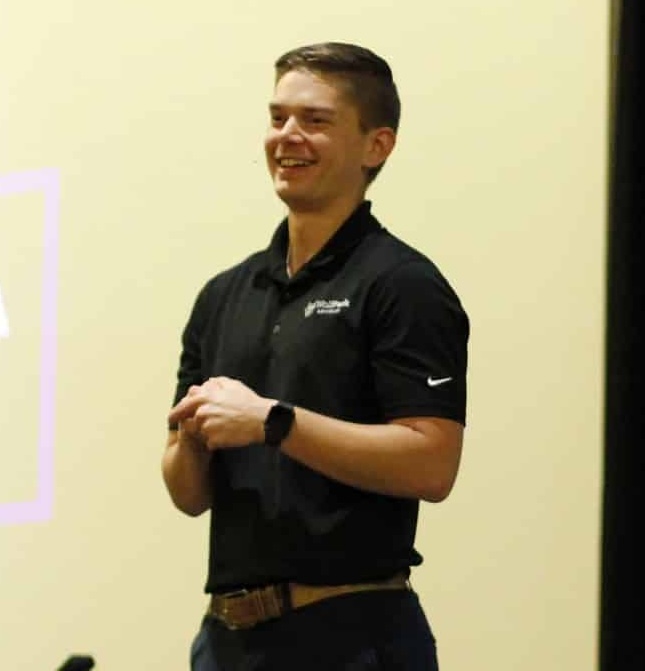
Aaron speaks nationally on AI, digital marketing, and the future of small business growth. Learn more about WolfPack Advising.