

This guide explains the best way to keep up on social media trends for local brands without burning time, energy, or credibility.
Keeping up with social media trends is one of the most common frustrations for local brands. Scroll constantly. Post faster. Jump on trends before they disappear. Be active everywhere at once.
Local brands do not fall behind because they miss one specific trend. They fall behind because they don’t understand which trends matter for their target audience, how to use them, and when to ignore them completely.
Without that clarity, social media becomes reactive instead of strategic. The goal is not viral content, but relevant, consistent, and steadily visible content. Here’s how to approach it without going crazy.
Why Brands Really Wonder About Social Trends
When local business owners search for social media trends, they are rarely trying to become influencers or entertainment brands.
What you’re actually asking is…
- Why does our reach feel lower than it used to?
- What kind of posts does the platform algorithm seem to reward now?
- Why do competitors keep showing up in feeds?
- How do we stay visible without posting nonstop?
Social media trends are not just viral sounds, dances, or memes. The trends that matter most for local brands are patterns. Patterns in how platforms distribute content. In how audiences engage with posts. In which formats consistently outperform others over time.
For example, the shift toward short-form video content. Instagram, Facebook, and TikTok have all publicly stated that video plays a major role in content distribution. That shift affected every account on the platform, regardless of industry, budget, or location.
Instead of chasing individual posts, focus on formats and behaviors that consistently support visibility for brands like yours.
Why Keeping Up With Social Media Trends Feels Impossible
If staying on top of trends feels exhausting or unrealistic, that is not a personal failure. It is a system problem. In most cases, several issues stack on top of each other and create friction.
1) Platforms Change Faster Than Guidance Can Keep Up
Social platforms evolve quietly and frequently. Features roll out gradually. Distribution rules shift without announcements. Best practices change before most brands even realize something has happened.
By the time advice spreads through blogs, social posts, or webinars, the window to act may already be closing. This creates a constant feeling of being late, even when effort is high.
2) Advice Is Often Conflicting
One source says post multiple times per day. Another says quality over quantity. One claims trends are essential. Another says trends do not matter at all.
Without context, this advice creates confusion. Brands are left guessing which rules apply to their business, their audience, and their capacity. That uncertainty slows decisions and leads to inconsistent execution.
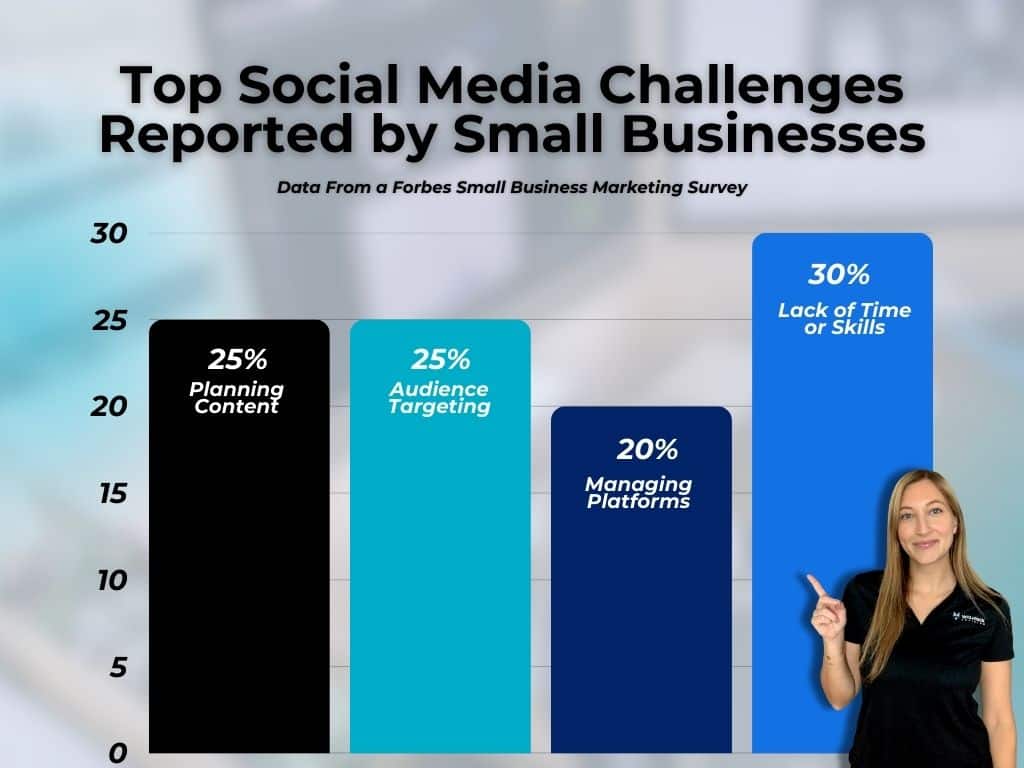
3) Social Media Is Rarely a Full-Time Focus
For most local brands, social media is one responsibility among many. It competes with sales, operations, customer service, hiring, and day-to-day management.
According to HubSpot’s 2025 marketing report, more than 60% of small businesses cite a lack of time as the biggest barrier to consistent social media marketing. The issue is not effort or interest. It is capacity.
4) The Cost of Getting It Wrong Feels High
Many brands hesitate to test trends because they worry about wasting time or hurting their brand. That fear often leads to inaction, which creates its own risk.
Without a clear system, trend awareness becomes reactive. Brands either burn out trying to keep up or disengage entirely and fall behind competitors who are operating with clearer processes.
How to Keep Up on Social Media Trends for Your Brand
The best way to keep up on social media trends for local brands is to focus on trend patterns, limit where you look, and review trends on a schedule instead of in real time.
Trends should inform content decisions, but not control them.
This distinction shifts the goal from reacting quickly to recognizing what is changing. You are not trying to catch every trend at its peak. You are learning how platforms and audiences evolve over time and adjusting accordingly.
Local brands that succeed with trends treat them as signals. Signals about what formats perform well, what messaging resonates, and how people prefer to consume information.
Stop Trying to Watch Every Platform
Trying to keep up with every platform is one of the fastest ways to fall behind.
Most local service businesses only need to focus on one or two platforms to see meaningful results. For many, that means Instagram and Facebook. For others, TikTok plays a growing role. LinkedIn can matter for certain professional services, but it is not essential for every business.
Spreading effort across too many platforms leads to shallow engagement, inconsistent posting, and unclear performance. Brands end up busy without seeing progress.
A more effective approach:
- Identify where your audience already spends time
- Commit to learning how that platform behaves
- Ignore platforms that do not support your goals
Research consistently shows that brands focusing on fewer platforms tend to see higher engagement and stronger consistency. Focus improves awareness. Awareness improves decision-making.
Know Where Social Media Trends Actually Start
Many brands look to competitors to identify trends. By the time a competitor adopts a trend, it is usually already saturated.
Trends typically begin in three places:
- Platform-level experimentation
- Early adopter behavior
- Algorithm-driven distribution tests
When a platform wants to promote a new feature or format, it often does so quietly by increasing distribution for certain types of content. This is why you may suddenly see similar video styles, hooks, captions, or layouts across unrelated accounts.
Early adopters experiment with these formats. If engagement signals are strong, the platform expands distribution further. By the time the trend reaches mainstream business accounts, it may already be past its most effective window.
The most reliable signal to watch is repetition. If you see the same format appearing across accounts you do not follow, that usually indicates the platform is testing something new.
[Example] Trending content format that WolfPack used on our own socials:
class="instagram-media" data-instgrm-permalink="https://www.instagram.com/reel/DRhir2CEZWW/" data-instgrm-version="14" style="background:#FFF; border:0; margin: 1px; max-width:540px; min-width:326px; padding:0; width:99%;">
How to Spot a Trend Worth Using
Not every trend is worth adopting, especially for local brands that rely on trust and clarity.
Before using a trend, it helps to evaluate it logically rather than emotionally. Popular does not always mean effective.
Start by asking:
- Does this format support education, clarity, or explanation?
- Can we adapt it without changing our brand voice?
- Will our audience understand it without extra context?
- Does it reinforce trust or undermine it?
Many trends work best for personality-driven content. That can, but won’t always translate well to service-based businesses. A trend that relies on sarcasm, exaggeration, or inside jokes may confuse or alienate a local audience.
Some trends require fast turnaround and frequent posting to stay relevant. If your team cannot realistically execute that way, the trend may create stress without meaningful payoff.
Strong trends for local brands usually:
- Make information easier to digest
- Highlight expertise or process visually
- Allow adaptation without copying exactly
- Fit naturally into existing content themes
The goal is not to recreate trends perfectly, but to borrow useful formats and apply them in a way that feels intentional and aligned with your brand.
How Often Should Local Brands Use Trends?
Trends are most effective when they support your content strategy rather than replace it.
For most local brands, trend-based content should represent a smaller portion of overall posting. The majority of content should still focus on education, proof, and trust building.
A sustainable approach looks like this:
- Core content is planned and consistent
- Trends are used selectively to improve visibility
- Performance is evaluated over time rather than post by post
Instagram has stated that accounts blending original informational content with trend-aligned formats tend to retain audience trust while benefiting from distribution. Consistency still matters more than novelty.
Using trends occasionally allows brands to test, learn, and adapt without disrupting their workflow.
Tips & Tools That Make Trend Tracking Easier
Trend tracking does not require advanced software or constant monitoring. The most effective tools are often simple ones used intentionally.
Platform Discovery Feeds
Instagram Explore and Reels feeds surface emerging formats because they are designed to test content distribution.
TikTok’s For You feed reflects real-time algorithm experimentation. The key is noticing repetition, not scrolling endlessly.
Save Posts for Inspo
Saving posts that catch your attention is one of the simplest and most effective ways to track trends without actively searching for them.
When you regularly save posts, patterns start to surface naturally. You may notice similar hooks, video structures, caption styles, or visual layouts appearing across different accounts.
This shifts trend tracking from passive scrolling to intentional observation.
- Save posts that stop your scroll, even if you are not sure why
- Review saved posts once a week instead of daily
- Look for repeated formats or themes rather than individual ideas
External Tools to Reduce Manual Work
External tools can help when they simplify the process instead of adding noise. Useful options include:
- TikTok Creative Center for trending formats and topics
- Google Trends for broader interest shifts tied to campaigns
- Social media newsletters or creator roundups that summarize trends weekly
If a tool creates more dashboards than decisions, it is probably not worth using.
What Trend Upkeep Might Look Like in a Normal Week
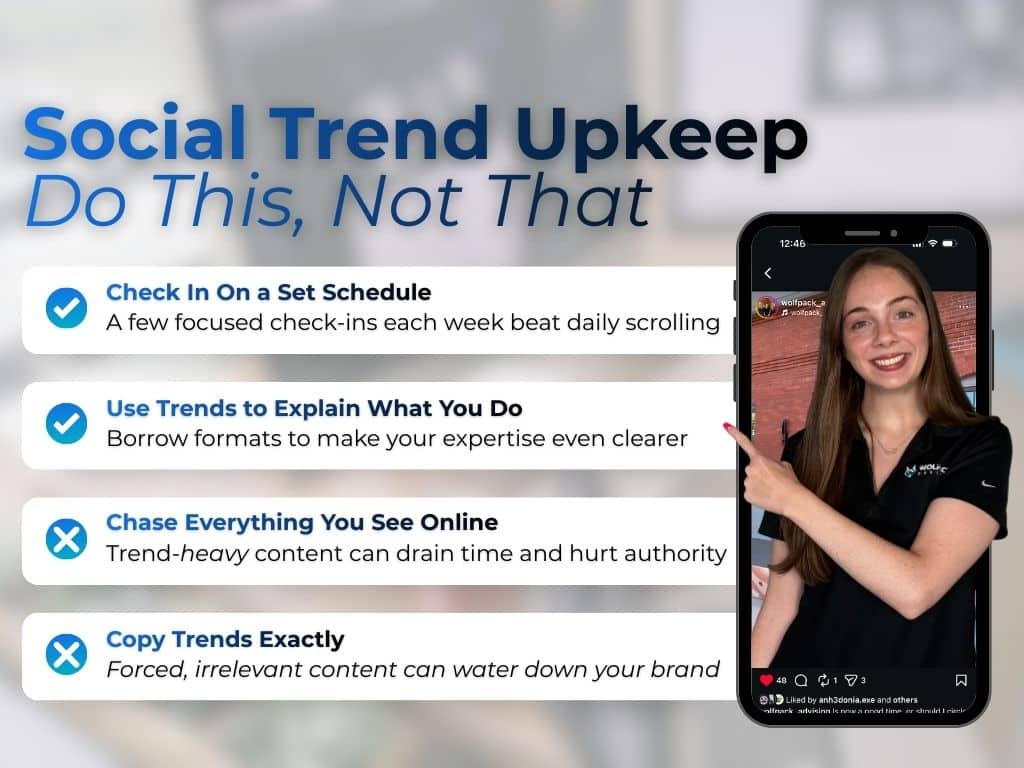
For most local brands, keeping up with social media trends does not mean daily research or constant monitoring. It works best when it is built into a simple, low-effort routine.
Here is what that can realistically look like.
- Once or twice a week, scroll with intention: Spend a few minutes checking Instagram Reels, Explore, or TikTok’s For You feed. You are not looking for ideas to copy. You are looking for patterns.
- Notice formats, pacing, hooks, or layouts that keep showing up across different accounts.
- Save posts that stop the scroll: If something catches your attention, save it. Do not worry about why it worked yet.
- Over time, your saved posts will naturally reveal trends through repetition.
- Review saved posts weekly: Set aside a few minutes once a week to review what you have saved. Look for overlap.
- Are multiple posts using the same structure or opening line? Are similar visuals or captions appearing repeatedly? These patterns are stronger signals than any single viral post.
- Decide if one trend is worth testing: If a format fits your brand and audience, test it once. Adapt the structure to your message rather than copying the content directly.
- If nothing stands out that week, skip it. Consistency matters more than forcing a trend.
Common Mistakes to Avoid
- Jumping on trends after they are oversaturated: By the time a trend feels obvious, it is often too late to stand out. A better approach is watching for formats that are gaining traction, not ones that are already everywhere.
- Using trends without adapting them: Copying trends exactly can feel forced or off-brand. Trends work best when the structure is adapted to your message and audience.
- Prioritizing reach over clarity: High reach does not help if the message is unclear. Trends should package information clearly, not distract from it.
- Letting trends disrupt consistency: Chasing trends can derail planned content. Trends should be optional additions, not replacements.
- Treating one viral post as a strategy: Short-term spikes do not replace steady visibility. Trends should support long-term goals, not redefine them.
Related FAQs
How often should a local business post on social media?
Posting frequency depends on the platform, available resources, and goals. Consistency matters more than volume for most service-based businesses.
What type of social media content works best for service businesses?
Educational content, proof-based posts, and behind-the-scenes insights tend to build trust while supporting long-term engagement.
Is short-form video required for social media growth?
Short-form video increases visibility on many platforms, but it must be paired with clear messaging and purpose to be effective.
How do social media and SEO support each other?
Social media supports brand awareness and engagement signals that often influence branded search behavior and website traffic.
Should small businesses outsource social media marketing?
Outsourcing can help when internal systems are inconsistent or when strategy and execution need alignment.
Conclusion
Keeping up with social media trends does not require chasing every new idea or living online.
Trends work best when they inform content decisions rather than dominate them. When social media is approached strategically instead of reactively, it becomes easier to manage and more effective over time.
Week after week, WolfPack helps local brands like yours turn social media into a growth asset instead of a stress point. Ready to see how we can transform yours?