
You publish a blog post. Then another. Then five more. Months go by and your search traffic barely moves. Sound familiar?
Here’s the hard truth. Most businesses are not losing at SEO because they write bad content. They are losing because they pick the wrong keywords. Either the phrases are too competitive to ever rank for, or they are so random that no real customer is searching them.
Learning how to find low competition keywords is the fix. But there is a catch. Not every low competition keyword is worth your time. Some will bring in the wrong audience. Some will bring in no one at all. The goal is to find low competition keywords that bring real traffic from people who could actually become customers.
This guide walks you through exactly how to find low competition keywords with a repeatable keyword research process you can use every time you plan a new blog post.
What Are Low Competition Keywords (And Why Traffic Matters More Than Volume)
Low competition keywords are search queries that few strong websites are actively targeting, which means your site has a real chance of ranking on page one. These are often long tail keywords, meaning phrases of four or more words with specific search intent.
But here is what most guides miss. Low competition does not automatically mean valuable. A keyword with 70 searches a month from ready-to-hire homeowners is worth far more than a keyword with 5,000 searches from curious students or people in a different country.
Think of it this way. Would you rather have 20 visitors who need a plumber today, or 2,000 visitors who just want to read fun facts about pipes?
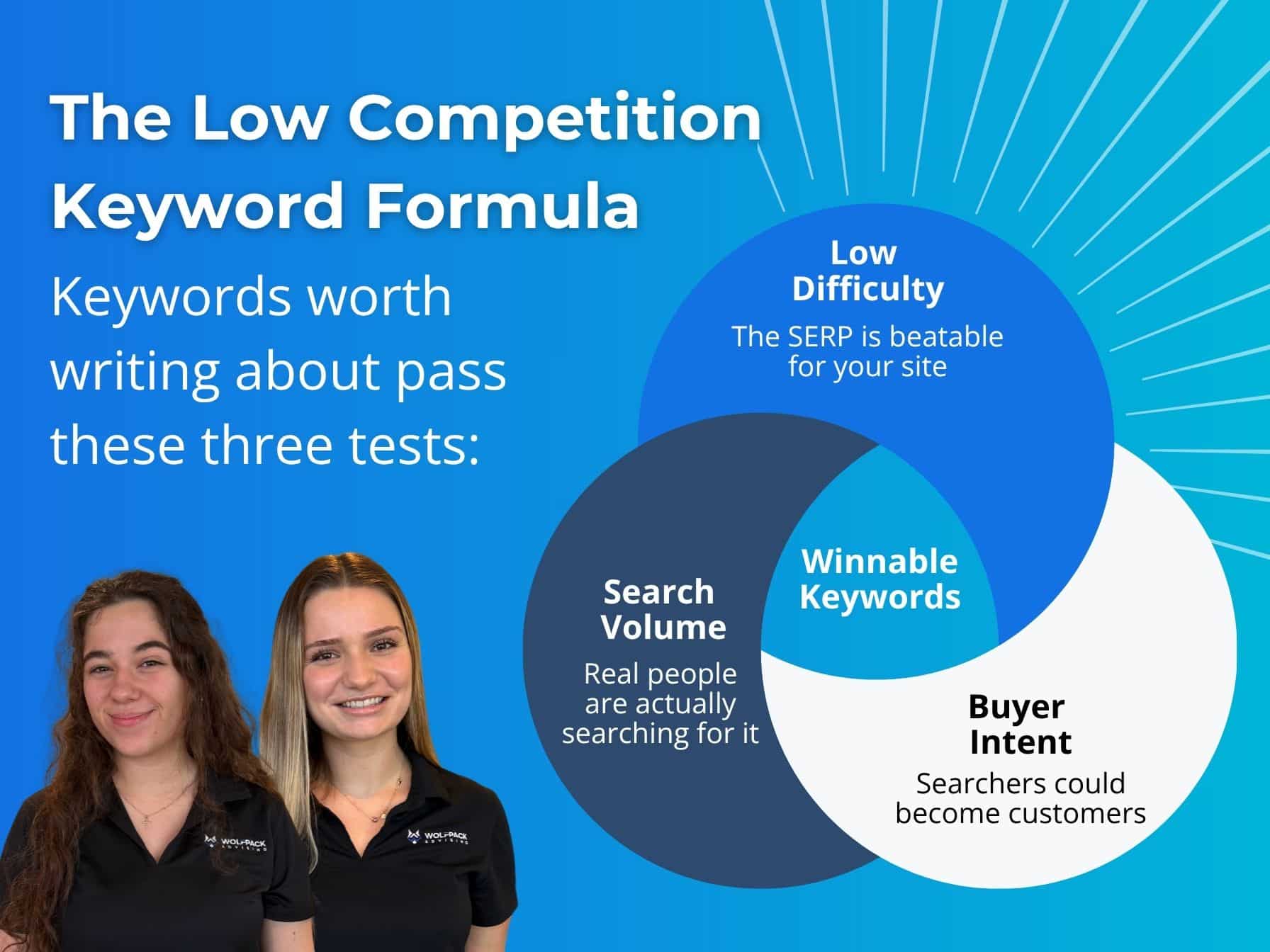
The businesses that win at SEO learn to filter for three things at once. Low competition. Real search volume. Buyer intent. Miss any one of those and the work does not pay off.
How to Find Low Competition Keywords in 5 Steps
The keyword research process below works whether you are a home service pro, a local shop, or a marketer managing multiple clients. It does not require expensive software, though paid tools do make it faster.
Start With Questions Your Customers Actually Ask
Before you open a keyword tool, open your own inbox.
The best keywords come from real conversations, not software. Your customers are already telling you what they want to know. You just have to listen in the right places.
Look at these sources for seed keywords:
- Sales call notes and voicemails
- Support emails and live chat transcripts
- Questions people leave on your Google Business Profile
- Comments on your social media posts
- Reddit threads and Facebook groups in your industry
For example, a roofer who takes 10 calls a week might hear “does insurance cover a roof replacement after a hailstorm” over and over. That exact phrase is a keyword. It is specific, it has intent, and most big SEO sites are not writing about it.
Write down every question you hear three or more times. That list becomes the foundation for your keyword analysis.
Check Search Volume Without Getting Tricked by Big Numbers
Once you have a list of questions, it is time to see how many people are actually searching them.
Free keyword research tools that work:
- Google Keyword Planner gives you volume ranges and keyword ideas straight from the source
- Google Search Console shows keywords your site already gets impressions for
- Ubersuggest offers basic search volume and keyword difficulty scores with a free tier
- Semrush’s Keyword Magic Tool expands a single seed term into hundreds of related variations (paid, but powerful)
Here is the mindset shift most people need. Do not chase high volume keywords. For a local or small business, a keyword with 30 to 300 monthly searches is often the sweet spot. High enough to matter. Low enough that the big players usually ignore it.
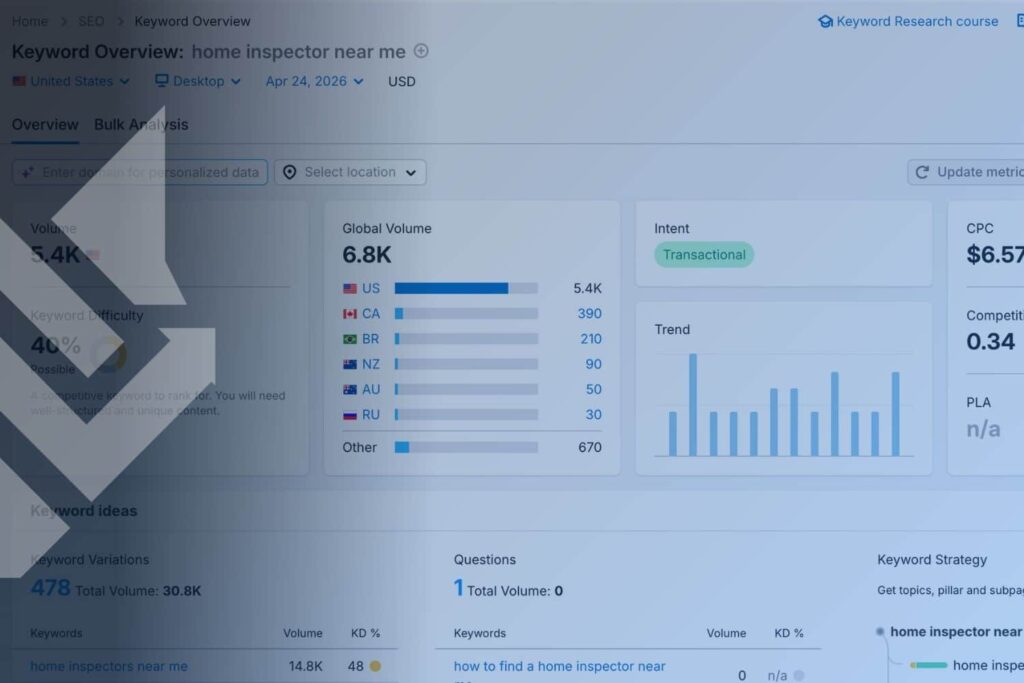
To make this real, the phrase “how to find low competition keywords” itself gets about 260 searches per month with low competition difficulty, according to WolfPack’s keyword research. That is exactly the range you want to target as a small business. Good search volume, winnable difficulty.
Judge Real Competition by Looking at the SERP
This is the step most guides skip, and it is the one that separates keywords you can rank for from keywords you cannot.
After you find a promising phrase, open Google and actually look at the first page of search results. You are looking for weak signals that tell you competitors rank there with beatable content.
Weak signals to watch for:
- Reddit, Quora, or forum threads in the top 10
- Articles that are four or more years old
- Thin pages with short, surface-level content
- No local businesses ranking for a local search
- Pages that do not clearly match search intent
If you see three or four of those on page one, you have found a keyword worth pursuing. If every result is from a huge authority site with deep, recent content, move on. Keyword difficulty scores from tools are helpful, but the SERP itself is the final judge.
Prioritize Long Tail and Question Based Phrases
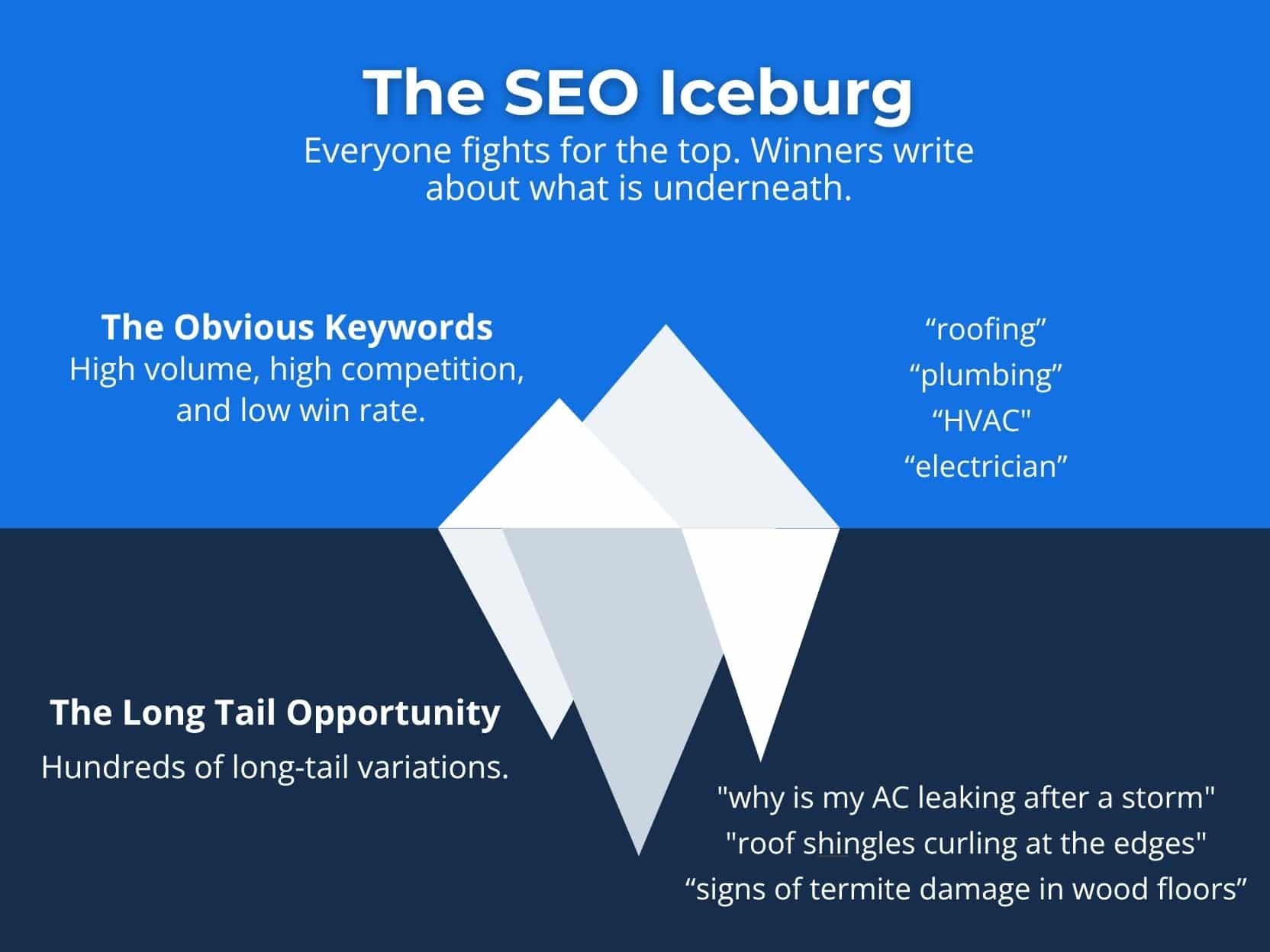
Short keywords are crowded. Long tail keywords are winnable.
A phrase like “plumber” has millions of pages fighting for the top spot. A phrase like “why is my kitchen sink gurgling when the washer runs” has far fewer. It also tells you exactly what the searcher needs, which makes writing SEO friendly content much easier.
Long tail keywords tend to have four to seven words and usually include a question word like how, why, what, or when. Because they are so specific, they often carry strong buyer intent. Someone searching a long, detailed question is usually closer to hiring than someone typing a single word. These related searches also tend to cluster together, so one post can pick up traffic from several related keywords at once.
Match Each Keyword to the Right Page Type
Finding the keyword is only half the job. Putting it on the wrong type of page wastes the whole effort.
A quick way to think about it:
- Transactional keywords like “emergency plumber near me” belong on service pages
- Informational keywords like “why is my water heater making noise” belong on blog posts
- Navigational keywords like your brand name belong on your homepage
Mixing these up is one of the most common SEO mistakes. If you want a deeper walkthrough on structuring a site for this, WolfPack’s guide on getting started with SEO for a new website covers it in detail.
Free and Paid Tools That Help You Find Them Faster
You can do all of this manually, but the right keyword tool cuts the time in half. Here are the best keyword tools our team actually uses, broken down by budget.
| Tool | Free or Paid | Best For |
|---|---|---|
| Google Keyword Planner | Free tool | Real search volume data from Google itself |
| Google Search Console | Free | Keywords you already rank for on page 2 |
| Ubersuggest | Freemium | Beginner-friendly keyword difficulty scores |
| AnswerThePublic | Freemium | Question-based long tail keyword ideas |
| Semrush or Ahrefs | Paid | Competitor gap analysis and keyword magic tool access |
If you are just starting out, the free stack is enough to save money while you build momentum. Combine Google Keyword Planner for volume, Search Console for keywords you already almost rank for, and manual SERP review for competition checks. That covers about 80 percent of what the paid keyword analysis tools do.
If you are managing SEO for several clients or want to move faster, a paid tool like Semrush pays for itself quickly. Our team uses a combination of both every day to build keyword lists for SEO clients.
The Mistake Most Businesses Make With Low Competition Keywords
The biggest mistake is targeting low competition keywords that are easy to rank for but have zero buyer intent.
Here is a classic example. A pest control company in Phoenix publishes a blog post called “10 Amazing Facts About Ants.” It ranks. Thousands of people search and visit. Almost none of them are homeowners with an ant problem. Most are students, kids doing homework, or curious readers from across the country.
The organic traffic looks great on a report. The phone does not ring.
Less competition only matters if the keyword also matches what your customers search when they are ready to spend money or learn something that leads to spending money. Before you commit to writing a post, ask yourself one question. Would a paying customer realistically type this search term into Google?
If the answer is no, skip it. For more on how traffic reports can mislead you, check out our breakdown of SEO performance trends and common data misconceptions.
A Real Example From a Home Services Business
Let’s make this concrete. Imagine a roofing company in Tampa that wants more leads from their website.
The wrong approach:
They target the keyword “roofing.” It gets tens of thousands of searches a month. Keyword difficulty is around 85. Their domain authority is 22. They write a 2,000 word post. Six months later, they rank on page 11.
The right approach:
They target “metal roofing vs asphalt shingles” It gets roughly 590 searches a month. Keyword difficulty is around 8%. The top results are a mix of outdated contractor blogs and one forum post. They write a helpful post with photos, insurance tips, and a clear call to schedule a free inspection.
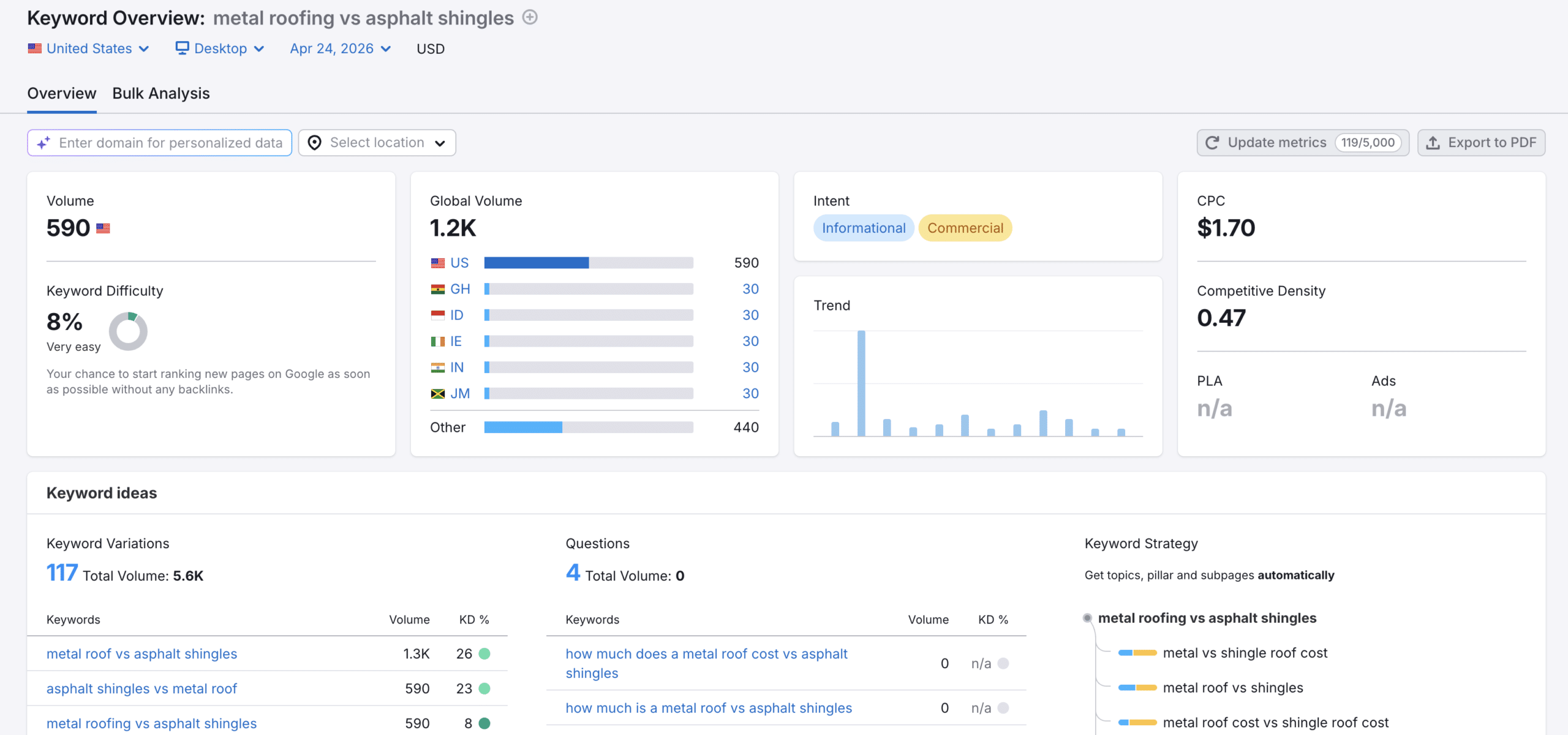
Three months later, they rank in the top three. The post brings in 50 to 70 visitors a month. About 5 percent request an inspection. That is two to three new leads per month from a single blog post, without needing huge backlinks to compete.
This is how smaller websites compete against the big national sites. Not by fighting for the same words. By finding the ones the big sites never bother to cover.
How Often Should You Refresh Your Keyword List
At a minimum, every 90 days.
Search trends shift constantly. New keywords pop up as products, laws, and seasons change. A keyword that was competitive last year might be winnable today, and the reverse is also true.
For home service businesses, seasonality matters even more. “Frozen pipe repair” spikes in January. “AC not cooling” spikes in July. “Roof leak after a storm” spikes in hurricane season. Review your list every quarter and adjust based on what your customers are actually searching in that moment.
A quick refresh process that works:
- Open Google Search Console and look at the “Queries” report
- Sort by impressions with a low click-through rate
- Those are pages ranking on page 2 that just need a nudge
- Add any new questions from your sales and support team
- Re-check the SERP for each target to confirm the competition is still weak
Fifteen minutes a quarter. That is the whole job.
Related Questions
What Is Considered a Low Competition Keyword?
A low competitive keyword usually has a keyword difficulty score under 30 on most SEO tools, though the number varies by platform. Beyond the score, the real test is the SERP itself. If page one includes forum posts, older articles, or thin content, the keyword is beatable regardless of what the tool says.
How Do I Find Low Competition Keywords for Free?
Start with Google Keyword Planner for search volume, then use Google Search Console to see what your site already shows up for. Add AnswerThePublic for question-based ideas, and finish by manually reviewing the top 10 results on Google for any keyword you are considering. Those four steps cost nothing and cover most of what paid tools offer.
Can I Rank for Low Competition Keywords Without Backlinks?
Usually, yes. If the content matches search intent, the page loads quickly, and your site has basic technical health, you can rank for low competition keywords without any backlinks. Backlinks help for competitive terms, but for long tail keywords and niche phrases, good content is often enough on its own.
What Is the Difference Between Low Competition and Low Volume?
Low competition means few strong websites are targeting the keyword. Low volume means few people search it. A keyword can be one without the other. The best keywords are low competition with meaningful search volume. Plenty of low volume keywords are also low competition, but if no one is searching, ranking first still brings zero traffic.
How Long Does It Take to Rank for a Low Competition Keyword?
For a newer site, expect two to six months after publishing. For an established site with some authority, it can happen in a few weeks. A realistic SEO timeline depends on your domain age, how well the content matches intent, and how quickly Google indexes the page.
Turn Keyword Research Into Real Leads
Finding low competition keywords is one of the highest-leverage skills in SEO. It is also one of the most overlooked. Most businesses are so focused on big, obvious keywords that they miss the smaller ones where they could easily win.
The good news is that this is a skill, not a secret. Once you get the hang of listening to your customers, checking volume, reading the SERP, and matching keywords to the right page, it becomes second nature. Fifteen minutes of keyword analysis before writing a post can be the difference between a page that gets ignored and a page that brings in leads for years.
Of course, not every business has the time to build this skill in-house, and that is where working with an SEO partner pays off. A good team already has the tools, the processes, and the hours of SERP analysis built into their workflow, so the opportunities get surfaced and acted on without pulling you away from running your business.
That is exactly what we do at WolfPack. Our SEO and AEO services are built around real keyword research, share-of-voice tracking, and ROI reporting that ties every organic lead back to revenue, so you always know what is working and where the next win is hiding.
If you want help finding the low competition keywords that matter most in your specific market, we do this every day for home service pros and local businesses across the country. Schedule a free, no-obligation strategy session and we will show you exactly where the opportunities are hiding in your industry.