
Last updated on March 19th, 2026 at 10:46 am
You hit send. You waited. Nothing. Frustrating. But how do you follow up on an email that got no response without seeming pushy or spammy?
It happens to everyone. But here is the thing that most businesses do not realize… a silent inbox does not always mean a dead lead. It usually just means the timing, messaging, or CTA were off.
Your response to this post-send silence can make or break the performance of your future attempts. Here’s why all of this matters, what to know, and what to do.
Click Here to Jump to a Simple Follow-Up Framework
Contents
Follow-Up Emails Matter More Than You Might Think
Most people send one email and move on. That is a costly habit.
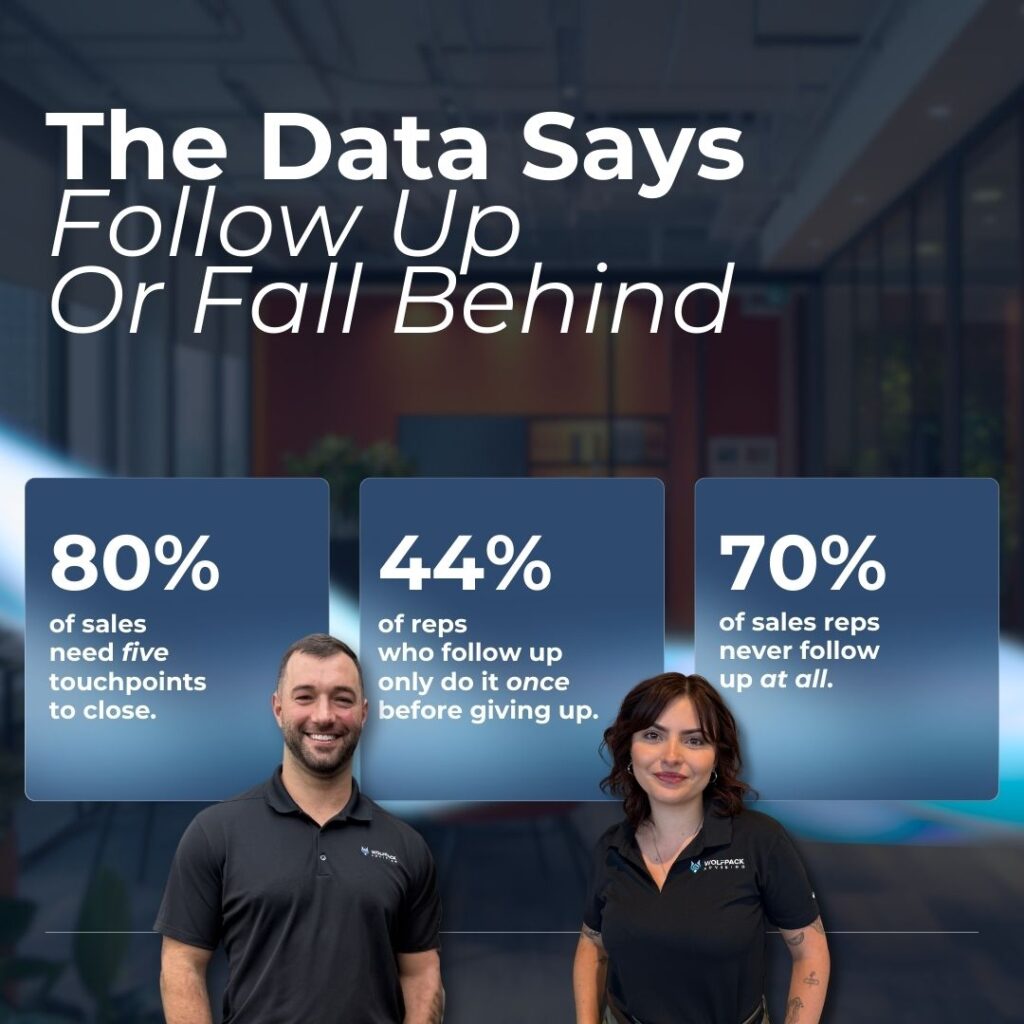
Industry data shows that 80% of sales require at least five follow-ups to close a deal, yet 44% of sales reps follow up with a prospect only once before giving up. That gap is where leads die (not because they were not interested, but because the follow-up never came).
If you are sending one email and calling it done, you are likely walking away from the majority of your potential conversions before the conversation even gets started.
And you are not alone… the same research shows that a staggering 70% of sales reps give up after their first email goes unanswered.
A smart, consistent follow-up strategy is one of the fastest ways to stand out and capture the leads others are letting slip.
Why Do Marketing Emails Go Unanswered?
Most unanswered emails have nothing to do with your offer being wrong or the recipient being uninterested. The most common reasons are timing, inbox overload, a weak subject line, a vague CTA, and sending to the wrong segment.
A closer look at each of these issues:
- Timing: You sent on a Friday afternoon or Monday morning when inboxes are at peak chaos. Tuesday through Thursday before noon tends to perform better for most audiences.
- Inbox overload: Has to do with your timing as well. Your email arrived alongside 80 others and did not stand out enough to earn an immediate open. It got buried and forgotten. Doing your best to learn your audience‘s inbox habits can help avoid this.
- Weak subject line: If the subject line does not give the reader a clear reason to open, they will not. Vague subject lines like “Checking in” or “Quick question” are easy to skip.
- Vague CTA: If your email ends with “let me know if you have any questions,” you are not asking for anything specific. Give the reader one clear, low-friction action to take.
- Wrong segment: A great email sent to the wrong person will always feel irrelevant and underperform. Sending the same message to a cold lead and a warm referral is a common mistake that hurts response rates across the board.
If you are not sure which of these is costing you replies, start by checking your open rate in your email platform. Low opens usually point to a subject line or timing issue. Healthy opens with low replies usually point to the message itself.
How Long Do You Wait Before Following Up?
The general rule: follow up within 2 to 3 business days of your original email.
Wait much longer, and your message loses context. Delaying a follow-up too much can cause a dramatic decline in the number of replies you get.
On the flip side, following up the same day often feels pushy and backfires. Waiting three days max before sending a follow-up can increase reply rates by as much as 31%.
Here is a quick guideline by scenario:
| Scenario | Suggested Wait Time |
| Cold outreach | 2 to 3 business days |
| Warm lead (has engaged before) | 1 to 2 business days |
| Post-event or CE class contact | 24 to 48 hours while it is fresh |
| Existing customer or past client | 3 to 5 business days |
Beyond timing, sequence structure matters. A three-touch approach spread across roughly ten days captures the large majority of replies you are likely to get. After that window, each additional touchpoint produces sharply diminishing returns.
A steady, spaced-out cadence signals professionalism and keeps your message feeling relevant rather than desperate.
It is also worth considering the channel. If someone is not responding after a couple of email touches, a brief LinkedIn connection or a quick phone call can break through where email alone has not.
How to Follow Up on a Marketing Email That Got No Response
A strong follow-up email does three things: it acknowledges the original message briefly, adds something new, and makes it easy to respond.
Here is a simple framework:
1. Reference the original lightly: One sentence reminding them of the context is enough. Do not re-paste your first email or guilt-trip the recipient for not responding.
2. Add new value: This is the most important part. Give them a reason to engage now that they did not have before. A helpful resource, a relevant insight, an updated offer, or a fresh angle all work here.
3. Keep it short: Research shows emails in the 50 to 150 word range tend to get the best response rates. A follow-up is a nudge, not a full pitch.
4. One clear CTA: Ask for one thing only: a reply, a quick call, or a click.
What NOT to do: do not open with “Just following up” (it signals you have nothing new to say), do not resend your original email word for word, and avoid guilt-tripping phrases like “I never heard back from you,” which can be considered a spam trigger.
How Many Follow-Up Emails Should You Send?
For most marketing email sequences, three to five touchpoints is the sweet spot. That’s whether you are following up on a new lead, a quote you sent, or someone you met at an event.
Sending four or more emails in a sequence can more than triple unsubscribe and spam complaint rates. More emails do not mean more results. It usually means more unsubscribes.
For home service businesses, your audience (homeowners, real estate agents, and local service buyers) tends to make decisions faster than corporate buyers. You do not need a 10-email sequence. You need the right four emails at the right time.
Here’s a simple framework:
- Email 1: Your original outreach
- Email 2: (Day 3): A short check-in that adds a new value point or context
- Email 3: (Day 7): Something useful (a resource, tip, or relevant article)
- Email 4: (Day 14): Your final touch (this is your “break-up email”… more on those below)
This works whether you are nurturing a new lead, following up on an estimate, or reconnecting with someone who went quiet. The goal is the same: stay on their radar without wearing out your welcome.
What to Say in Each Type of Follow-Up Email
Here is how to approach each touchpoint without sounding like a broken record.
Touch 2: The Soft Check-In
Short and low-pressure. Acknowledge that they are busy, restate the value in one line, and ask a simple yes or no question to lower the barrier to responding.
“Hey [Name], just wanted to circle back with you. If a reliable [pest control, inspection, etc.] partner is still on your radar, I’d love to connect. Here’s a link for a free quote.”
Touch 3: The Value-Add
Bring something new. A recent blog post, a useful stat, a relevant case study, or a timely tip. This one should feel helpful, not salesy.
“Wanted to share something quick. We recently put together this [resource on relevant topic] that a lot of agents have found really useful. Happy to send it over if it would be helpful.”
Touch 4 to 5: The Last Chance
Be direct. Let them know this will be your last outreach for now, keep the door open, and keep it brief.
“I don’t want to keep filling your inbox, so this will be my last note for a while. If the timing ever changes, we would love to reconnect. Wishing you a great season either way!”
How to Automate Your Follow-Up With AI and Drip Campaigns
The biggest reason most businesses do not follow up consistently is not laziness. It is time.
Manual follow-up does not scale. When you are running a home service business and managing a team, operations, and sales all at once, tracking down every unresponsive lead is not realistic.
That is where advantages like automation and AI agents change the game.
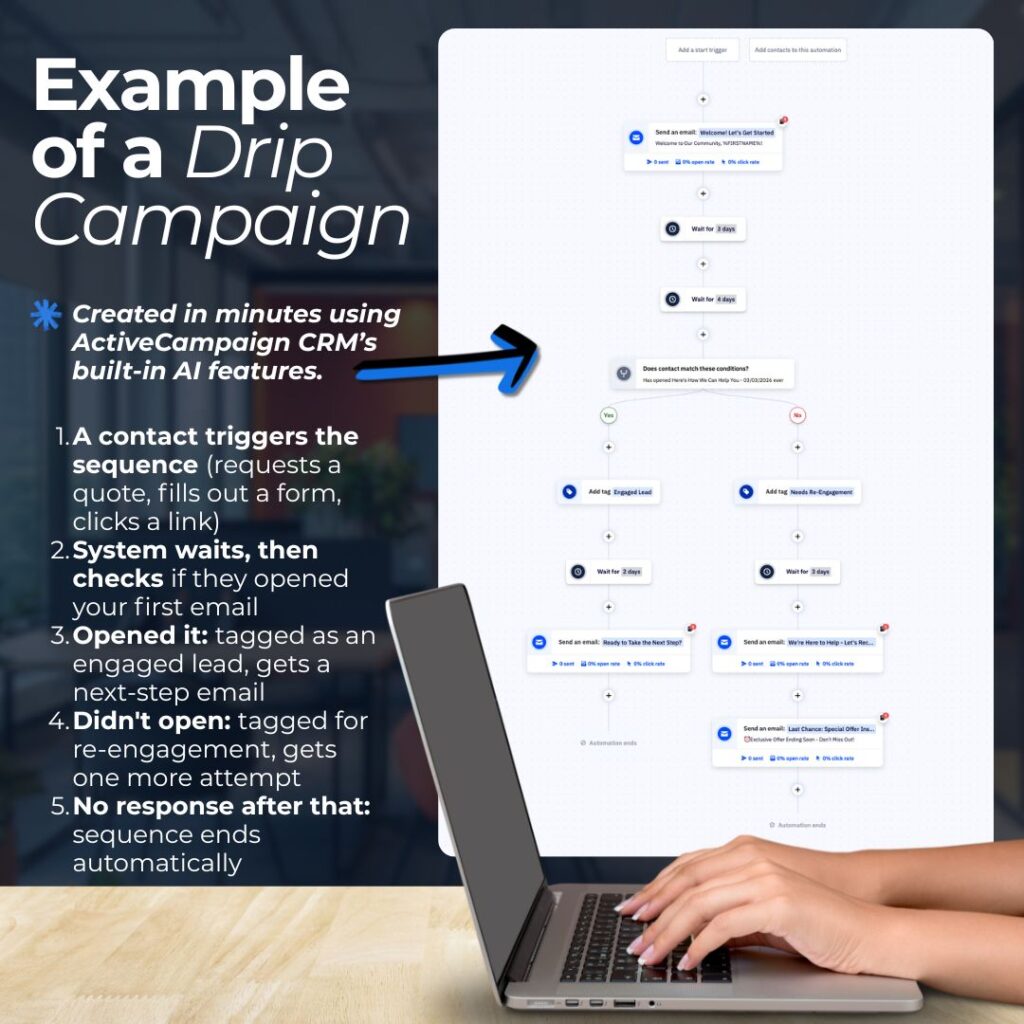
- Trigger-based automation fires a follow-up sequence automatically when a contact meets a certain condition: filling out a form, clicking a link, or not opening an email after a set number of days.
- Behavior-based branching takes it further. If someone opens your email but does not click, they get a different follow-up than someone who never opened it at all.
- The right message goes to the right person based on what they actually did (not a one-size-fits-all cadence).
- AI agents can now handle even more of this intelligently. They monitor engagement signals, personalize message content, adjust send times based on when individual contacts are most likely to open, and flag high-intent leads for priority outreach (all without manual input).
- This is what turns a CRM from a contact list into a follow-up engine that runs on its own.
What is a Drip Campaign?
A drip campaign is a pre-built series of emails sent on a set schedule or based on specific triggers.
For home service businesses, common use cases include new lead nurture, post-event follow-up (CE classes, conferences, trade shows), real estate agent relationship building, and seasonal reactivation campaigns.
The goal is to stay top of mind with the right people at the right time, without you having to remember to do it manually. Platforms like ActiveCampaign and HubSpot make it possible to build these sequences with conditional logic, so your follow-up responds to what each contact is actually doing.
When to Send a Break-Up Email
A break-up email is exactly what it sounds like: a short, final message letting a contact know you will not be reaching out again (at least for now).
It works because people respond to finality. When someone realizes this is the last time they will hear from you, they are more likely to take action than they were during any of the previous emails. Send one after three to four ignored follow-ups with no engagement.
A good break-up email is three to five sentences, warm without being passive-aggressive, and leaves the door open without propping it open.
“Hey [Name], I totally understand if the timing’s not right. If anything changes and you need [an inspector, an agent, pest control services, etc.], we are always here. Wishing you the best either way.”
Done right, it often generates a stronger response than the touchpoints that came before it. At a minimum, it closes the loop professionally and protects your sender reputation.
When to Stop Following Up on a Lead
There is a difference between persistence and noise.
If a contact has made it through your full follow-up sequence (including the break-up email) with zero engagement, it is time to disqualify them. Not every lead is going to convert, and holding on to contacts who have gone completely dark does more harm than good.
Clear signals that a contact should be disqualified as leads or just removed from your list:
- They have unsubscribed or asked to be removed
- Multiple emails have bounced (bad or outdated contact info)
- They have replied with a firm no
- There has been zero engagement across five or more touchpoints over a 30-day window
At that point, continuing to reach out can hurt your email deliverability and sender reputation, which affects every campaign you send going forward.
In your CRM, disqualified contacts should be marked accordingly so they do not re-enter active automations and your reporting stays clean. Depending on your setup, some may be fully deleted while others are moved to a suppression list for compliance purposes.
If a contact has gone cold but you are not ready to fully disqualify them, a re-engagement campaign (a single email asking if they still want to hear from you) is a clean way to test the waters first.
Related Questions
What is a drip campaign, and how does it work?
A drip campaign is an automated series of emails sent based on a trigger or schedule. Instead of manually following up with every lead, the system sends the right message at the right time based on where that person is in the funnel.
How can AI agents help automate email follow-up?
AI agents can monitor contact behavior, personalize follow-up content, adjust send timing, and flag high-intent leads for priority outreach (all without manual input). They are giving home service businesses the kind of follow-up capability that used to require a dedicated sales team.
How do home service businesses use email marketing to generate leads?
The most effective approach combines a lead capture strategy (forms, landing pages, events) with an automated nurture sequence that keeps new contacts engaged over time. Email works especially well for real estate agent outreach, seasonal promotions, and post-service follow-up designed to drive referrals and repeat bookings.
When should you remove someone from your email list?
Remove or disqualify contacts who have unsubscribed, repeatedly bounced, or shown zero engagement over 60 to 90 days. Regular list cleaning keeps your deliverability healthy and ensures your metrics reflect how your active audience is actually engaging.
Check out a case study on WolfPack Email Marketing:
Conclusion
The fortune really is in the follow-up. Most businesses already have the leads they need. They are just not doing enough to recover them.
A structured follow-up strategy does not require more hours in your day. It requires a smarter system: the right message, at the right time, delivered automatically to the right person.
From your first check-in to your final break-up email, every touchpoint is a chance to turn silence into a conversation.
If you are ready to stop letting leads go cold and start building a follow-up system that works while you focus on everything else, book a chat with the expert team at WolfPack.