Last updated on June 23rd, 2026 at 01:40 pm
Google algorithm changes happen thousands of times every year. Most are too small to notice. However, a handful of them are large enough to flip rankings overnight and send a business’s organic traffic into a sharp decline.
The good news? You do not need to predict every update. Instead, you just need to build the kind of website and content strategy that holds up no matter what Google changes next.
This guide breaks down what Google algorithm changes actually are, why they keep happening, and what you can do right now to protect your rankings and keep your business visible.
What Are Google Algorithm Changes?
Google algorithm changes are updates to the system Google uses to decide which websites rank for which search terms.
Think of Google’s algorithm as a massive scoring system. It looks at hundreds of signals on your website and across the web to decide how relevant, trustworthy, and useful your content is for any given search. When Google updates that scoring system, rankings shift.
Some updates are small and barely noticeable. Others, however, are broad enough to change rankings for millions of websites at once.
The Difference Between Core Updates, Spam Updates, and Minor Changes
Not all Google algorithm changes are created equal. Here is a simple breakdown:
| Update Type | How Often | Scope | Typical Impact |
|---|---|---|---|
| Core Update | 3 to 4 times per year | Broad, affects all sites | High — ranking swings can be significant |
| Spam Update | 1 to 3 times per year | Targets manipulative practices | High for sites violating spam policies |
| Minor/Unconfirmed Updates | Daily to weekly | Narrow, often specific signals | Low to moderate — usually small shifts |
Core updates are the ones that get the most attention. They are broad changes to how Google evaluates content quality and relevance across the entire web. Spam updates, on the other hand, target specific tactics that violate Google’s policies, like fake links or low-quality AI-generated content at scale. Minor updates happen constantly in the background and are rarely announced.
How Often Does Google Update Its Algorithm?
Google makes thousands of algorithm changes every year. In fact, the company only publicly confirms the larger, more impactful ones.
Google confirmed three core updates and one spam update in 2025. In 2024, the pace was even more aggressive, with four core updates, two spam updates, and a site reputation abuse update targeting parasite SEO tactics. Google has also signaled that more frequent core updates are the new normal going forward.
The takeaway: Google algorithm changes are not occasional events. They are a constant part of doing business online.
Why Google Algorithm Changes Keep Happening
Google’s stated mission is to deliver helpful, reliable results to searchers. As a result, every algorithm update is an attempt to get closer to that goal.
The open web is always changing. New content gets published every day. Some of it is genuinely useful. A lot of it, unfortunately, is not. Because of this, Google’s algorithm has to keep pace with that constantly shifting landscape.
Google’s Core Mission Drives Constant Refinement
According to Google’s own Search Central documentation, core updates are designed to ensure Google is delivering helpful and reliable results for searchers. The updates are broad in nature and do not target specific sites. Instead, they reassess how well the overall system is doing its job.
What that means in practice: if your website is already focused on being genuinely helpful to real people, core updates tend to work in your favor over time.
The Rise of AI Search Is Accelerating the Pace
Search behavior is changing fast. AI Overviews now appear at the top of many Google searches. Additionally, tools like ChatGPT, Perplexity, and Gemini answer questions directly without requiring a click. As a result, Google’s algorithm has to evolve alongside this shift.
This is where AEO (Answer Engine Optimization) comes in. AEO is the practice of structuring your content so AI-powered tools can find it, read it, and use it to answer a user’s question. Sites that are optimized for both traditional SEO and AEO are far better positioned to hold rankings as the search landscape continues to shift.
The Most Impactful Google Algorithm Changes in Recent History
Understanding where Google has been helps you understand where it is going. Here is a look at the updates that matter most.
The Helpful Content Era and What It Changed
In 2022, Google launched the Helpful Content Update. It introduced a sitewide signal that penalized websites where most of the content was created for search engines rather than real people. If a site was mostly thin, keyword-stuffed content with little real value, the whole site took a hit.
The March 2024 Core Update was a turning point. Google folded the Helpful Content System directly into its core algorithm. In other words, it is no longer a separate signal. Google baked it directly into how it evaluates every website, every update cycle.
The 2024 Core Updates and What They Targeted
Google released four confirmed core updates in 2024. Each one reinforced the same theme: reward content that genuinely helps people, and demote content that exists primarily to rank.
The March 2024 update was the biggest of the year, taking 45 days to fully roll out. That is the longest rollout in Google’s documented history. It combined a core algorithm update with new spam policies targeting scaled content abuse.
The August 2024 update, in particular, incorporated feedback from content creators who felt their improved sites still had not recovered from earlier updates. Google acknowledged this and adjusted accordingly.
What 2025 Core Updates Tell Us About Where Google Is Headed
Google released three core updates in 2025: March, June, and December. Google described each one as a regular update designed to surface relevant, satisfying content for searchers.
The pattern is clear. Google is not chasing new signals. Rather, it is continuing to sharpen its ability to tell the difference between content written for people and content written for rankings. Businesses that have always prioritized quality are consistently the ones that come out ahead.
How Google Algorithm Changes Affect Local and Home Service Businesses
For a home service business, a ranking drop is not just an analytics problem. It is a lead flow problem.
Why Local Service Businesses Feel Algorithm Shifts Differently
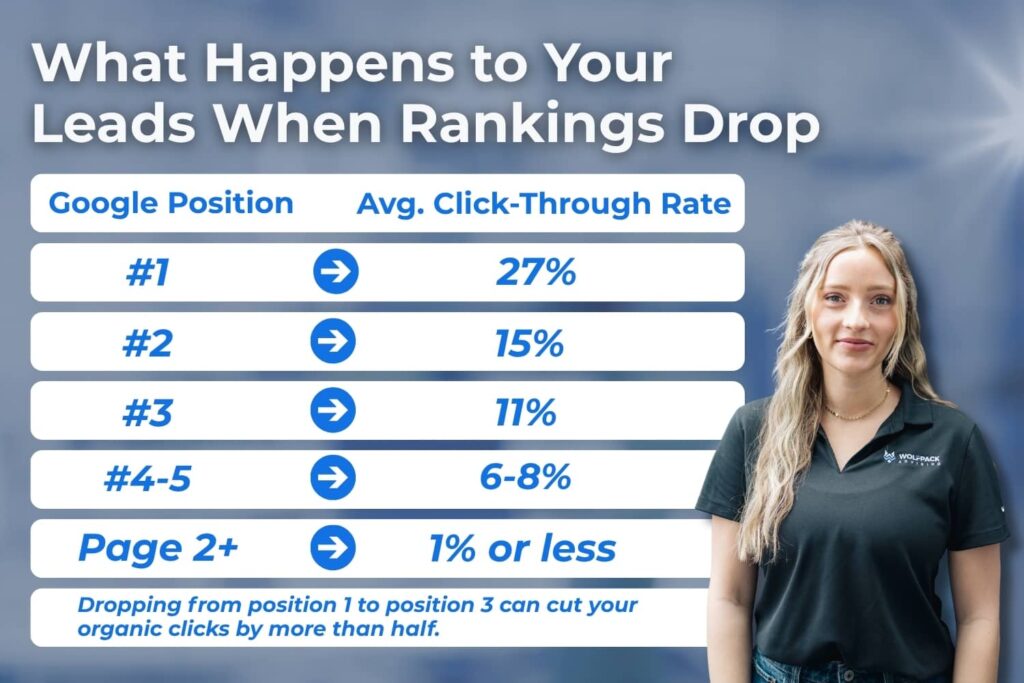
In local search, the stakes are concentrated. There are only so many spots in the Google Map Pack and the top organic results for any local search. Consequently, dropping even one or two positions means fewer impressions, fewer clicks, and fewer calls.
A national e-commerce brand might absorb a traffic drop across thousands of product pages. A local plumber or HVAC company running on a handful of service pages, however, feels the same kind of drop much more directly.
Local SEO Signals That Google Keeps Reinforcing
Across every major update cycle, certain local SEO signals have consistently held their value:
- A complete and accurate Google Business Profile
- A steady stream of genuine customer reviews
- Consistent name, address, and phone number (NAP) information across the web
- Dedicated service area pages with locally relevant content
- A fast, mobile-responsive website with clean technical structure
These are not workarounds or tactics. They are the fundamentals that Google has rewarded update after update.
What WolfPack’s Client Data Shows
One consistent finding in WolfPack’s own client data reinforces this point: responsive, properly structured websites built on a strong technical foundation pulled in more than twice the organic monthly traffic compared to sites that came in without those elements in place. In short, the technical foundation sets a ceiling on how far SEO efforts can take you.
How to Prepare Before a Google Algorithm Change Hits
The best time to prepare for a Google algorithm change is before it happens. Fortunately, there are clear steps you can take right now.
Build on Content Quality, Not Tricks
This is the most straightforward answer and the most important one. Content written to genuinely help real people with real questions has consistently held up or improved after major core updates. Content written to game rankings, on the other hand, consistently loses ground.
Ask yourself: if Google did not exist, would this content still be worth publishing? If the answer is yes, you are on solid ground.
Make Sure Your Technical Foundation Is Solid
Core Web Vitals, mobile responsiveness, page speed, and clean site architecture are not optional features. They are the floor that every other SEO effort builds on.
Google’s mobile-first indexing means the mobile version of your site determines how you rank across all devices. As a result, a slow or broken mobile experience puts a ceiling on your rankings before you even think about content.
Practical steps worth checking regularly:
- Run your site through Google’s PageSpeed Insights and address any failing Core Web Vitals scores
- Check your mobile usability report in Google Search Console
- Make sure your heading structure is clean with one H1 per page and logical H2 and H3 labels throughout
- Confirm your schema markup is in place so search engines and AI tools understand who you are and what you do
Diversify Your Traffic So No Single Update Can Break You
A business that depends entirely on organic search is one core update away from a revenue problem. That is why traffic diversification matters so much.
Email marketing, social media, and paid ads create traffic sources that Google algorithm changes cannot touch. When organic rankings fluctuate, a strong email list and an active social presence keep leads coming in. This is not just a good SEO strategy. It is a good business strategy.
How to Recover If a Google Algorithm Change Hurt Your Rankings
Ranking drops happen even to well-run businesses. Here is how to approach recovery the right way.
First, Confirm the Drop Is Actually From an Algorithm Update
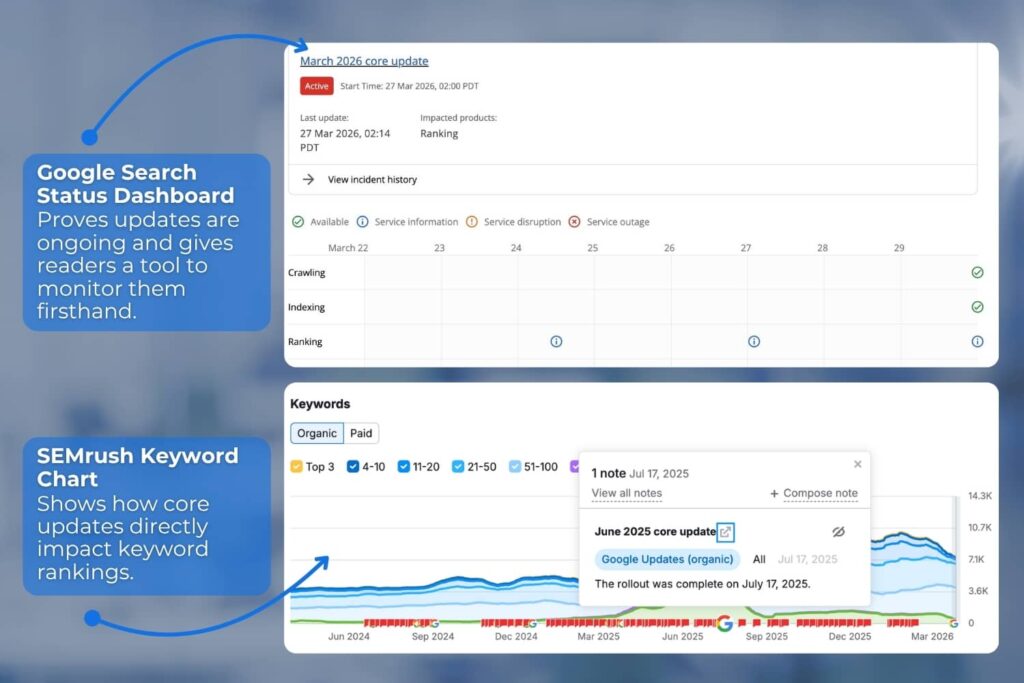
Not every traffic drop is algorithm-related. Before assuming the worst, open Google Search Console and check when the drop started. Then, cross-reference that date with confirmed algorithm update timelines from sources like Search Engine Journal or Google’s own Search Status Dashboard.
If the timing lines up, you are likely dealing with an update impact. If the drop started at a random time with no confirmed update nearby, you may instead be dealing with a technical issue, a ranking bug, or a competitor gaining ground.
Audit Your Content for Helpfulness and E-E-A-T Signals
E-E-A-T stands for Experience, Expertise, Authoritativeness, and Trustworthiness. It is the framework Google uses to evaluate whether content is credible and worth ranking.
When auditing your content after an update, look for:
- Pages that are thin or do not fully answer the question they target
- Content that lacks clear authorship or expertise signals
- Outdated information that no longer reflects current best practices
- Pages that exist to capture a keyword rather than genuinely serve the reader

Fix the weakest pages first. Then update them with real depth, accurate information, and clear signals of who created the content and why they are qualified to do so.
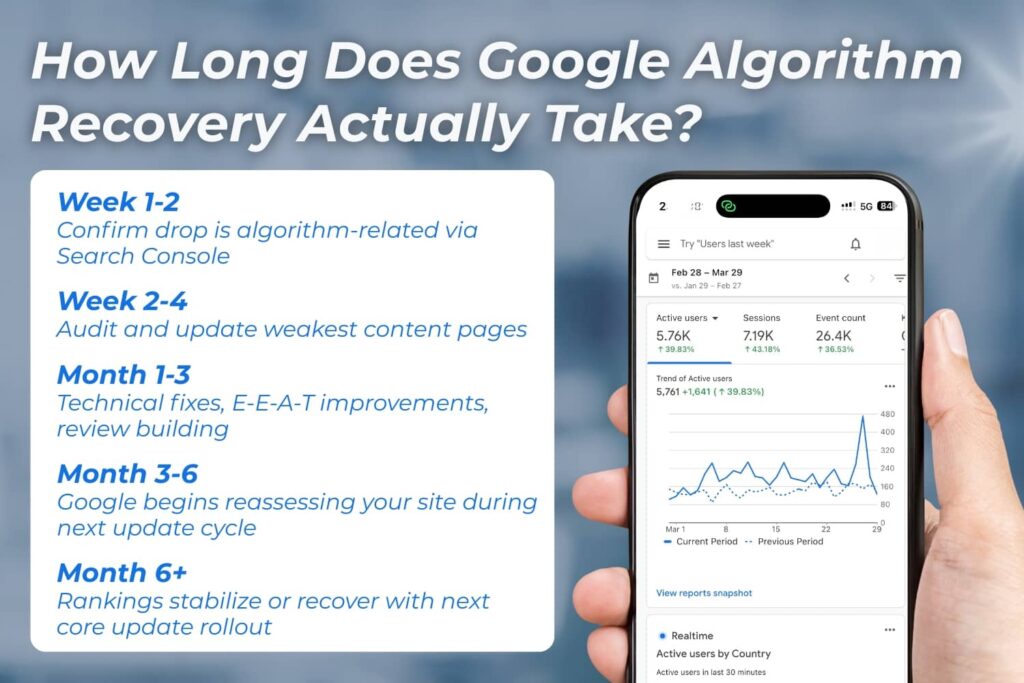
Recovery Takes Time. Here Is What That Looks Like
Google has confirmed that recovery from major updates, especially Helpful Content-related drops, can take multiple update cycles. There is no instant fix.
The path forward is consistent improvement. Strengthen your content, clean up your technical foundation, and keep building legitimate signals like reviews and backlinks. Google reassesses sites over time, and the improvements you make today can show up in rankings weeks or months from now.
What Actually Protects You From Google Algorithm Changes
Here is the honest answer: the businesses that weather every update are the ones that were never trying to game the system in the first place.
The Foundation Always Wins
Strong technical foundations, content written for real people, genuine customer reviews, and a diversified marketing strategy are not advanced tactics. They are the fundamentals that hold up across every update cycle.
For home service businesses specifically, that means investing in the whole picture. A fast, mobile-responsive website built for both SEO and AEO. Content that answers real customer questions. A review system that keeps social proof growing. And email and CRM automation that keep leads warm even when rankings fluctuate.
Not sure where your AEO stands right now? Run your site through WolfPack’s free AEO Grader Tool and find out in minutes.
Your Long-Term Strategy Is Your Best Defense
Google algorithm changes are not going to slow down. In fact, as AI search continues to grow, updates will likely come faster and carry more weight. Businesses that build for the long term, rather than chasing short-term ranking tricks, are the ones that consistently come out on top.
The right foundation makes every update something to monitor rather than something to fear.
Related Questions
What is a Google core update, and how does it affect my website?
A Google core update is a broad change to Google’s ranking algorithm that reassesses how content across the web is evaluated. Core updates do not target specific sites. Instead, they recalibrate how Google scores content quality and relevance overall. Your site may see ranking increases or decreases depending on how well it aligns with what the update rewards.
How do I know if my site was hit by a Google algorithm change?
Check Google Search Console for a drop in impressions or clicks and note when it started. Then cross-reference that date with confirmed algorithm update timelines. If the timing aligns with a known update, that is your likely cause.
How long does it take to recover from a Google algorithm update?
Recovery timelines vary. Minor ranking fluctuations can stabilize within days. Recovery from major core update impacts, particularly those tied to content quality signals, can take several months and may not show until a subsequent update rolls out.
Do Google algorithm changes affect local businesses differently?
Yes. Local businesses operate in a more concentrated search environment. As a result, ranking drops have a more direct and immediate impact on lead volume because fewer positions are competing for local search traffic.
What is the difference between a core update and a spam update?
A core update is a broad reassessment of how Google evaluates content quality and relevance across all sites. A spam update, on the other hand, specifically targets practices that violate Google’s spam policies, such as manipulative link schemes or scaled low-quality content.
Conclusion
Google algorithm changes are not slowing down. The businesses that stay ahead are the ones with the right foundation in place before the next update hits.
At WolfPack, we build and optimize websites for home service businesses that need to rank, convert, and stay competitive as search continues to evolve. From responsive web design and technical SEO to AEO, email marketing, and CRM automation, we give you the full-stack strategy that keeps your business visible no matter what Google changes next.
Book a call with our team today, and let’s build something Google can’t knock down.