

Last updated on June 23rd, 2026 at 01:40 pm
When it is done with a clear purpose, blogging does help SEO generate more leads for a business. However, many businesses blog only because they feel like they are supposed to.
They publish posts without a plan, without understanding how people search, and without thinking about how those readers eventually become customers.
When that happens, blogging turns into busywork instead of a growth tool. This post is your guide to blogging so that it actually supports SEO, where it fits in the buyer journey, and how it helps turn visibility into real leads.
Does Blogging Still Matter for SEO and Lead Generation?
Search engines need content to understand a business.
They cannot see your experience, your customer results, or your process unless you explain it clearly.
Blogging gives search engines the explanation needed to trust, rank, and reference your business.
Every blog post creates another opportunity to show up when someone searches a question related to your services. Many of those searches happen well before a person is ready to contact a company.
Blogging helps your business by:
- Expanding the number of searches you can appear for
- Explaining your services in a helpful, non-sales-focused way
- Letting potential customers educate themselves first
- Supporting longer and more thoughtful buying decisions
According to Google, over 15 percent of daily searches are completely new, meaning people are constantly asking questions in different ways. Blog content gives your site the opportunity to match those evolving queries.
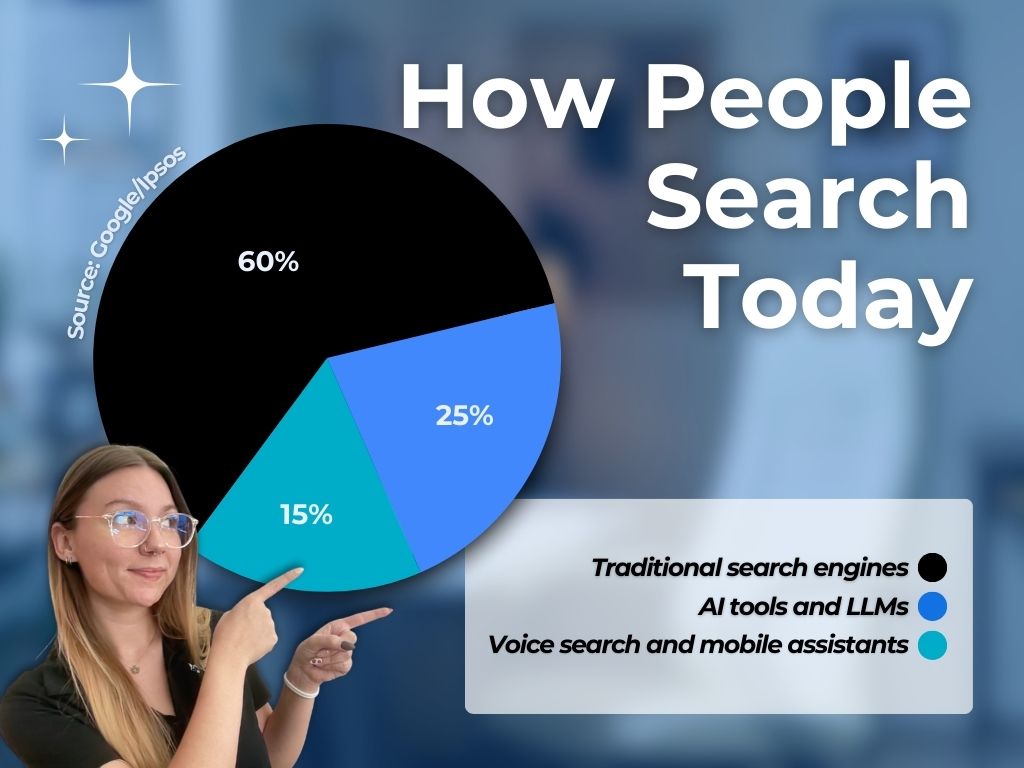
Blogging also supports how people search today, which means accounting for users of voice search, mobile assistants, and AI tools. Clear, educational blog content helps your business appear in all of those places.
How Search Engines and AI Tools Understand Blog Content
Search engines and AI tools both aim to answer questions, but they process content in different ways. Understanding both helps explain why blogging works across platforms.
How Search Engines Read Blog Content
Search engines scan blog content to determine what the page is about and when it should appear in results.
They look for signals like:
- Headings that match real questions
- Clear explanations written for humans
- Relevance to what someone searched
- Helpful connections to other pages on your site
Search engines reward content that makes it easy for users to find answers quickly.
Pages that avoid the point, overuse keywords, or try to sound overly technical often struggle.
How AI Answer Tools Use Blog Content
AI tools work differently. They are not ranking pages. They are generating answers.
People use AI tools for many types of intent, such as:
- Learning how something works
- Comparing options
- Exploring whether something is worth it
- Getting a quick explanation before deeper research
AI tools look for content they can understand, summarize, and explain clearly. Blog posts are ideal for this because they often break topics down step by step.
AI tools favor content that:
- Answers questions directly
- Stays focused on one topic
- Uses plain language
- Follows a logical structure
Businesses can appear in AI responses in different ways. Sometimes the AI summarizes your content to provide the user with an answer.
Other times, it references your site as a source or recommends visiting it for more details. In many cases, users click through to learn more.
When your blog explains a topic clearly, it becomes useful to people and AI tools across many different search and research scenarios.
Getting Your Blogs Referenced in AI Answers
While we’re on the topic of AI tools and your content, this is worth clearing up.
Answer Engine Optimization focuses on helping your content appear in AI-generated answers and recommendations.
You do not need a separate strategy for this. Strong modern blogging already supports it. Blogs perform well for AI visibility when they:
- Use natural language
- Explain topics step by step
- Answer questions directly
Answer-first formatting is especially important in your content. That means clearly responding to the main question in each section before expanding with details and examples.
You want AI tools to use your content for prompts like:
- Do I need a home inspection before buying a house?
- What does a termite inspection include?
- How do I know if I have a pest problem or just seasonal bugs?
- What repairs usually come up during a home inspection?
- Is pest control worth it for preventative treatment?
When your blog content clearly answers questions your audience has, AI tools can summarize your advice, reference your business, or recommend your site for readers who want more detail.
How People Decide to Hire a Service Business
Most people do not hire a service business right away. They go through a short decision process first. Before diving deeper into your content strategy, it helps to understand that process.
Most buyers will move through three basic stages:
| Buyer Stage | What They Are Doing |
| Learning | Trying to understand a problem |
| Considering | Comparing options or approaches |
| Deciding | Choosing who to contact |
In the learning stage, people are asking basic questions. They want to understand what is going on and what their options are.
In the considering stage, they compare solutions, approaches, or providers. They are narrowing their choices.
In the deciding stage, they are ready to contact someone.
Blogging plays its biggest role in the learning and considering stages. That is where people want explanations, clarity, and reassurance.
When your blog helps someone early, it builds familiarity and trust. By the time they are ready to decide, your business already feels like a safe option.
Blogging for Search Intent Instead of Just Keywords
Search intent means understanding why someone is searching, not just what words they type.
There are a few common types of search intent:
| Intent Type | What the Person Wants |
| Informational | To learn or understand |
| Comparative | To compare options |
| Transactional | To take action |
Blog posts are best suited for informational and comparative intent.
For example:
- “What does a home inspection include?” is informational.
- “Is quarterly pest control worth it?” is comparative, or commercial.
- “Best roofers near me” is transactional.
Good blogging focuses on intent by answering the question clearly, explaining the topic in simple terms, and avoiding aggressive selling.
This approach attracts readers who are genuinely interested in what you offer. Those readers are more likely to become strong leads later.
AI tools also rely heavily on intent. They analyze the meaning behind a question, not just the exact wording. Blogs that focus on intent tend to perform better in both search engines and AI responses.
How Does Blogging Improve Search Engine Visibility?
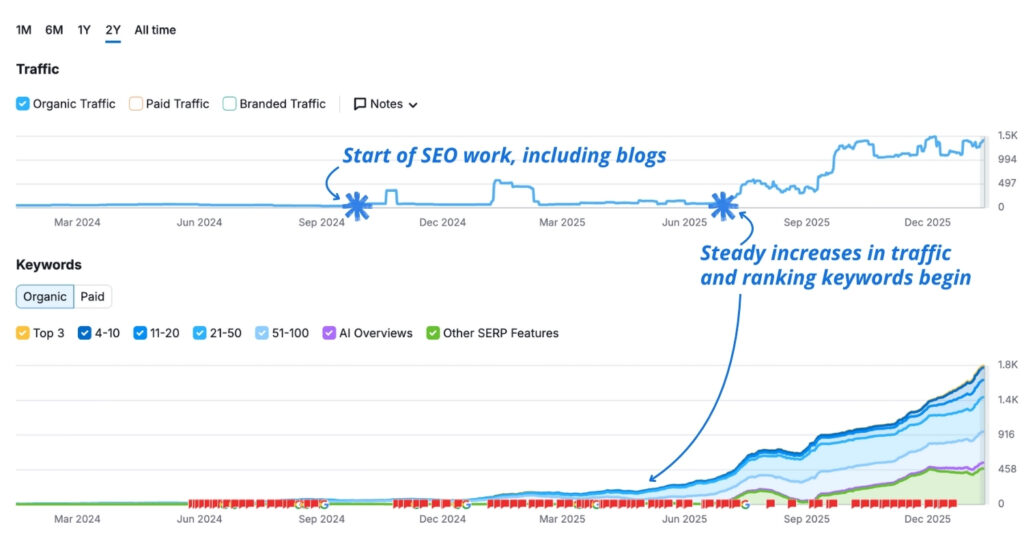
Blogging improves search engine visibility in very practical and measurable ways.
First, it increases the number of pages your website has that can appear in search results. Each blog post targets a different question, concern, or situation your audience may search for.
Second, blogs strengthen your service pages. When blog posts link naturally to service pages, they help search engines understand what those services are about and when they should appear.
Third, blogging allows you to show up for searches that your service pages should not target. Service pages are meant to convert. Blogs are meant to explain, educate, and prepare the reader.
Over time, blogging builds topical relevance. Your website becomes associated with the subjects you consistently write about, not just the services you sell.
Here is a simple way to understand how content types work together:
| Content Type | Main Purpose |
| Service pages | Convert leads |
| Blog posts | Educate and attract |
| Internal links | Connect and support |
When these elements support each other, your site becomes easier to find and easier to trust.
Choosing Blog Topics For Better Lead Gen
Choosing the right blog topics matters far more than how often you publish.
The goal is not to write about everything. The goal is to write about what your audience is already searching for and what connects directly to your services.
Keyword research helps you understand those searches. Tools like SEMrush and Ahrefs show you:
- Common search terms
- Related questions people ask
- Approximate search volume
- How competitive a topic is
A simple process for beginners to start with:
- Start with a service or problem you help solve
- Enter it into a keyword research tool
- Review related questions and variations
- Choose topics with a clear, helpful intent
You do not always need to chase the highest-volume keywords! More specific questions often bring fewer visitors but better leads.
How Blogging Fits Into an Integrated Marketing System
Blogging works best when it is part of a broader system, not a standalone task.
That system usually includes:
- Your website
- Search visibility
- Email communication
- Social content
Blogs support all of these channels. One well-written blog post can:
- Rank in search results
- Be shared on social media
- Be included in email campaigns
- Support sales conversations
Most businesses do not need to blog every week. Consistency matters more than volume.
Planning blog content ahead of time and aligning it with other content helps ensure each post has a purpose. This approach turns blogging into a long-term asset instead of a constant obligation.
Blogging Mistakes That Limit Your Results
Many businesses blog but see little return. The issue is rarely effort. It is usually a lack of direction.
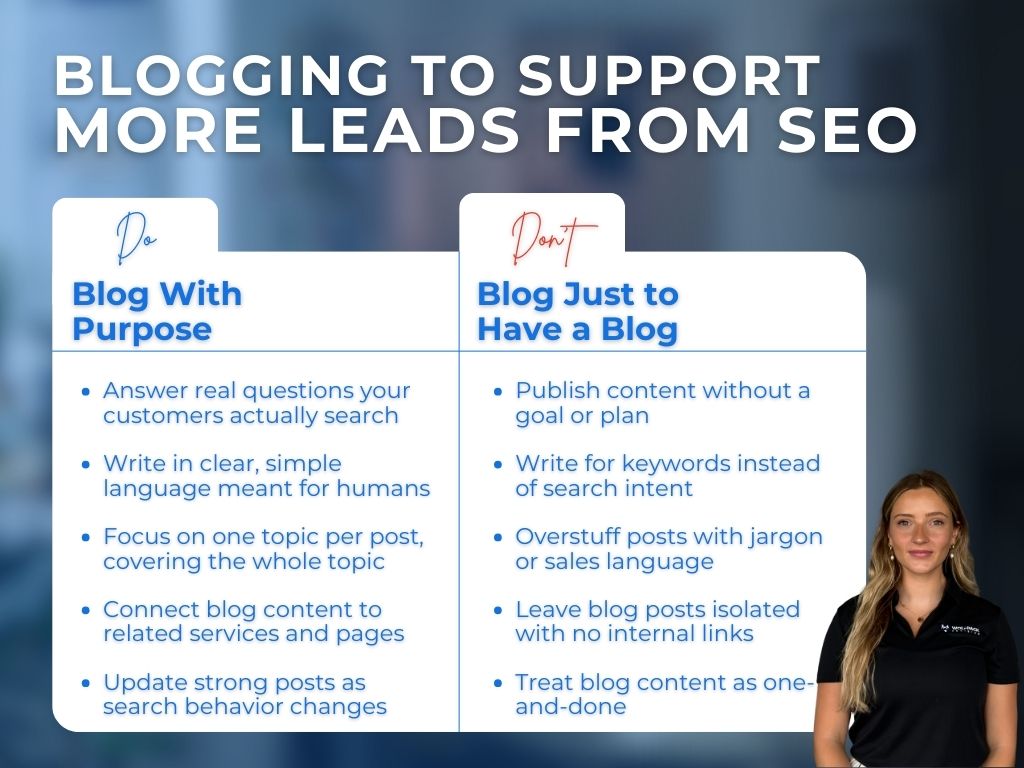
Common mistakes include:
- Writing without a clear goal: Blogs written just to “post something” often lack focus and do not help the reader take the next step.
- Every blog should have a purpose, whether that is answering a common question, explaining a service, or helping someone decide what to do next.
- Choosing topics unrelated to services: Topics that are only loosely connected to what you offer may bring traffic, but they rarely bring leads.
- Blog topics should naturally connect to your services so interested readers can easily see how you help.
- Publishing blogs without internal links: Blogs with no internal links often become dead ends. Readers get their answer and leave.
- Linking to related articles or service pages helps guide readers and shows search engines how your content fits together.
- Never updating older content: Treating blogs as one-time posts causes missed opportunities over time.
- Updating strong posts with clearer explanations, fresh examples, or better links often improves performance without creating new content.
According to HubSpot data, updating and republishing existing blog content can increase organic traffic by over 100 percent, showing that improving what you already have often delivers stronger SEO and lead results than publishing more new posts alone.
Related Questions
Does blogging still help SEO in 2026?
Yes. Blogging continues to support SEO by increasing visibility, building topical relevance, and supporting AI-driven search and research.
How many blog posts does it take to see SEO results?
There is no fixed number. Results depend on competition, topic quality, and consistency. Many businesses see early traction within three to six months when content is strategic.
What types of blog posts generate the most leads?
Posts that answer service-related questions, explain processes, and address common concerns tend to attract higher-quality leads.
Can AI-written blogs help SEO?
AI can assist with research and drafting, but human review is critical to ensure clarity, accuracy, and trust.
Should service businesses focus on blogs or service pages first?
Service pages convert leads. Blogs attract and prepare them. Blogging supports service pages rather than replacing them.
Conclusion
Blogging will help your SEO generate more leads when it is clear, intentional, and focused on real questions. If your blog is not driving results yet, blogging itself is not the problem.
The strategy behind it is. At WolfPack, we help service businesses turn blogging into a real lead-generating system, not just content on a page.
If you want help building or improving a blog strategy that actually supports SEO and leads, book a strategy call with WolfPack.
We’ll review what you have, identify opportunities, and create a plan built for growth.