
Local customers find small businesses that look trustworthy and close by. However, a bigger website does not do that on its own.
Most small business owners decide they cannot rank, and then they either stop working on it or pay for an expensive redesign. Unfortunately, both choices tend to make things worse. A site with no clear location signals gives Google nothing to work with, so it shows the competitor across town who gave it more to go on.
Instead, what actually works is a complete Google Business Profile, consistent business details across the web, service pages built for real towns, and steady reviews. As a Tampa-based digital marketing agency, we handle local SEO for home service companies across the country, and we see this same pattern in almost every account.
What Is Local Search Optimization for Small Business?
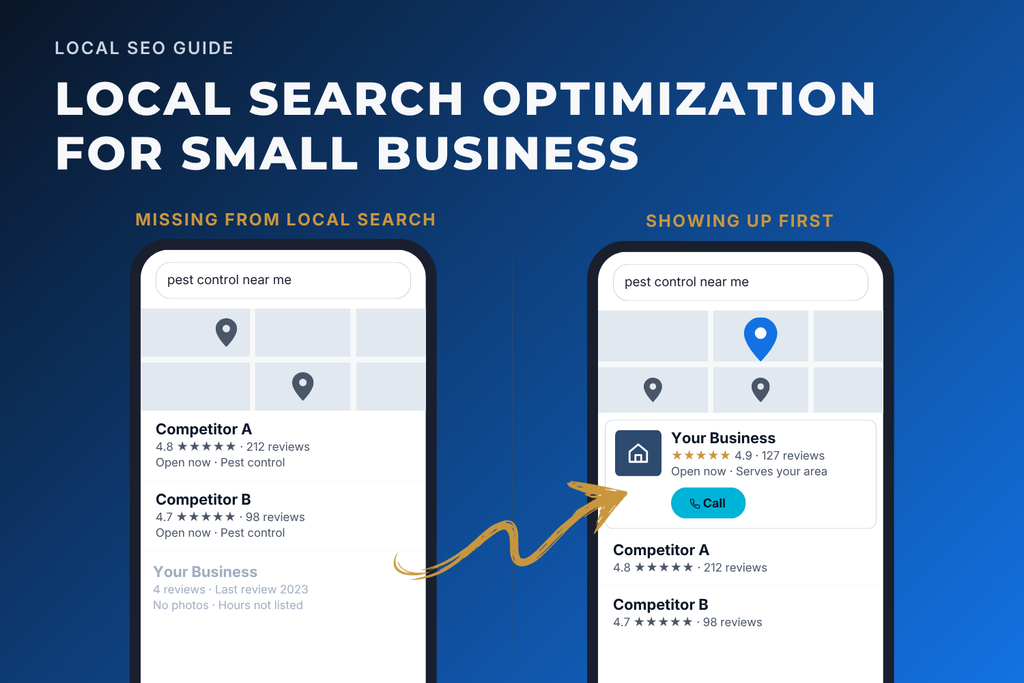
Local search optimization for small business is the work of getting your company into the map results and organic listings that Google shows when someone nearby searches for your service. In other words, if the searcher’s location affects the results, local SEO applies.
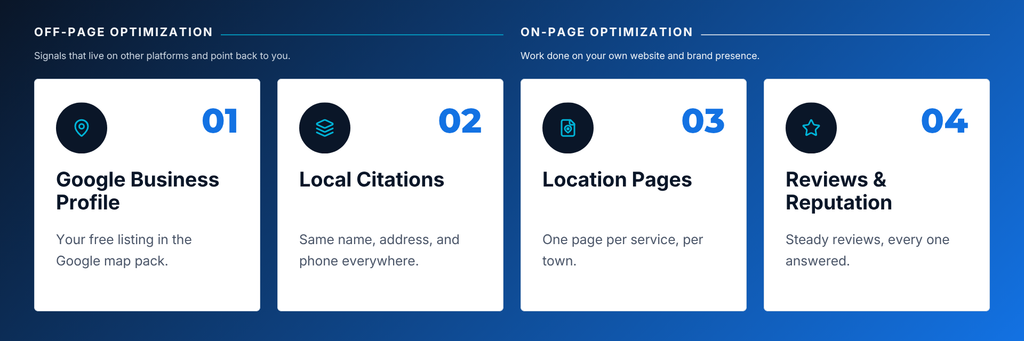
For a local service business, four areas do almost all the work:
- Google Business Profile: Your free listing in the map pack, with hours, photos, reviews, and service areas.
- Local citations: Your name, address, and phone number listed the same way on directories, apps, and data aggregators.
- Location-focused website pages: Service pages and city pages that tell Google where you work and what you do there.
- Reviews and reputation: How many reviews you have, how recent they are, and whether you respond.
You can see how we handle all four on our local SEO services page.
Why Do Small Businesses Struggle to Rank Locally?
You may be missing from local results because Google sees another business as more relevant, closer, or better known than you. Google’s own guidance on improving local ranking lists three factors: relevance, distance, and prominence. You can’t change where a searcher is standing. You can change the other two.
Google also says you cannot pay to improve your local ranking. In short, local results are earned, and that is why small businesses can compete with national brands in them.
These are the problems that hold most local businesses back.
- Your Google Business Profile is half finished. A missing service list, the wrong primary category, or no photos gives Google less to match against searches. A thin profile reads as a less relevant one.
- Your business details don’t match across the web. One directory has your old suite number, another has a tracking phone number, and your website spells the business name differently. Every mismatch makes Google less confident about who you are.
- You have one generic services page. A page that lists ten services and no towns can’t rank for “termite inspection in Lexington.” With that, Google needs a page that is clearly about that service in that place. However, a city name alone isn’t enough. The pages that win share knowledge only a local pro would have
- For example, a home inspector might point out the “homes built during the 2005” boom. Your competitors likely aren’t writing about those details, especially now that so much content is generated by AI. That firsthand expertise is exactly what makes your page stand out, both to Google and to the homeowner reading it.
- Your reviews stopped coming in. A profile with 40 reviews where the newest one is from 2023 looks inactive next to a competitor collecting reviews every week.
- You never reply to reviews. Silence on a bad review costs you trust with the next person who reads it.
- Nobody outside your website talks about you. Most owners overlook this one, and it matters most. Prominence comes from links, mentions, press, and community activity. A business the local web never mentions has a hard time looking important to Google.
What Improves Local Rankings the Fastest?
Start with the fixes that take an afternoon and show results within weeks. Then move down the list.
| Fix | Effort | Impact | Why it works |
|---|---|---|---|
| Complete every field in your Google Business Profile | Low | High | Gives Google more details to match against searches |
| Choose the correct primary category | Low | High | Your category is one of the strongest relevance signals |
| Clean up NAP across major directories | Medium | High | Consistent details build trust in your listing |
| Add real photos of your team and work | Low | Medium | Active, complete profiles get more engagement |
| Build one page per service | Medium | High | Matches your site to the exact searches people make |
| Set up a review request after every job | Low | Very high | Recent, steady reviews raise prominence |
| Respond to every review | Low | Medium | Shows activity and wins over future customers. Also contributes to ad visibility. |
| Earn local links and mentions | High | Very high | Shows Google that your community knows you |
Two of these are worth a closer look.
Fix Your Business Details First
Search your business name and phone number and check the first few pages of results. You will usually find old addresses, disconnected numbers, and duplicate listings. Then, Correct them or remove them.
After that, pick one exact version of your name, address, and phone number and use it everywhere. Your website footer, your Google Business Profile, and every directory listing should match character for character.
Pro Tip From the Pack: Skip the Home Address Shortcut. If customers don’t come to your home, don’t list it as your business address. We see this all the time when owners are looking for a shortcut to the top of the map. A home address might boost your rankings for a while, since you’ll look closer to more searchers. However, Google can tell when an address isn’t a public, commercial location, and it can suspend your profile for it. Then you’re invisible while competitors keep collecting your calls, and getting reinstated can take weeks. Instead, hide your address and set up a service area until you have an office or storefront where customers can visit.
Build a Review Engine, Not a Review Campaign
It sounds simple, but most businesses don’t keep it going. They ask for reviews in a big push and then stop for a year. Reviews only help rankings when they keep arriving.
Send a review request automatically after every finished job, with a direct link to your profile, preferably by text. When customers mention the service and the town in their own words, that context helps your relevance too.
This is the highest-impact habit for most local businesses, and it’s also the one that slips first because nobody owns it. For that reason, pick one person to be responsible for it.
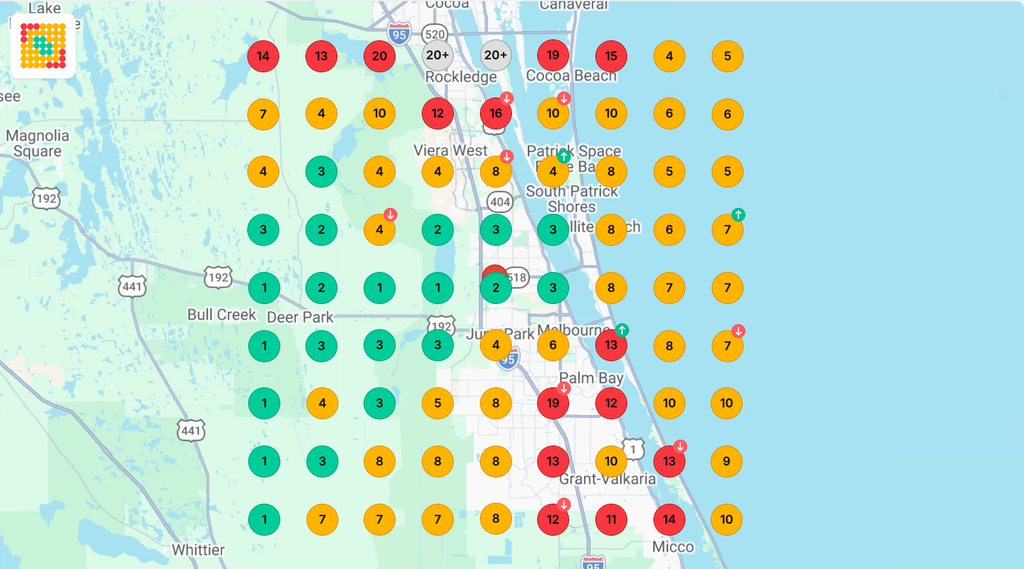
Before you change anything, get a baseline of where you rank today and where your calls come from. Your Google Business Profile performance report and Google Search Console show you both for free.
How Does Paid Advertising Support Local SEO?
Paid ads support local SEO because they put your name in front of people before they’re ready to search for you. Later, people who recognize your brand pick you out of the map pack. The argument is practical: familiarity turns into clicks, calls, and reviews.
Running ads alongside local SEO does three things.
- Branded searches go up: When people have already seen your ads, more of them search your business name directly. Branded searches send Google a clear signal that people know you.
- Reviews arrive faster: Ads bring in more jobs, and more jobs mean more customers you can ask for a review. Paid volume becomes organic reputation.
- You learn which keywords bring in real work: Search terms reports show you what people type before they call. Those phrases tell you exactly which service pages and city pages to build next.
Still, Order matters here. A strong local SEO base makes every ad dollar work harder, and ads speed up the reputation signals local SEO needs.
You can watch our Social Media and Advertising team leads explain how organic and paid work together, using real data and industry insights, in our free webinar. Check it out here.
Which Part of Local SEO Brings in the Most Customers?
Your Google Business Profile usually brings in the most local customers, because map results show up above the organic listings for most “near me” searches. Your website still matters. It backs up the profile, ranks for specific service searches, and turns visitors into calls. That’s why most businesses that do well locally invest in both.
Keep two things in mind. Distance is the factor you can’t control, so a business located at one edge of its service area won’t win map results across the whole region. Fortunately, service pages and city pages cover the areas your profile can’t reach. Also, local search demand rises and falls with the seasons. Pest control searches climb in spring and summer. Heating searches spike with the first cold snap. Publish content and push for reviews before your busy season, not during it.
We compared map rankings and organic rankings in detail in our local SEO services overview.
How Do You Know It’s Working?
Local SEO is working when more people who find you in search end up calling, booking, or walking in. Simply put, rankings are where it starts, not the result you’re after. Calls from your Google Business Profile and form fills from your service pages are the numbers to watch.
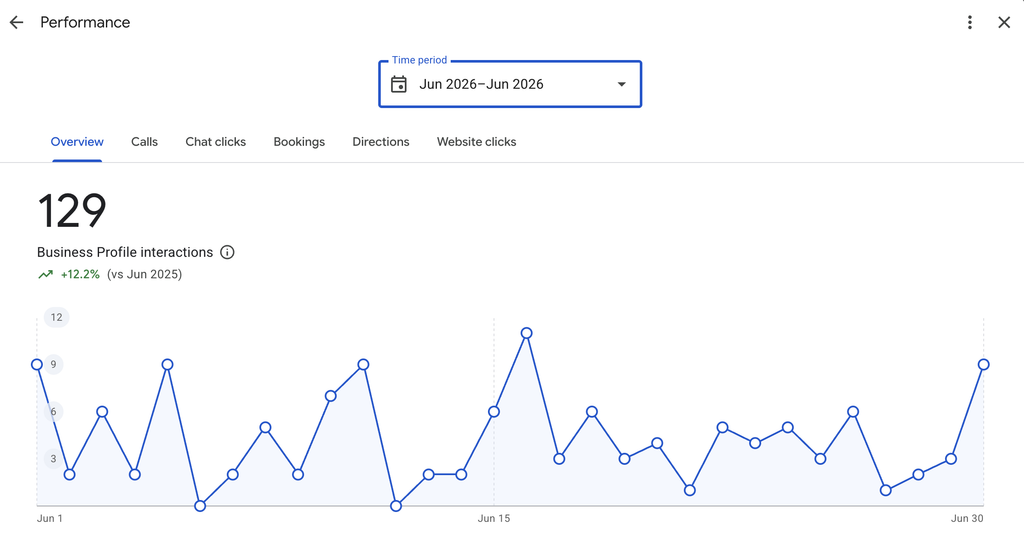
For example, a top-three ranking for a phrase nobody searches is worth very little. A fifth-place ranking for “emergency plumber” in your main town may bring in more work every month.
In short, rankings, impressions, and clicks tell you where to look. They don’t settle whether it’s working:
| What you are seeing | Where the problem is | What to do first |
|---|---|---|
| Lots of profile views, few calls | Your profile isn’t convincing | Add photos, services, and fresh reviews |
| Ranking well, but only close to your office | Distance is limiting you | Build city pages for the towns farther out |
| Good traffic, no form fills | Your website or your offer | Put the phone number up front and add a clear CTA on every service page |
| Rankings dropped suddenly | Listing issues or a suspension | Check your profile for edits, duplicates, or policy problems |
| Steady rankings, flat growth | Prominence has stalled | Push for reviews and start earning local links |
Before you blame Google, look at how quickly you answer the phone. Local SEO can bring someone to call you, but if nobody picks up, that customer calls the next listing.
For help setting goals for these numbers, see how long SEO takes to work for local businesses.
Related Questions to Explore
What is the difference between local SEO and regular SEO?
Regular SEO helps your website rank for searches anywhere. Local SEO is focused on searches where location matters, like “near me” and “[service] in [city].” Local SEO depends heavily on your Google Business Profile, reviews, and citations. Regular SEO depends more on content and backlinks.
Why isn’t my business showing up on Google Maps?
Usually for one of five reasons. Your profile isn’t verified, Your primary category is wrong, your business details don’t match across the web, you have few or outdated reviews, or the searcher is far from your business location. Check them in that order.
How long does local search optimization for small business take to work?
Profile fixes can show up within weeks. Bigger improvements in rankings and calls usually take three to six months, depending on how competitive your market is and how much groundwork is already in place.
Can I do local SEO myself?
Yes, the basics. Filling out your profile, correcting your directory listings, and asking for reviews are things an owner can handle. Technical work, building content at scale, and earning links take more time and skill.
When to Partner With Experts
Do the basics yourself. Completing your profile, correcting your listings, and starting a review habit can all happen in a week, and they bring the fastest gains.
On the other hand, get help when you run into any of these:
- You serve many towns: Building useful service and city pages for every area is real content work, and thin copy-and-paste pages can backfire.
- Your rankings are fine, but calls aren’t: That points to conversion, and figuring it out means looking at your profile, your pages, and your call handling together.
- Your listing got suspended: Getting reinstated requires knowing Google’s guidelines and submitting the right documentation.
- You’ve done the basics and stalled: Earning local links and mentions takes ongoing outreach that most owners don’t have time for.
WolfPack Advising handles local SEO for home service businesses nationwide, and we report on calls and booked jobs rather than rankings alone.
The Bottom Line
Local rankings improve when your business looks relevant and well known. In contrast, adding more pages to your website won’t get you there by itself.
The quickest gains come from a complete Google Business Profile, consistent business details, and correct categories. Meanwhile, T\the biggest long-term gain comes from a steady flow of reviews.
To start, look up your own listing this week. Correct the details that don’t match, ask your last ten customers for a review, and give Google every reason to put you in front of the customers already searching nearby.
If you want to know where your local presence is falling short, request a free, custom proposal, and we will walk through it with you.