
As a business, you already know that you need to be on social media. So you post here and there, maybe boost something on Facebook, and wait for the calls to come in. Then they don’t.
Here’s the thing. Using social media to help fill your marketing funnel works. But only when you stop expecting it to do everything on its own. A social media marketing funnel is one piece of a bigger system. When you treat it that way, it actually starts pulling its weight.
This post breaks down how social media fits into your funnel, what to post at each stage, and the mistakes that keep most home service businesses stuck.
What Is Social Media’s Place In Your Funnel?
Along with your emails, ads, or website, social media is a part of the journey someone takes from “never heard of you” to “loyal customer who tells their neighbors about you.”
It mirrors the traditional marketing funnel but uses social media platforms as the main way to move people through each step.
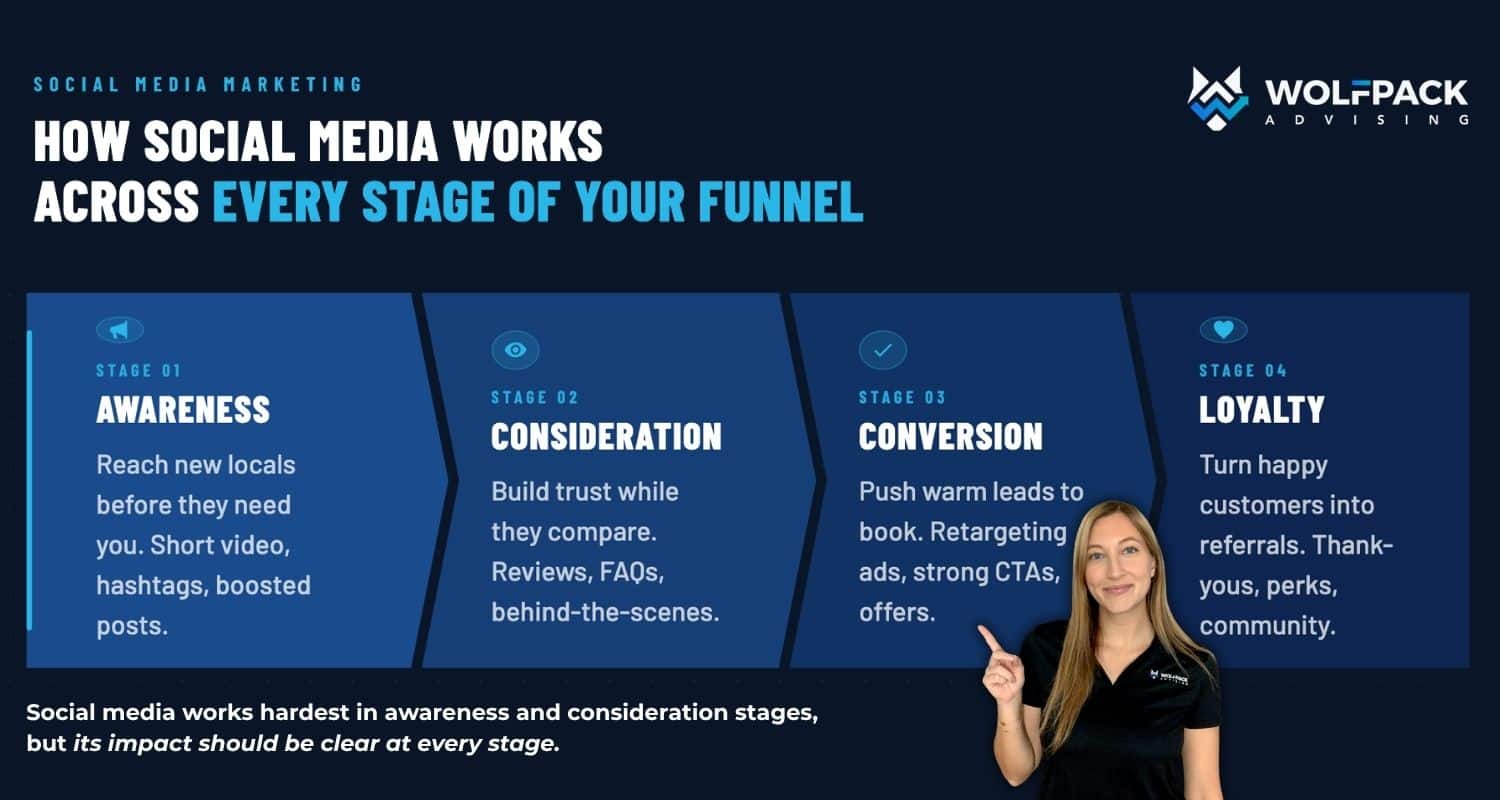
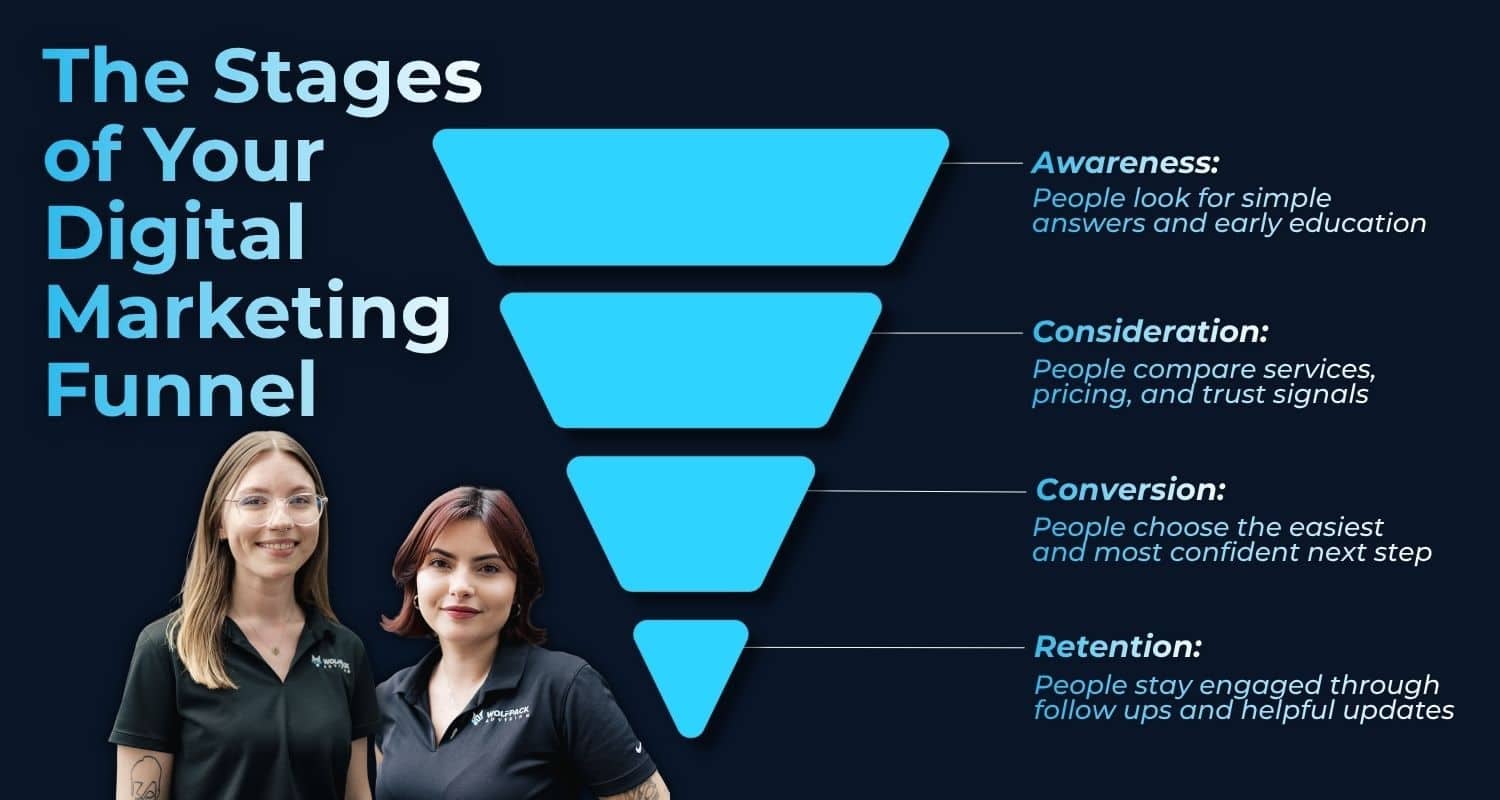
Most funnels have four key stages:
- Awareness stage: People who don’t know your business yet
- Consideration stage: People checking you out and comparing options
- Conversion stage: People ready to call, book, or buy
- Loyalty stage: Happy customers who come back and refer others
A healthy marketing funnel is usually focused on awareness, with consideration, decision, and retention each playing a supporting role as people get closer to booking. That breakdown helps you plan your content and your ad spend without putting all your eggs in one basket.
Filling your funnel means keeping a steady flow of people moving through each stage. Think of it like a leaky bucket. You can pour water in all day, but if there are holes, you’ll never fill it up. Social media helps you pour water in. The rest of your marketing keeps the water from leaking out.
How Social Impacts the Whole Customer Journey
Social media works hardest at the top and middle of your customer journey. It’s how you create awareness, build trust during the consideration stage, and stay top of mind until someone actually needs you.
Most home service jobs aren’t impulse buys. A homeowner doesn’t usually scroll Instagram, see a pest control post, and book the same day. But they might see your post, follow you, watch a few more, and then call you three weeks later when they spot termite damage.
That’s the funnel doing its job. Social media keeps you in the picture long enough for someone to remember you when the timing is right. The first touchpoint should focus on offering value and support, not a hard sell. People remember the brands that help them, not the ones that pitch them.
Awareness Stage: Getting Found by the Right Locals
At the awareness phase, social media helps homeowners in your service area discover your business before they need you. This stage is about reach, ad recall, and building brand awareness, not closing sales.
Here’s what works to create awareness for home service businesses:
- Short-form videos with strong hooks. Reels, TikToks, and YouTube Shorts get pushed to new audiences who don’t follow you yet. The first three seconds matter most. A 20-second clip of a roof inspection or a pest treatment can reach thousands of locals.
- Local hashtags and geo-tagging. Tag your city, county, or neighborhood. Use hashtags like #OrlandoHomeInspector or #TampaPestControl to show up in local searches.
- Boosted posts and targeted ads. Even a small boost budget ($5 to $20 per post) can put your content in front of homeowners in specific zip codes.
- Before-and-after content. This is one of the highest performing post types for home service brands. People love seeing transformation.
- Helpful content and educational tips. Quick answers to questions homeowners actually Google, like “what does mold look like behind drywall” or “how to tell if your roof has storm damage.”
- Captions optimized for social SEO. Write captions like search results, not just clever lines. Use the actual words your customers would type.
The goal at this stage isn’t to sell. It’s to get noticed by the right target audience. So if you only have time for one type of content, make it a short video. The algorithm rewards engagement quality (watch time, saves, and shares) over likes, and short videos drive all three.
Across the home service brands we work with, the awareness content that performs best almost always has one thing in common. It teaches or offers something useful before it ever asks for the click.
Consideration Stage: Keeping People Interested Until They’re Ready
The consideration stage is where social media earns its keep. This is where you stay visible while a homeowner is comparing options, getting quotes, or just waiting for the right time to book.
Most businesses lose people here. Someone finds you, follows you, and then never hears from you again because every post is the same surface-level promo (or it’s just boring). Targeted content for viewers in the consideration phase builds trust and keeps you in the running.
Here’s the kind of compelling content that works for viewers in this stage:
- Customer testimonials and reviews. Especially when paired with a real photo of the job or the customer. This is some of the strongest social proof you can post.
- FAQs answered in posts or short videos. Things like “what’s included in a home inspection” or “how often should I treat my lawn for pests.”
- Process explainers. Walk people through what working with you actually looks like. This removes friction.
- Behind-the-scenes content and company culture. Show your team, your trucks, your gear. People hire people, not logos.
- Service area highlights. Posts that mention specific neighborhoods or counties make you feel local and relevant.
- User-generated content. Repost photos and videos from happy customers when they tag you. It’s free trust.
A good rule of thumb is the 4-1-1 mix. For every four pieces of helpful or entertaining content, share one piece of social proof (like a review, testimonial, or case study) and one promotional post. That ratio keeps your feed from feeling like a commercial while still nurturing leads toward booking.
This is also where you should be replying to comments and DMs fast. A homeowner who messages you and gets a reply within an hour is way more likely to book than one who waits a day. Social media is a two-way channel, and consideration campaigns work best when the conversation goes both ways.
Conversion Stage: Turning Followers Into Booked Jobs
Social media at the conversion stage works best as a nudge, not a closer. The bottom of the funnel is about minimizing friction and giving high-intent leads a clear reason to take action right now.
Here’s what works at this stage:
- Retargeting ads. Run targeted ads to people who have already visited your website but didn’t book. These are warm leads who just need a reminder. Facebook and Instagram make this easy with the Meta Pixel installed on your site.
- Strong CTAs in captions and bios. Make it stupid easy for someone to know what to do next. “Call us,” “Book online,” “Tap the link in bio.”
- Limited-time offers and direct incentives. A spring pest control discount or a pre-storm roof inspection special can move fence-sitters.
- Customer success stories with clear next steps. Pair a real result with a direct invitation to get the same outcome. Case studies and reviews work as social proof at the conversion stage too.
- Direct links to booking or contact forms. Don’t make people hunt for how to hire you.
This is also where the rest of your marketing has to back you up. A great social post that sends someone to a slow, ugly website is a wasted lead. The same goes for a contact form that takes too long, or a team that doesn’t follow up fast enough.
If you want social media to actually drive customer acquisition, your website, your CRM, and your follow-up process all need to work together. That’s why we treat social media as one part of a bigger funnel, not a standalone tactic.
Loyalty Stage: Turning Happy Customers Into Brand Advocates
The loyalty stage is the part most businesses skip. Once you’ve earned the job, social media can keep that relationship alive and turn satisfied customers into brand ambassadors.
Why does this matter? Repeat business is cheaper than customer acquisition, and word-of-mouth referrals close faster than cold leads. Loyal customers also leave better reviews and provide the user-generated content that fuels your awareness stage.
Here’s how to keep existing customers engaged after the job:
- Post-purchase engagement. Send a thank you DM, share a quick tip related to the service they just had, or post a follow-up reminder before their next service window.
- Loyalty programs and referral discounts. Offer exclusive perks or loyalty rewards for repeat customers and referrals. Make it easy for happy customers to advocate for you.
- Private groups or VIP communities. A Facebook group for past customers gives them early access to seasonal offers and creates a sense of community. That community makes switching to a competitor emotionally harder.
- Spotlight your power users. Feature long-time customers or share their stories. People want to be seen, and recognition turns customers into long-term brand advocates.
Loyal customers are the engine that makes the whole funnel run faster. The more you invest in them, the less you have to spend at the top of the funnel to grow.
Which Social Platforms Should Home Service Businesses Use?
Most home service businesses get the best return from Facebook, Instagram, and YouTube, with Nextdoor as a strong local add-on. You don’t need to be on every platform. You need to be consistent with the ones your customers actually use.
Here’s a Quick Breakdown:
| Platform | Best For | Content Type | Funnel Stage |
|---|---|---|---|
| Local reach, reviews, community groups | Photos, videos, boosted posts | Awareness and consideration | |
| Visual storytelling, before/after | Reels, photos, carousels | Awareness and consideration | |
| YouTube | Long-form education, search visibility | Tutorials, walk-throughs | Awareness and consideration |
| Nextdoor | Hyper-local trust building | Recommendations, local posts | Consideration and conversion |
| TikTok | Younger homeowners, visual trades | Short videos | Awareness |
If you’re starting from scratch, pick two platforms and do them well. Facebook and Instagram are the safest bet for most home service businesses. Meta lets you run them together, and the local ad targeting is hard to beat.
Add YouTube if you have time to film longer videos. It doubles as a search engine, and your videos can keep working for years.
Skip the platforms where your customers aren’t. If you’re a residential pest control company in Florida, LinkedIn isn’t going to fill your funnel. Pick the right ponds before you start fishing.
What Kind of Content Marketing Works at Each Stage?
Match your content to the lifecycle stage your audience is in. Awareness content educates, consideration content builds trust, and conversion content moves people to act.
Here’s a Simple Cheat Sheet:
| Funnel Stage | Content Examples |
|---|---|
| Awareness | Quick tips, before/after photos, short videos, local content |
| Consideration | Reviews, FAQs, process videos, team intros, service explainers |
| Conversion | Special offers, testimonials with CTAs, retargeting ads, and booking reminders |
| Loyalty | Thank you posts, loyalty perks, customer spotlights, private group content |
The mistake most businesses make is posting only one type of content. If everything you put out is a sales pitch, you’ll never build awareness. If everything is educational, you’ll never close. A healthy mix moves people through your funnel without feeling pushy.
A good way to plan this is to map your week’s posts to touch on different stages.
For example, Monday is a customer review (consideration stage), Wednesday is a quick tip video (awareness stage), and Friday is a behind-the-scenes post showing company culture (consideration stage).
Once a month, you might run a promo or a limited-time offer (conversion). And once a quarter, you might spotlight a loyal customer (loyalty). That rhythm keeps the funnel full without having to overthink every post.
Engagement Metrics That Actually Matter
Likes and follower counts are important, but they don’t pay the bills. The engagement metrics worth tracking are the ones that show whether your content is moving people through the funnel.
Here are some key metrics to watch:
- Watch time and saves for awareness content (signal that the algorithm is pushing your content further)
- Comments and DMs for consideration content (signal of real interest)
- Click-through rates and link clicks for conversion content (signal of action)
- Repeat engagement from existing customers for loyalty content (signal of long-term advocacy)
Regular testing and optimization matter here. Watch where people drop off. If your awareness posts get reach but no one clicks through, the hook is working, but the offer isn’t.
If your conversion stage posts get clicks but no bookings, the problem is on your website or in your follow-up. Proper tracking helps you fix the right thing.
Awareness
Awareness
Consideration
Consideration
Conversion
Loyalty
Tracking
Common Mistakes That Stall Your Social Media Funnel
Most home service businesses don't have a social media problem. They have a strategy problem, which is fixable.
After years of running social media for home service brands across the country, here are the mistakes we've seen repeatedly:
- Posting without a goal. Every post should serve a purpose, even if that purpose is just "build trust."
- Only promoting services. If every post is "call us today," people lose interest fast.
- Ignoring comments and DMs. This is where leads slip away. Respond quickly, even if it's just a thank you.
- Inconsistent posting. Posting five times one week and then disappearing for a month kills momentum.
- No link to your website or booking page. Make sure your bio, profile, and posts always point somewhere actionable.
- Treating every post the same. A funnel only works when your content is intentional at each stage.
- No way to track what's working. If you can't tell which posts drive traffic or leads, you're guessing.
- Skipping the loyalty stage. Repeat business and referrals are the cheapest leads you'll ever get. Don't ignore them.
The good news is that fixing these doesn't require a bigger budget. It just requires your awareness, a plan, and a little consistency.
Related Questions
What's the difference between a marketing funnel and a sales funnel? A marketing funnel covers everything from awareness to interest. A sales funnel picks up where marketing leaves off and focuses on closing the deal.
For most home service businesses, the two work together. Marketing fills the top, sales handles the bottom.
How often should a home service business post on social media? A safe baseline is three to five posts per week per platform. Consistency matters more than volume. It's better to post three times a week every week than to post daily for two weeks and then disappear.
Can social media replace paid ads for local home service businesses? Not really. Organic social builds trust and keeps you visible. But paid ads, especially local Facebook and Instagram ads, are usually the fastest way to fill the top of your funnel. The two work best together.
How do I know if my social media is actually driving leads? Track the basics. Use UTM links in your bio and posts, ask new customers how they found you, and check your website analytics for traffic from social platforms. If you have a CRM, tag your leads by source so you can see what's actually working.
How is the social media funnel changing in 2026? Building a social media funnel in 2026 means leaning into community-driven, data-informed strategies. Algorithms reward authentic engagement over vanity metrics.
Short video, private groups, and real human connection are doing more work than polished branded content right now.
Conclusion
Social media is a powerful tool. But it works best when it's part of a complete marketing strategy. That means a clear plan, consistent content, a website that converts, and a follow-up system that turns leads into booked jobs.
If you've been posting and hoping, and you're ready for social media to actually drive leads, the team at WolfPack Advising helps home service businesses build marketing funnels that work from awareness to loyalty. We handle the strategy, content, and follow-up so you can stay focused on running your business.
Reach out anytime to talk through what's working, what's not, and how to make your social media pull its weight.