


An AI seo agent helps analyze data, identify patterns, and speed up optimization. It does not replace strategy. For local SEO, it changes how Google evaluates trust, reviews, content depth, and relevance. Businesses that combine AI tools with smart planning will have an advantage in local search.
If you are a home inspector, contractor, or service professional, this shift matters. Local rankings are becoming more competitive, and Google is using smarter systems to decide who appears first.
Contents
Why Everyone Is Talking About the AI SEO agent
AI is no longer just a trend. It is part of how Google works today.
Google uses machine learning to understand search intent, evaluate content quality, and interpret behavior patterns. That means local rankings are influenced by systems that are more advanced than ever before.
An AI seo agent refers to tools that use artificial intelligence to:
- Analyze search data
- Predict ranking opportunities
- Optimize content
- Monitor competitors
- Identify gaps in authority
AI processes information fast. But it does not replace planning or local expertise.
Is AI replacing SEO agencies?
No. AI is changing how optimization is done, but it does not remove the need for strategic thinking. In fact, automation without direction can weaken results.
What is an AI SEO agent in Simple Terms?
In simple terms, an AI seo agent is software that helps improve search visibility using data modeling and automation.
Think of it as a research assistant.
It can:
- Scan thousands of keywords
- Detect content gaps
- Analyze ranking patterns
- Suggest internal linking
- Monitor technical signals
But it cannot determine your positioning or understand local nuances the way an experienced strategist can.
AI Tool vs Strategic AI SEO agent
There is a difference between using AI to generate content and building a structured SEO plan supported by AI insights.
A strategic approach includes:
- Data analysis: Not just pulling keyword lists, but interpreting search intent, identifying demand trends, evaluating ranking difficulty, and understanding which topics drive real business outcomes instead of just traffic.
- Human review: AI can surface opportunities, but experienced SEO professionals validate recommendations, adjust tone and positioning, and ensure accuracy, compliance, and brand alignment before implementation.
- Competitive benchmarking: Analyzing what top-ranking competitors are doing, including their content depth, backlink profiles, authority signals, internal structure, and user engagement patterns, then identifying realistic pathways to outperform them.
- Local intent targeting: Understanding how search behavior changes by geography. This includes optimizing for city-specific modifiers, service-area signals, Google Business Profile relevance, proximity factors, and localized content themes that AI alone cannot fully contextualize.
- Conversion-focused planning: Ranking is only part of the equation. A strategic AI SEO agent supports content and page structures designed to convert visitors into leads or customers through optimized calls-to-action, user flow design, trust elements, and intent-matched messaging.
That layered process separates websites that rank from those that remain invisible.
How the AI SEO Agent Is Changing Local Search
Local search is becoming more entity-driven and trust-focused.
Google now evaluates:
- Business reputation
- Review sentiment
- Topical authority
- Structured data
- Engagement behavior
AI systems connect related topics. This makes shallow content easier to identify and ignore.
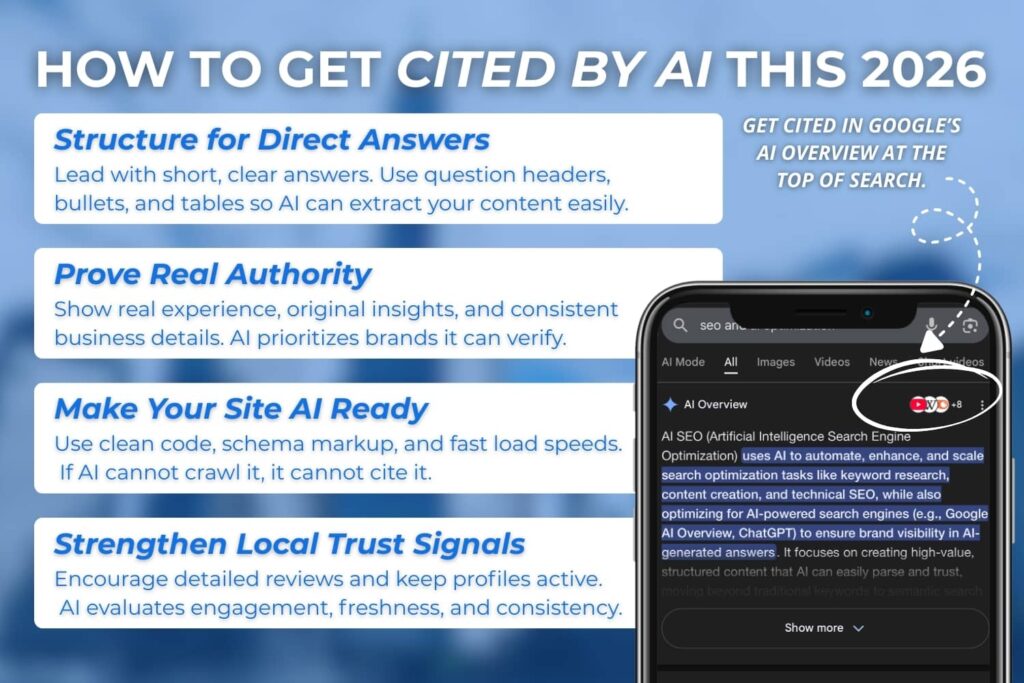
Google AI Overviews and Local Results
With AI summaries appearing in search results, Google pulls from multiple trusted sources to answer questions directly.
If your website lacks depth, it may not be referenced in these summaries.
To stay competitive, local businesses need:
- Topic clusters instead of isolated blog posts
- Clear service pages
- Accurate citations
- Consistent business details
- High-quality reviews
Ranking Shifts in Local SEO
| Older Approach | Emerging Approach |
|---|---|
| Single keyword targeting | Topic authority |
| Exact match repetition | Natural language clarity |
| High backlink volume | Trust and engagement signals |
| Basic directory listings | Entity consistency |
AI helps search engines connect the dots faster. That raises the bar for content quality.
What This Means for Home Service Businesses
Competition in local markets is increasing.
SEO investment is increasing, business profiles are becoming more refined, and review activity is growing across nearly every local market.
AI systems are sorting through all of it.
Reviews Now Carry Deeper Weight
Google does not just count reviews. It analyzes them.
AI evaluates:
- Words used in reviews: Natural language processing systems identify recurring service terms, problem descriptions, and outcome phrases. When reviews consistently reference specific services such as leak detection, panel upgrades, or emergency plumbing repair, those phrases reinforce topical relevance for those services.
- Recency: Recent reviews signal operational consistency. A steady flow of new feedback indicates active service delivery, which strengthens local visibility compared to profiles with long review gaps.
- Sentiment: It is not only star ratings. Language tone, specificity, and problem-resolution details help algorithms assess overall customer satisfaction and service reliability.
- Service mentions: Repeated references to niche or specialized services reinforce the semantic association. For example, if multiple customers mention storm damage inspections or insurance claim assistance, the business becomes more strongly associated with those service categories.
If several reviews mention “detailed inspection report” or “thorough roofing evaluation,” that reinforces service relevance in ways that simple star ratings cannot.
Authority Signals Matter More
Your website should clearly show:
- Local expertise
- Educational depth
- Clear service explanations
Structured content clusters often outperform scattered blog posts. When service pages connect to related educational resources, authority strengthens.
How Google Maps Rankings Are Being Influenced by AI
Maps’ rankings are influenced by more than proximity.
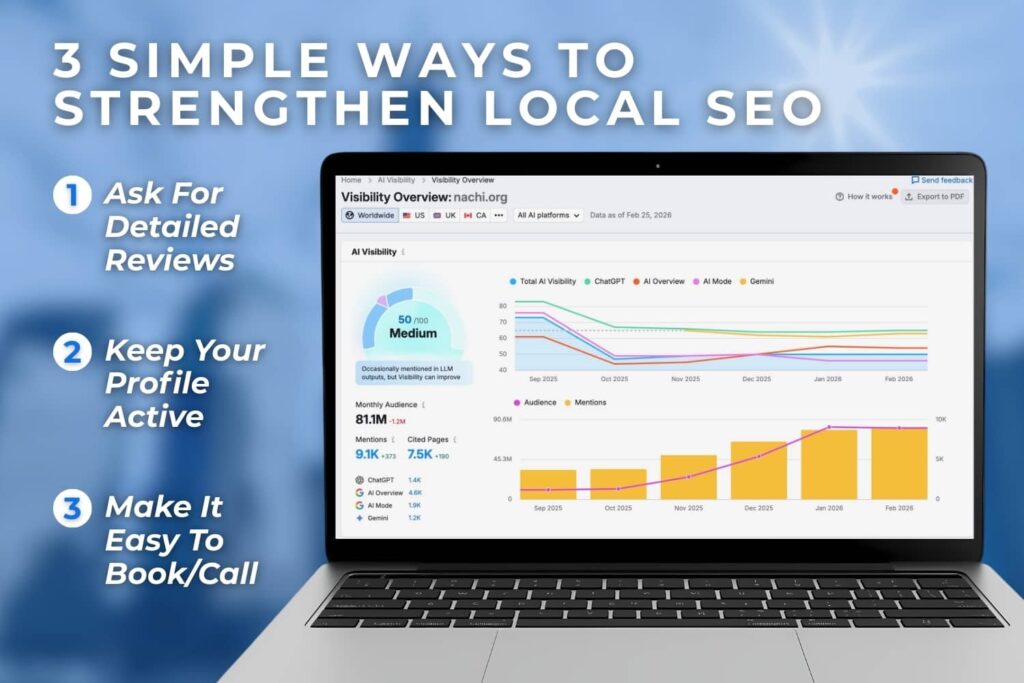
AI evaluates:
- Review quality
- Click behavior
- Profile activity
- Photo updates
- Posting consistency
Does AI read Google reviews?
Yes. Google uses natural language processing to understand review themes and sentiment.
Google Maps Optimization Checklist
- Complete every profile field
- Use natural language service descriptions
- Encourage detailed reviews
- Upload fresh photos regularly
- Respond to every review
- Post consistent updates
Inactive profiles often lose visibility over time because engagement signals weaken.
How AI Should Be Used in Local SEO Strategy
AI works best as a support tool, not a replacement for thinking.
In local SEO, artificial intelligence can process large amounts of data quickly. It can identify keyword gaps, spot competitor patterns, and detect technical issues. That makes research faster and more efficient.
But speed does not equal strategy.
Strong local SEO still requires:
- Clear positioning
- Competitive analysis at the city or county level
- Thoughtful content structure
- Conversion planning
- Ongoing refinement
| Where AI Adds Value | Where Human Oversight Is Essential |
|---|---|
| Identifying emerging search queries | Interpreting local competition differences |
| Modeling content gaps across service areas | Deciding which services deserve priority |
| Analyzing internal linking opportunities | Structuring content around real customer questions |
| Monitoring ranking fluctuations | Ensuring messaging builds trust |
| Summarizing review trends | Aligning SEO with lead quality goals |
For example, two home inspectors in the same state may target different property types or price ranges. AI can detect search volume, but it cannot decide how to position the brand.
Why This Matters for Local Businesses
Local SEO is not about publishing content and hoping it ranks.
It is about:
- Demonstrating expertise
- Building consistent authority signals
- Answering specific homeowner questions
- Maintaining accurate business information
AI helps organize the data behind these decisions. It does not replace structured planning.
Used correctly, artificial intelligence becomes a tool that supports clarity rather than shortcuts.
How to Tell If Your Local SEO Is Falling Behind
You may need to reassess your strategy if:
- Your Google Maps listing dropped out of the top three
- Organic traffic has stalled
- Competitors publish more in-depth content
- Reviews have slowed
- You are not appearing in AI summaries
Why did my rankings drop?
Common causes include:
- Algorithm updates
- Stronger competitor investment
- Outdated content
- Weak internal linking
- Inconsistent citations
Local SEO requires continuous attention.
Action Plan for Local Businesses in 2026
To stay competitive in AI-influenced search:
1. Strengthen Topic Authority
Build clusters around core services and link them clearly.
Instead of relying on a single broad service page, create a structured content cluster around each revenue driver. For example, a plumbing company might build a main “Water Heater Services” page supported by separate pages for water heater repair, replacement, tankless installation, maintenance, cost guides, and common failure signs.
Each supporting page should target a distinct search intent and internally link back to the core service page using descriptive anchor text. This reinforces topical relationships and helps search systems understand the depth of coverage rather than surface-level relevance.
2. Optimize Your Google Business Profile
Keep it active and detailed.
Review your primary and secondary categories to ensure they match your highest margin services. Add individual services within the profile dashboard, not just in the description field.
Upload project photos tied to specific service types. Publish updates that reference seasonal demand, recent projects, or limited-time offers. Respond to reviews using service-specific language. Activity consistency and service clarity improve profile strength in competitive map results.
3. Improve Internal Linking
Connect blogs to service pages naturally.
Educational blog posts should not exist in isolation. If you publish a post about “Signs You Need a Roof Inspection After a Storm,” it should link directly to your roof inspection service page.
This passes contextual relevance and authority to revenue-generating pages. Internal links should use descriptive phrases such as “storm damage roof inspection” rather than generic wording like “click here.” Clear internal architecture helps search systems prioritize the pages that matter most.
4. Encourage Specific Reviews
Ask customers to describe their experience in detail.
Instead of asking for a general review, guide customers with prompts such as:
- What service did we complete for you?
- What problem were you experiencing?
- What stood out about the process?
Detailed reviews often mention service types, timelines, communication quality, and outcomes. This creates stronger semantic alignment between your review profile and your target service categories.
5. Monitor Performance Regularly
Review rankings, traffic, and engagement trends.
Track local pack positions for priority keywords in your primary service areas. Monitor Google Search Console for impression growth and click-through rate changes on service pages.
Watch for declines in review velocity or sudden ranking shifts that may indicate competitor movement or algorithm adjustments. Reviewing performance monthly allows you to identify patterns early rather than reacting after visibility significantly drops.
Related Questions
Will AI replace SEO agencies?
AI improves research, automation, and data analysis, but it does not replace strategic thinking. Local SEO requires positioning, competitive insight, and conversion planning that software alone cannot provide. Agencies use AI as a tool, but human direction is still what drives long-term growth.
How does AI affect Google Maps rankings?
AI helps Google evaluate patterns in reviews, engagement behavior, and profile activity. It looks at how often users click, call, request directions, and leave detailed feedback. Businesses with consistent activity and strong review signals tend to perform better over time.
Can AI automatically rank my website?
No tool can automatically guarantee rankings. AI can help identify opportunities, improve content structure, and monitor performance, but authority and trust still determine results. Rankings improve when strategy, content quality, and local signals work together.
What is the difference between an SEO agency and an AI seo agent?
An AI seo agent is software that analyzes data and suggests optimizations. An SEO agency uses tools like AI but adds strategy, competitive analysis, content planning, and ongoing adjustments. The difference is between automation alone and guided execution.
How can local businesses compete in AI-driven search?
Local businesses can compete by building clear topic authority and maintaining consistent business information across platforms. Encouraging detailed reviews and keeping Google Business Profiles active also strengthens visibility. The goal is to create strong trust signals that AI systems can easily recognize and validate.
Conclusion
The AI seo agent is reshaping local search by raising the bar for trust, authority, and structured content. Businesses that rely only on shortcuts or automation without a strategy may struggle as Google’s systems become more advanced.
WolfPack Advising provides SEO services built for this shift, combining AI-driven insights with structured content, Google Maps optimization, and data-informed strategy.
We help local businesses build sustainable visibility through consistency, authority, and ongoing refinement.