


If you’re launching a new website, whether the business is totally new or you’re just rebranding, SEO should not be a guessing game.
At its core, SEO is about helping search engines clearly understand what your business does so that the right people find you when they are searching for solutions.
SEO is a foundation. Especially early on. When it’s built correctly from the start, everything else you do later works better. When it is rushed or skipped, growth slows, and fixes become more expensive.
This guide walks through SEO in the order that makes the most sense for a brand-new site. Each section explains what the step is, why it matters, and how it affects real business outcomes.
What Makes SEO Different for a New Website?
You’ll approach SEO differently for a new website than for an established one simply because Google has no prior relationship with your site.
There is no history, performance data, or established trust.
Older websites benefit from signals that build over time, including:
- Pages that have been indexed and crawled repeatedly
- Links from other reputable websites
- Engagement data that shows how users interact with content
- Historical ranking and traffic trends
This is why many SEO efforts fall flat early. Jumping right in and publishing a bunch of content or targeting highly competitive keywords does not solve the core issue, which is uncertainty.
Early SEO should focus on reducing that uncertainty by being clear, accurate, and consistent. Google Search Central emphasizes that relevance and trust are built gradually through helpful content and reliable information.
New websites that prioritize clarity tend to gain traction more steadily than those that chase shortcuts.
What You Should Have Ready Before You Touch SEO
Before you think about keywords, content calendars, or rankings, your website must be technically ready. SEO cannot overcome a site that is unstable or inaccessible.
At a minimum, your website should:
- Use HTTPS with a valid SSL certificate
- Load reliably on both desktop and mobile devices
- Allow search engines to crawl and index pages
- Use clean URLs and simple navigation
HTTPS with SSL means your website uses a secure connection. Visitors see a lock icon instead of a warning message. Google has confirmed that HTTPS is both a trust signal and a ranking factor. Sites without it often see lower engagement because users hesitate to interact with unsecured pages.
Mobile usability matters because Google uses mobile-first indexing. This means Google primarily evaluates the mobile version of your site when deciding how pages rank. If pages are hard to use on a phone, SEO performance suffers regardless of desktop quality.
Indexing access allows search engines to discover and evaluate your pages. Many new sites accidentally block indexing during development and forget to remove those settings at launch.
If Google cannot crawl a page, it cannot rank it.
Clean URLs and clear navigation help both users and search engines understand your site. A URL that clearly describes a page builds more trust than a long string of parameters.
SEO Setup Before and After Launch
| Task | Before Launch | After Launch |
| Domain and SSL | Required | Done |
| Mobile usability | Required | Required |
| Indexing access | Required | Required |
| Page structuring | Strongly recommended | Harder to change |
| Keyword strategy | Strongly recommended | Ongoing |
| Content publishing | Optional | Strongly recommended |
Where Google Business Profile Fits Into Early SEO
For service-based and local businesses, Google Business Profile is one of the most important early SEO assets.
While a new website takes time to earn authority, a properly set up profile can appear in local search results much faster.
Google relies heavily on business listings to understand location-based relevance and confirm that a business is real.
Your Google Business Profile helps Google verify:
- That your business exists
- Where you operate
- The services you provide
- How customers interact with you
Early setup should include:
- Claiming and verifying the profile
- Using a consistent business name, address, and phone details
- Selecting accurate primary and secondary service categories
- Linking to the most relevant website pages
Google states that complete and accurate profiles improve visibility and trust in local search. While a profile cannot replace a website, it often drives early calls, directions requests, and website visits while organic rankings are still developing.
For many service businesses, the profile is the first impression. When the profile and website reinforce each other, credibility improves, and conversion rates follow.
How Website Structure Sets the Tone for Everything Else
Website structure is the framework that supports all SEO work. It tells search engines how pages relate to one another and which topics are most important.
A strong structure:
- Groups related pages logically
- Makes navigation intuitive for visitors
- Supports internal linking naturally
- Scales as services and content expand
Early structure mistakes often create long-term limitations. Combining multiple services on one page may feel efficient, but it makes keyword targeting, internal linking, and performance tracking harder later.
Most new service websites benefit from:
- A homepage focused on positioning and clarity
- Individual service pages for each offering
- Supporting informational pages
- A simple navigation menu that reflects priorities
Search engines rely heavily on structure to understand topical relevance. A well-organized site gives clearer signals and more long-term growth.
What Site Content Do You Need at the Start?
Content should support business goals, not just fill space.
Many new websites rush into blogging without clearly explaining what they do or who they serve. This often leads to traffic that does not convert and SEO efforts that feel ineffective.
Early content priorities usually include:
- Service pages that clearly explain offerings
- Pages that answer common buyer questions
- Supporting content that builds trust and credibility
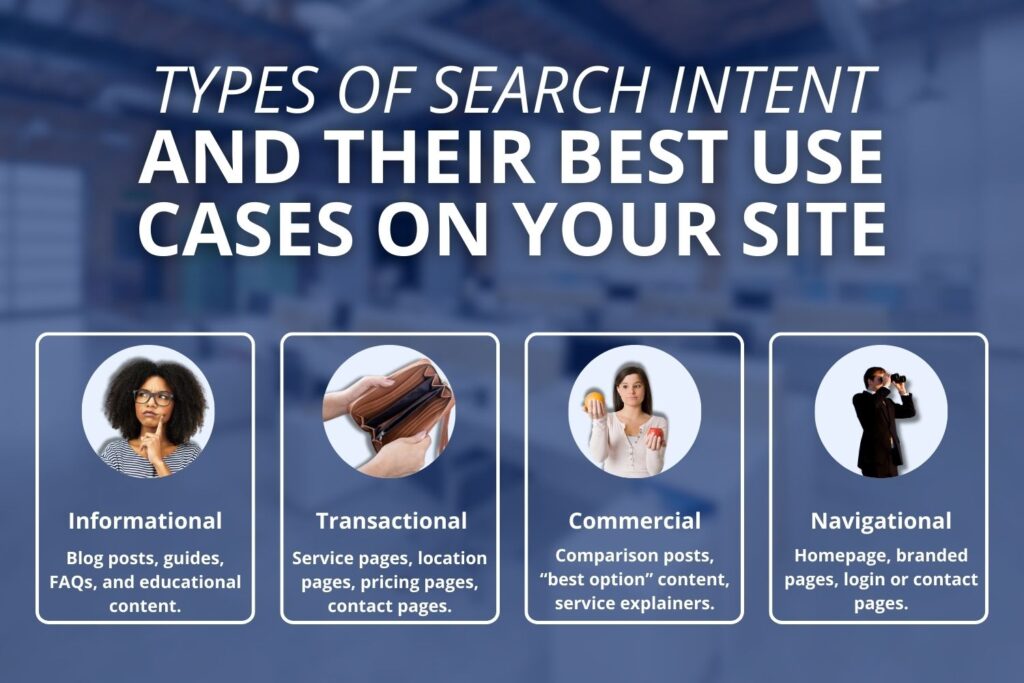
Service pages target transactional intent. These visitors are closer to taking action.
Blog content usually targets informational intent, where users are learning or researching.
SEMrush research shows that content aligned with search intent performs better long-term than content created solely to target keywords.
Starting with clarity prevents wasted effort and sets the stage for future growth.
How to Choose the Right Keywords for Your Website
Keyword research should come after you understand what content your website needs. For a new website, keyword strategy is less about search volume and more about matching intent to the right page type.
Search intent describes what someone wants when they search. If a page does not match that intent, it will struggle to rank.
A simple way to think about search intent:
- Transactional intent means someone is ready to hire or contact a provider
- Informational intent means someone is researching or learning
- Navigational intent means someone is looking for a specific business
For example, a search like “home inspection near me” belongs on a service page, while “what does a home inspection include” belongs in a blog post.
New websites should focus first on transactional and high-intent informational keywords tied directly to their services. Broad, competitive terms usually make progress harder early on.
Keyword Intent and Page Matching
| Page Type | Search Intent | What the User Wants |
| Service page | Transactional | To hire or contact a provider |
| Blog post | Informational | To understand a problem or solution |
| FAQ page | Mixed | Quick answers to specific concerns |
Research shows that pages ranking on the first page of Google closely match search intent. For new websites, choosing clear, well-matched keywords matters more than chasing reach.
How On-Page SEO Helps Google Understand a New Site
On-page SEO is how you communicate the purpose of each page to search engines and users.
For a new website, this matters even more because there is no historical context to fall back on. Every signal helps Google understand what your site is about.
Strong on-page SEO includes:
- Clear page titles that accurately describe the topic
- Headings that break content into logical sections
- Internal links that connect related pages
- A single primary topic per page
Page titles are often the first relevance signal Google evaluates. Headings help structure content for both readers and search engines. Internal links reinforce topical relationships and help distribute authority across the site.
For new websites, fewer pages with a clear focus almost always outperform many pages with mixed or unclear topics.
Why Technical SEO Matters Even on Day One
Technical SEO ensures search engines can access, crawl, and understand your website.
You do not need advanced optimizations immediately, but the basics must be correct.
Early technical priorities include:
- Making sure important pages are indexable
- Avoiding broken links or error pages
- Using a logical navigation structure
- Keeping URLs simple and descriptive
Once again, if a page cannot be crawled or indexed, it cannot rank. Google is clear on this.
Technical barriers stop SEO progress regardless of content quality.
How to Build Lasting Trust and Authority
For new websites, trust comes before authority.
Authority is often associated with backlinks, but backlinks are not the first step. Before other sites are willing to link to you, your business must look legitimate and consistent.
Early trust signals include:
- Accurate and consistent business information
- Clear service descriptions
- Reviews and testimonials
- Citations across relevant directories
Consistency matters more than volume at this stage. Research shows that accurate citations and consistent business information play a major role in local search visibility, especially for newer businesses.
How Long Does SEO Take to Work for a New Website?
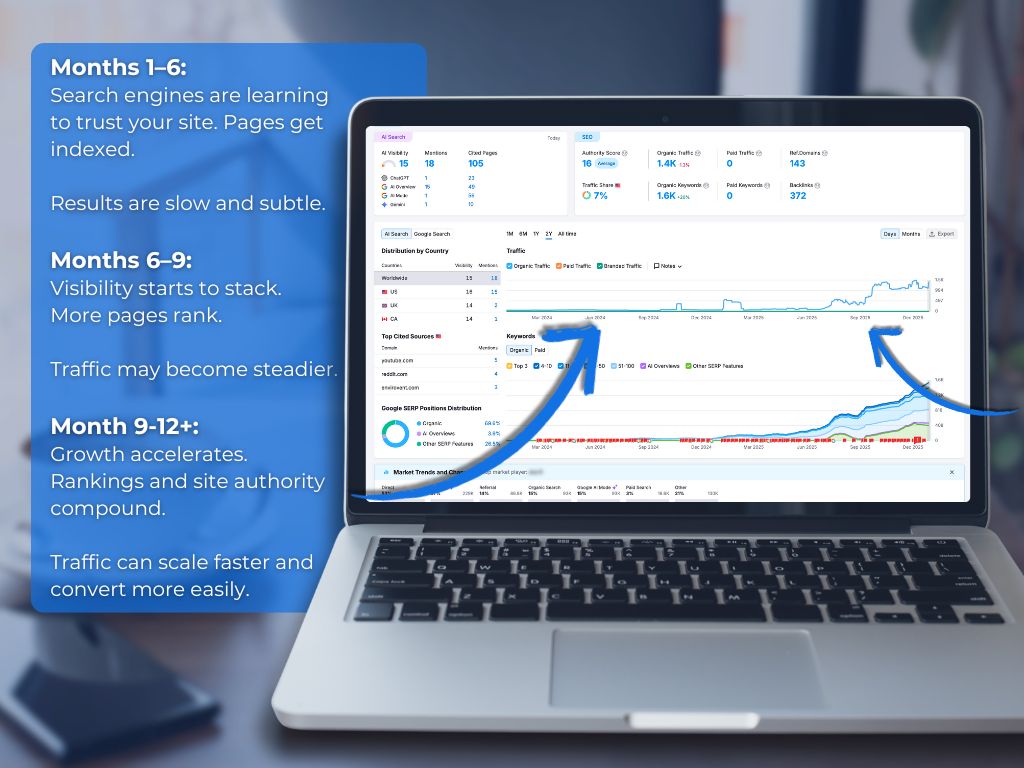
SEO is not immediate, especially for a new website.
Progress usually happens in stages:
- Pages begin indexing
- Search impressions increase
- Rankings improve gradually
- Traffic grows over time
According to Ahrefs data, most pages ranking at the top of Google are several months old. This does not mean nothing is happening early. It means the foundation is being evaluated before results accelerate.
How Your Site’s SEO Evolves Over Time
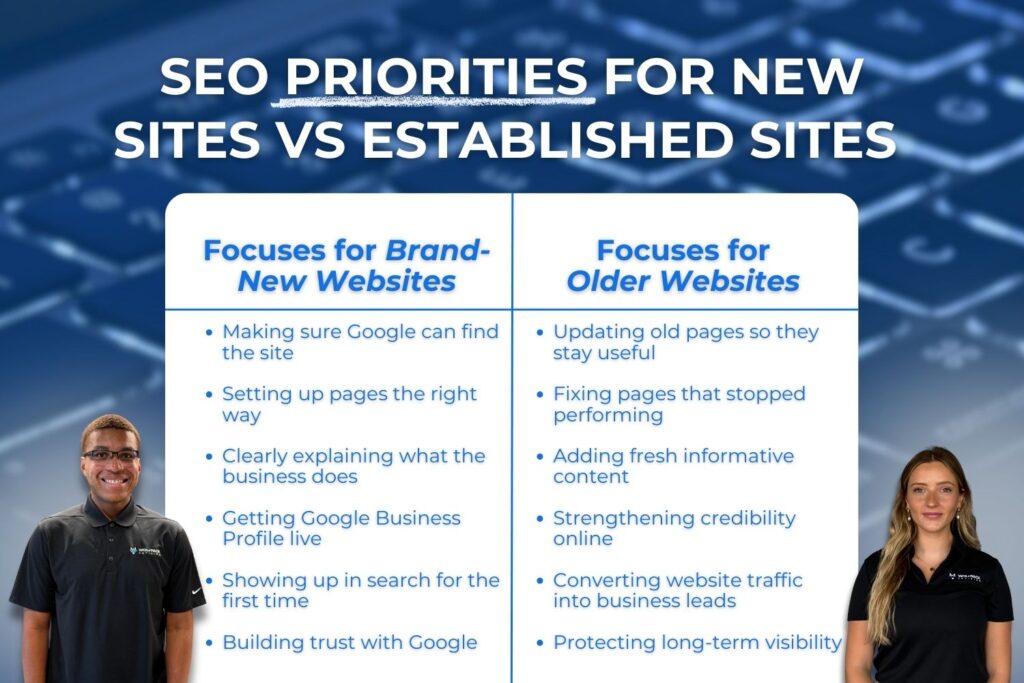
SEO priorities change as your website matures. Early on, the focus is on building. That means clear structure, strong service pages, and consistent trust signals.
As your site gains history and data, SEO shifts from building to maintaining and improving. Established sites spend more time updating what already exists, while new sites focus on growth.
Over time, content can lose relevance as search intent changes and competitors publish stronger pages. This is often called content decay. Addressing it means reviewing and refreshing pages so they remain accurate and competitive.
As SEO evolves and your site ages, priorities expand to include:
- Expanding content depth
- Targeting more competitive keywords
- Building authority through links and mentions
- Improving conversions from existing traffic
- Refreshing content to prevent performance decline
How to Measure Progress Without Fixating on Rankings
Rankings alone are no longer a reliable way to measure early SEO progress, especially for new websites. Search results now include AI summaries, featured answers, and local results where visibility does not always come from a traditional blue link.
Because of this, early SEO success often shows up before rankings improve.
Better indicators to watch include:
- Search impressions in Google Search Console
- Pages that are indexed and surfaced for relevant queries
- Engagement signals such as time on page
- Leads, calls, and form submissions
More impressions signal that search engines are beginning to understand your content, even if clicks are still limited. Engagement helps confirm that pages are answering real questions.
From an AEO standpoint, visibility matters more than position. If your content is being surfaced, referenced, or used to answer queries in search results, that is progress.
For new websites, the goal is to build clarity and trust first. Measuring the right signals helps you track real momentum without chasing vanity metrics.
Common SEO Mistakes New Websites Make
Many SEO problems are caused not by doing too little, but by doing the wrong things too early.
Common mistakes include:
- Publishing content without a strategy
- Ignoring conversion paths and calls to action
- Chasing competitors instead of fundamentals
- Treating SEO as a one-time setup
Strong fundamentals outperform shortcuts over time.
Related Questions
Should SEO start before a website launches?
Yes. Planning and setting up your SEO before launch helps avoid structural issues and missed opportunities.
Is Google Business Profile enough without a website?
No. A website provides depth, credibility, and clear conversion paths.
How many pages does a new website need?
Enough pages to clearly explain services and build trust. Quality matters more than quantity.
Can ads replace SEO early on?
Ads can supplement traffic, but SEO builds long-term visibility and lower-cost leads.
Is local SEO different for a brand-new site?
The fundamentals are the same, but local relevance plays a larger role early on.
Conclusion
SEO for a new website is about building a foundation that supports long-term growth. When structure, content, keywords, trust signals, and tracking are aligned early, progress compounds instead of stalling.
Taking the time to get SEO right from the beginning reduces wasted effort, shortens the learning curve, and creates momentum that lasts well beyond launch.
If you want help building or refining that foundation, this is where the right guidance can make the biggest difference. Book a strategy call with WolfPack Advising today.