Last updated on June 23rd, 2026 at 01:40 pm
A home-based service business can get more leads from ChatGPT by strengthening the same visibility signals that help with search and local discovery.
That means a clear website, content that answers real audience questions, a fully optimized Google Business Profile, and consistent business information across the web.
ChatGPT and similar AI tools use the content you already have to influence a homeowner’s decision long before a call or form submission.
At WolfPack Advising, we look at this as SEO plus AEO. You are building a “best answer” footprint, which both Google and AI can understand and trust, leading human users to choose you.
How Do Homeowners Use ChatGPT to Find Home Services?
Homeowners are not always searching for a company name first. Most people start with a problem, then search for what it means and what to do next.
ChatGPT and other LLMs (large language models) are often part of that early phase.
Some ways homeowners use ChatGPT include:
- Understanding what a symptom might mean
- Comparing services or repair options
- Asking which professional they need
- Checking whether a situation seems urgent
For example, a homeowner might ask, “Why is my crawl space wet?,” then follow up with “Does moisture cause mold?”, later moving to “Who inspects for mold near me?”
This pattern is important. According to a recent survey, 66% of consumers use search engines and online resources to research local services before contacting a business.
That means the decision process often begins earlier with questions that AI tools like ChatGPT help answer. Businesses that show up clearly for those early questions increase the chance they influence the eventual lead.
What Determines Whether an LLM References a Business?
When it comes to answering everyday AI prompts and user queries, ChatGPT does not choose businesses as a search engine does, but it still favors information that is consistent, clear, and trusted.
AI tools look for:
- Content that matches the question asked
- Clear business information across websites and listings
- Service descriptions that are specific
- Reviews that describe real work and outcomes
If your business information is incomplete or inconsistent, AI tools find it harder to reference your content or details. But if your website and local listings are complete, detailed, and match one another, AI tools are more likely to use your content when summarizing answers.
Clarity leads to trust, and trust increases the chance your business shows up in AI examples.
Why SEO Is Still the Foundation for AI Leads
Search engine optimization (SEO) remains the foundation for visibility that helps all discovery channels, including AI.
Organic search accounts for over 53% of all website traffic, making it the largest source of digital visits for most industries.
That means people still start their home service journey with search engines. AI tools like ChatGPT often use similar sources to organize answers.
Because of this, strong SEO makes it easier for AI tools to find your content in the first place.
A strong foundation includes:
- Clearly defined service pages
- Informational blog content that answers homeowner questions
- Internal links that connect related topics
- Fast, mobile-friendly performance
If search engines struggle to crawl and index your site, AI tools generally do too. SEO makes your business easier to find. AEO helps tools understand what the content means.
How AEO Builds on SEO for AI-Driven Search
AEO stands for AI Engine Optimization. It means structuring content so AI can read, interpret, and summarize it.
AEO writing looks like this:
- Main question answered clearly at the top (this is called answer-first formatting)
- Headings that match natural language patterns
- Simple sentences with clear definitions
- Helpful context and examples without filler
AEO builds on SEO. SEO helps people find you. AEO helps AI tools pull the right parts of your content when summarizing answers that might influence a homeowner’s choice.
Optimizing Your Website So ChatGPT Can Understand It
Your website has to serve two audiences: people and machines.
It needs to…
- Help homeowners feel confident
- Help search engines and AI tools understand what you do
Creating Content Around Real Homeowner Questions
Create content based on real homeowner questions. The best ideas usually come from the questions you hear most often on calls, emails, and during estimates.
Examples of common homeowner questions:
- What causes basement moisture?
- How do I know if I need a roof repair?
- When is mold a health concern?
- What should I check before hiring a contractor?
Write content that answers these questions in simple, clear language.
Structuring Pages for AI Readability and Context
Even strong content can underperform if it’s hard to follow.
Use a structure like this:
- A main question at the top
- Headings that look like real questions
- Short paragraphs with one idea each
- Clear transitions from problem to solution
Good structure makes the content easy to scan, which helps AI tools pull relevant answers and summaries.
A Practical Website Checklist That Supports AI Visibility
| Website Element | Good Example | Why It Helps |
| Service pages | “Termite Inspection in Charleston, SC” | Improves relevance and clarity |
| Educational blogs | “How to Spot Termite Damage at Home” | Answers early research questions |
| Internal links | Pages linked by topic | Builds content authority |
| Mobile performance | Fast load, readable buttons | Keeps people engaged |
| Trust signals | Reviews, photos, badges | Builds confidence |
Your Google Business Profile and AI Citations
Citations are mentions of your business name, address, and phone number on trusted sites. Your Google Business Profile (GBP) is often one of the first places people see your business.
It matters for people and for AI tools. When this information matches everywhere, it builds confidence. When it conflicts, it creates friction and doubt. AI tools favor consistency in facts.
Why Your Google Business Profile Still Matters
A complete Google Business Profile builds trust quickly.
Google reports that businesses with photos receive more customer actions, including direction requests and website clicks.
When a homeowner uses ChatGPT or searches and then sees your business profile with detailed services, photos, and reviews, that reinforces confidence.
Even when no click happens, your business still leaves an impression.
How to Optimize Your Google Business Profile for AI and Search
A strong GBP includes:
- Business description: Clearly explain what you do, who you help, and the services you specialize in
- Primary and secondary categories: Pick the best match for your core services
- Services list: Include specific service names that match your website
- Photos: Upload real job photos, not just stock images
- Reviews: Encourage customers to mention the specific service and outcome
- Regular updates: Use posts for seasonal tips or service reminders
Each part helps confirm your business details across the web. That makes it easier for AI tools and homeowners to recognize you.
Common Google Business Profile Gaps That Limit Visibility
Many businesses have the same gaps, such as:
- Missing services
- Generic descriptions, empty fields
- Few, super old, or low-quality photos
- Reviews that lack detail
Fixing these simple gaps usually improves local search engagement quickly.
Knowing Which Prompts You Want to Show Up For
Not all prompts are equal. Some build awareness. Some compare services. Others lead to booked jobs.
Here is a simple way to think about prompt intent:
| Prompt Intent | Example Prompt | Why It Matters |
| Informational | “Why is my crawl space wet?” | Answers early questions people ask |
| Comparison (or Commercial) | “Sump pump vs French drain” | Helps people weigh service/business options |
| Transactional | “Who inspects crawl spaces near me?” | Leads to direct contact |
If you only target service-intent prompts, you miss people early in the journey. If you only publish informational materials, you may not convert enough leads.
A mix of intents ensures visibility and conversions over time.
How to Track the Prompt Responses You Appear In
AI visibility is more measurable than it used to be, but it still looks different from traditional traffic tracking.
You will not always see a clear “ChatGPT referral” in analytics. Instead, you track a mix of prompt-level insights and supporting behavior signals to understand where your business is showing up.
Why Prompt Tracking Is Still Partly Indirect
Most AI platforms do not pass clean referral data the way ads or organic search clicks do. Because of that, some tracking still relies on trends and patterns.
Key signals to watch include:
- Growth in question-style search impressions
- Increases in branded search terms
- Higher engagement on educational pages
- More repeat visitors before conversion
These patterns help confirm that your content is being surfaced, referenced, or influencing decisions earlier in the journey.
Using Google Search Console
Google has confirmed that Search Console shows actual queries and prompts that trigger AI features, like AI Overviews and AI Mode.
These queries are included directly in your Performance report and treated like standard search queries. There is no separate “AI” filter yet, but AI prompts still appear as individual queries.
In Google Search Console, you can identify likely AI prompts by looking for:
- Longer, conversational queries instead of short keywords
- Question-based searches that start with how, what, why, or compare
- Queries that read like full sentences or follow-up questions
- Pages that gain impressions before clicks or conversions increase
Because each AI follow-up question is logged as its own query, you will often see more detailed and specific searches showing up over time.
This makes Search Console a great place to understand which questions your content is being pulled into, even if the traffic does not convert right away.
Using SEMrush
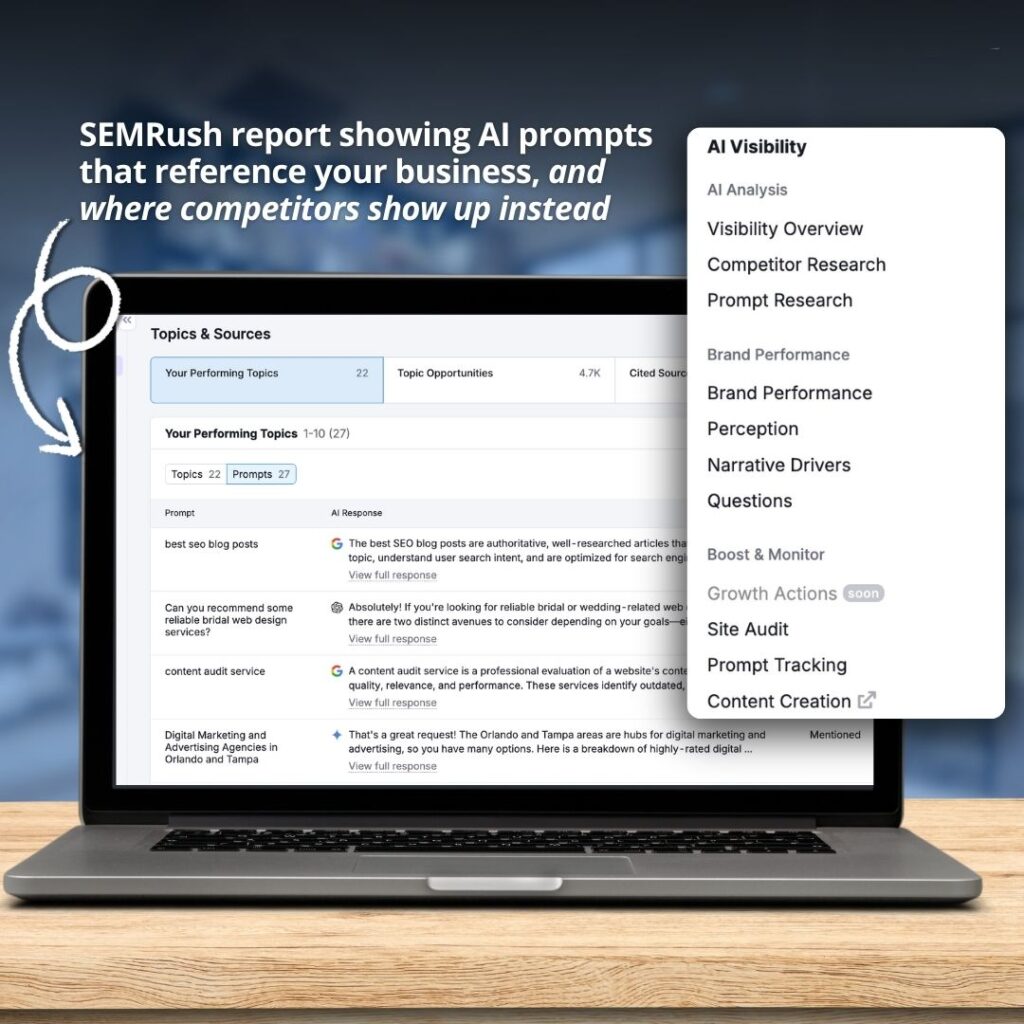
SEMrush adds a more direct layer of AI visibility tracking. SEMrush now includes AI prompt tracking and competitor prompt gap analysis, which helps you see how your site performs across AI-driven search experiences.
In SEMrush, you can:
- Track specific AI-style prompts and questions tied to your services
- See whether your domain appears in AI responses for those prompts
- Compare your prompt visibility against competitors
- Identify prompt gaps where competitors show up, and you do not
- Monitor changes over time as you publish or update content
This is especially useful for planning your content. Instead of guessing which questions to target next, you can see which prompts already surface your brand and which ones represent missed opportunities.
When used together, Google Search Console shows what people are asking, and SEMrush helps show where you appear and where you should expand coverage.
How to Track Leads Influenced by ChatGPT and AI
Tracking leads influenced by AI requires focusing on behavior patterns, not single metrics.
What You Can and Cannot Track
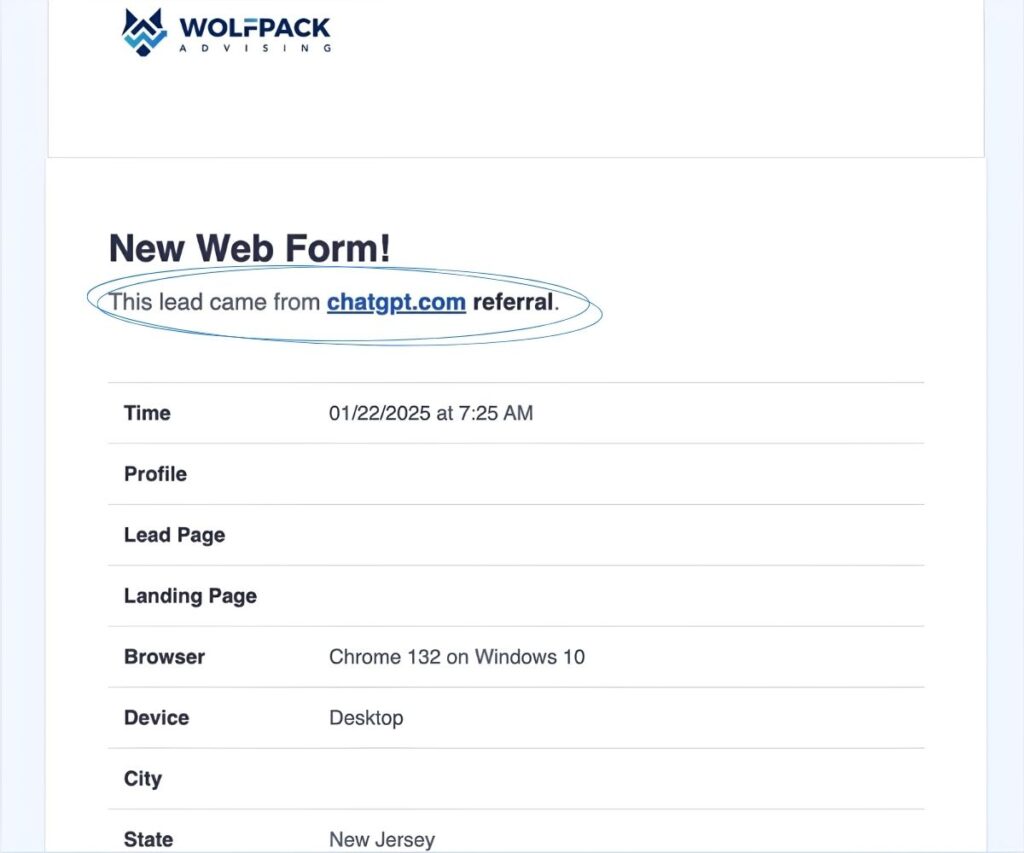
You cannot tag a lead as “ChatGPT source,” but you can ask new customers how they heard about you, using a simple form, once they do convert.
Alternatively, watch how your content influences behavior. Look for:
- Branded search growth
- More direct traffic
- More visits to educational content before conversion
- Higher multi-touch paths before contact
These patterns help you see whether visibility and trust are increasing.
Using Google Analytics to Spot AI-Influenced Behavior
In Google Analytics, watch for:
- Visitors landing on informational pages early
- Visitors returning to service pages
- Increased engagement metrics
- More contact form submissions from pages with lots of question-style impressions
These patterns suggest content played a role in the decision.
A Quick Tracking Key:
| Platform | Main Thing to Watch | What It Tells You |
| Google Search Console | AI-triggered queries in Performance reports | The actual queries and prompts that surface your pages in search, including those that trigger AI Overviews and AI Mode |
| SEMrush | AI prompt visibility and prompt gaps | Whether your site appears in AI-style prompt responses, how you compare to competitors, and which prompts you are missing |
| Google Analytics | Landing pages that lead to conversions | Which pages users visit before calling or submitting a form, showing how AI and search discovery influence real leads |
How Leads From ChatGPT Fit Into Your Long-Term Funnel
Home-based business leads from ChatGPT work best when your site and messaging are already set up to support them.
This is not a new channel to manage. It is an extension of your existing SEO and local strategy.
To make your funnel ready for AI-influenced leads, focus on a few core areas:
- Clear answers up front: Your content should explain problems, services, and next steps in plain language. This helps AI tools pull accurate answers and helps homeowners know when to contact you.
- Strong connections between content and services: Educational pages should lead naturally to related service pages. This keeps visitors moving forward instead of getting stuck.
- Consistent trust signals everywhere: Your website, Google Business Profile, and reviews should tell the same story. Consistency builds confidence and reduces hesitation.
- Simple, obvious next steps: Calls, contact forms, and service requests should be easy to find on every key page.
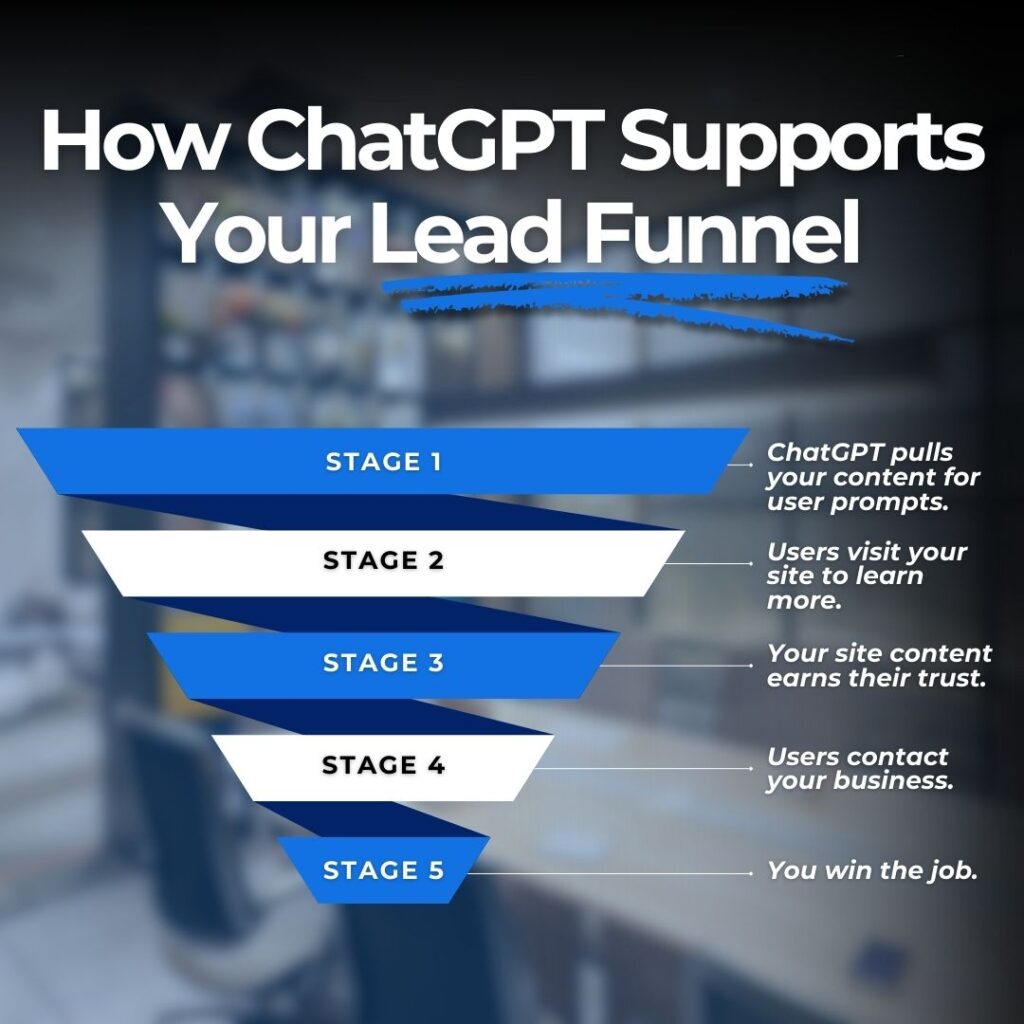
When these pieces are in place, ChatGPT does not disrupt your funnel. It supports it by sending more informed, higher-intent visitors into a system that is already built to convert.
Related Questions
What should a home service website include to get more leads?
A strong home service website includes clear service pages, easy ways to contact you, trust signals like reviews and photos, and content that answers common homeowner questions.
How do I know which services deserve their own pages?
Create separate pages for services that customers search for by name and that you want to rank for. Each core service should have its own page with its own details.
What is the difference between local SEO and standard SEO?
Local SEO focuses on showing up in map and location-based results using tools like your Google Business Profile. Traditional, organic SEO focuses on your website content and how it ranks in traditional search results.
What is share of voice, and why does it matter for SEO?
Share of voice measures how visible your business is compared to competitors across a group of relevant keywords. It matters because it shows whether your overall presence is growing, not just individual rankings.
Conclusion
Getting more home-based business leads from ChatGPT is effectively making your business easier to trust and easier to understand, wherever homeowners are searching or asking questions.
That starts with strong SEO foundations, clear answers, helpful content, a fully optimized Google Business Profile, and consistent citations across the web.
When your business consistently answers the right questions and presents clear, trustworthy information, AI tools pick up on that, and your visibility turns into leads that compound.
If you want a clearer picture of how your site and local presence stack up today, WolfPack can help spot the gaps and focus on the changes that actually drive lead growth.