Before running a social media ad campaign, there’s one question to ask first. Are you trying to get seen, or are you trying to get a result? Meta, TikTok, and LinkedIn each package that choice a little differently, but the underlying logic is identical. At WolfPack, we manage social ad campaigns across multiple platforms. Picking the wrong side of that choice is still the most common budget-waster we see. Here’s what awareness and conversion actually mean on each platform, how they decide audience, and how to tailor campaigns around the right one.
Awareness vs. Conversion: The Same Choice, Every Platform Makes You Make It
Every social ad platform optimizes your campaign toward one of two things: getting remembered, or getting acted on.
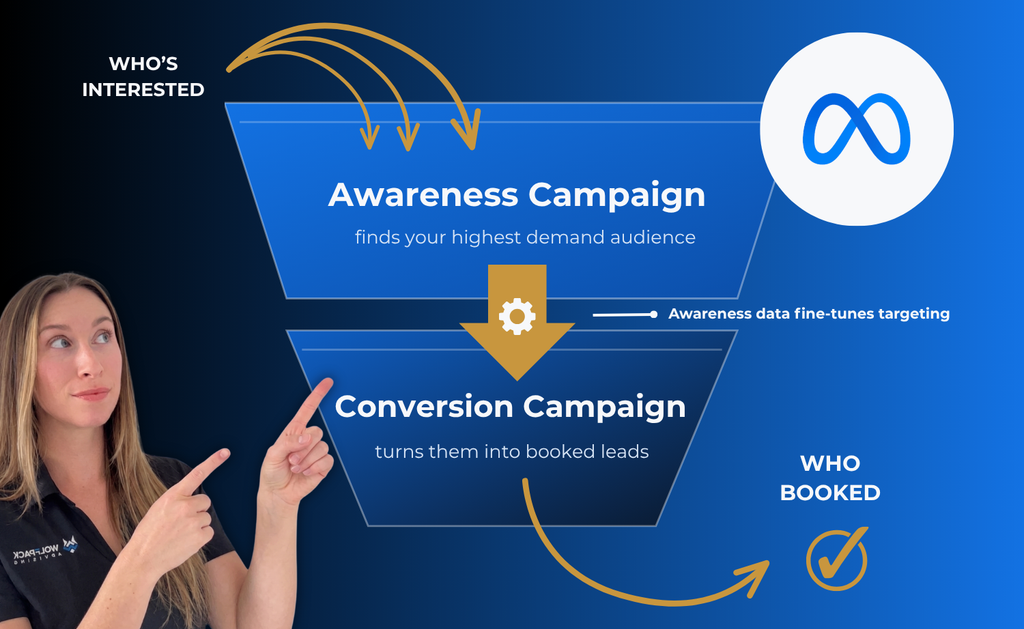
- Awareness Campaign (Top of Funnel / TOFU): Getting people to recognize your brand or product. These give you the chance to find the audience with the highest demand for what you offer.
- Conversion Campaign (Bottom of Funnel / BOFU): Getting people to take a final action, like buying a service or signing up. You then use the data from that awareness campaign to fine-tune your targeted conversion ads.
That’s why awareness and conversion aren’t competing choices. They’re two halves of the same system. One warms up your audience, and the other turns that warm audience into results.
What This Looks Like On Meta
The creative that wins an awareness campaign, and the creative that wins a conversion campaign often look nothing alike. Even when they’re running on the same platform to the same audience.
People scroll through Meta fast. An ad that looks too polished or too much like traditional advertising gets scrolled past. That’s why awareness creative on Meta leans hard into looking real. Actual photos of your team, work in progress, before-and-after shots, your branded vehicle, happy customers. Video works the same way. Raw, casual footage, shot vertically and kept under a minute, tends to outperform anything that feels commercial or overproduced. The goal is a scroll-stopping moment, not a polished pitch.
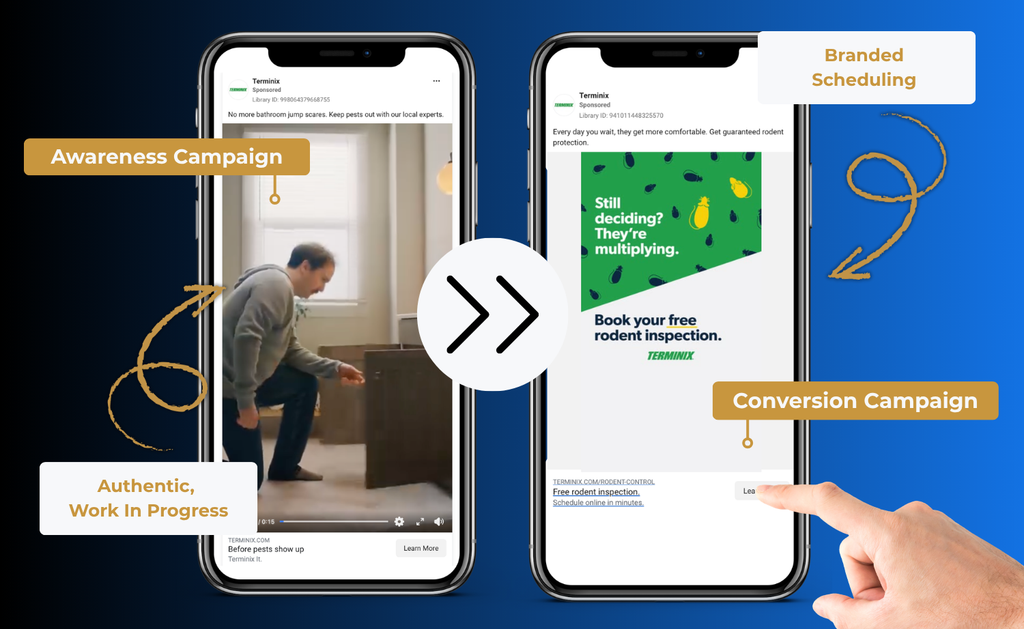
Conversion creative asks more of the viewer, so it needs more than an authentic feel. It needs a hook, a bold statement, a relatable problem, or a direct question. That earns your first second or two of attention. Then it needs a specific reason to act now instead of scrolling on. For example: A guarantee, a certification, a review count, or a turnaround time competitors can’t match. “Same-day inspection reports, guaranteed” gives someone a reason to click. “Quality service you can trust” doesn’t, since nearly every competitor claims some version of the same thing.
Put simply: awareness creative earns attention by feeling native to the feed. Conversion creative earns action by being specific about why you, and why now. Build both into the same social media ad campaign plan instead of treating creative as one-size-fits-all across objectives. That’s usually what makes an ad memorable and actionable.
Building Your Own Awareness vs. Conversion Strategy
Start with your audience’s temperature, not with which objective sounds more advanced. A few steps that apply no matter which platform you’re running:
- Match the objective to where your audience actually is. A cold audience in a new market has no signal to convert on yet. A warm audience that already knows your brand is ready for a conversion-side push.
- Set up tracking before you launch, not after. Whether it’s Meta’s Pixel and Conversions API, TikTok’s Pixel, or LinkedIn’s Insight Tag, a conversion campaign with no tracking connected is guessing, not optimizing.
- Give it enough volume before judging it. Most platforms need somewhere around 50 tracked actions per week (per ad set or ad group) before the algorithm reliably learns who converts. A campaign that looks slow in week one is often still in that learning window, not underperforming. Pulling the plug at day five is one of the more common ways businesses waste a conversion campaign’s budget before it ever gets the chance to work.
- Sequence awareness into conversion, don’t run them forever in parallel. Build recall with an awareness push, then retarget that warmed audience with a conversion objective. Running both indefinitely, with no plan to move people from one to the other, usually means paying twice for the same audience: once to make them aware, and again to reach them with an ad that still isn’t asking for anything.
- Prove your tracking, then shift budget toward conversion. Reserve awareness spend for specific situations (a new market, a seasonal push, a pre-launch) rather than treating it as a permanent line item. Most local businesses find that once conversion campaigns are producing reliable leads, ongoing awareness spend adds less value than putting that same budget toward scaling what’s already working.
How to Measure Each Social Ad Campaign Type
Judging an awareness campaign by how many leads it produced is like judging a billboard by how many phone calls it generated on day one. It’s the wrong metric for the job, and it’s one of the most common reasons a working social media ad campaign gets pulled early.
Awareness campaigns are measured on reach and recall, not on action. Conversion campaigns need a completely different scorecard. Here’s how the two line up side by side:
| Campaign | Timeline | KPI | Your Number | What It Tells You |
|---|---|---|---|---|
| Awareness | 30–60 days | Reach | Scales with service area size | Whether people are seeing and remembering your ad |
| Frequency | 1.5–3 / week | |||
| CPM (cost per 1,000 impressions) | Ideally below $20 | |||
| Video view / completion rate | Compare across creatives | |||
| Conversion | Ongoing (1–2 wks to clear learning phase) | CPL / CPA | Well below avg. job value | Whether people are taking action, and whether it’s turning into revenue |
| Conversion rate | 8–15% | |||
| ROAS (return on ad spend) | 3–5x | |||
| Booked jobs (not just form fills) | Varies with local demand |
A Few of These Are Worth a Bit More Context:
Reach and frequency of your social media ad campaigns
Low frequency with high reach usually means you’re still introducing the brand to new people. Rising frequency with flat reach means you’re starting to repeat the same audience, a signal it may be time to refresh creative or shift budget toward conversion.
CPM (cost per 1,000 impressions)
Awareness ad spend is priced. Comparing CPM across campaigns or placements tells you which audiences are cheapest to reach, not which ones are most likely to buy, so a low CPM alone isn’t a sign of success.
Conversion rate
This is where a mismatched objective shows up fastest. A high click rate paired with a low conversion rate often means the ad promised something the landing page didn’t deliver.
ROAS on your social media campaign
Relevant for ecommerce and catalog sales, where revenue can be tied directly back to the ad.
Booked jobs
For local and home service businesses, count a lead only once you’ve tracked it through to a scheduled job or closed sale. A dedicated lead-tracking tool exists to catch exactly that. An awareness campaign often puts a contact in front of your business weeks before a conversion campaign closes them. Without that connection, credit for the sale often lands entirely on whichever campaign happened to run last.
Don’t kill an awareness campaign for a low lead count, and don’t call a conversion campaign a win because it generated cheap clicks. Match the metric to the objective, the same way you matched the objective to the audience.
When Your Social Media Ad Campaign Needs a Pro
Matching the right objective to the right platform is only half the job. Getting the tracking connected correctly, structuring social media ad campaigns so each platform’s algorithm has clean data to learn from, and knowing when to shift a campaign from building awareness to driving conversions is where a lot of self-managed accounts lose budget without realizing it. Businesses that go pro after running their own campaigns share the same story. An awareness campaign that built plenty of reach but never got followed up with a conversion push. Or a conversion campaign was launched before tracking was configured.
Both are fixable, but they’re easier to avoid from the start than to untangle later. That’s exactly what our advertising team handles: full-funnel campaigns built around real conversion data, tied back to WolfPack’s Lead Center so every result traces to the exact campaign that produced it.
Related Questions to Explore
How much does a social media ad campaign cost?
It varies by platform, audience, and objective, but budgets for local and home service businesses typically start in the low four figures monthly to generate a reliable, repeatable lead flow. Awareness campaigns usually price and bill by impressions (CPM), while conversion campaigns price against the tracked action itself. You won’t see the real cost until the campaign clears enough volume to exit its learning phase. Testing a small budget for the first few weeks, then scaling once a platform proves it can hit your target cost per lead, is generally a safer path than committing a large monthly spend on day one.
How should you split budget between awareness and conversion campaigns
For most local businesses with working tracking, the majority of budget belongs in conversion campaigns. Awareness gets a smaller, deliberate slice reserved for specific situations, a new market launch or a seasonal push, rather than an even split maintained indefinitely.
How do you replicate a successful campaign across multiple platforms?
The creative and targeting rarely transfer directly. What does transfer is the objective logic: identify whether the original campaign won on recall or on a tracked action, then rebuild toward the equivalent objective on the new platform (Reach on TikTok, Brand Awareness on LinkedIn, and so on), rather than copying the exact settings.
How do agencies manage large-scale social media ad campaigns?
By separating awareness and conversion work into distinct campaigns with distinct budgets and success metrics, then connecting the results back to a shared tracking system so leads and sales trace to the specific campaign and platform that produced them.
Should you run awareness and conversion campaigns on the same platform at the same time?
Often, yes, but for different jobs. An awareness campaign runs continuously in a new market or ahead of a seasonal push. A separate conversion campaign targets the audience that’s already engaged. The mistake isn’t running both. It’s letting an awareness campaign run indefinitely with no conversion campaign downstream to catch the audience it’s building.
Conclusion
Every platform asks the same question in different words: are you optimizing for recall, or for a tracked action? A few things worth remembering:
- Awareness objectives optimize for reach and recall with no tracking attached. Conversion-side objectives need a pixel, tag, or API connected before they can perform.
- The packaging differs by platform (Meta flattened its funnel tiers; TikTok and LinkedIn still use them directly), but the underlying logic is the same everywhere.
- Sequence the two: build recall, then retarget that warm audience with a conversion objective, rather than running both forever with no plan to connect them.
Get a custom proposal, book a free call, and we’ll tell you what to handle first.