

Last updated on March 25th, 2026 at 07:32 am
If your business already invests in SEO, you are closer to winning in AI search than you might think. The foundation is already there.
What most businesses are missing is the layer that sits on top of it. The one that tells AI engines not just where your content lives, but what it means and why it should be trusted.
That layer is your AEO strategy. And for home service businesses competing in a market where Google and major AI platforms increasingly answer questions before anyone clicks a link, getting this right is no longer optional.
This post walks through what an AEO strategy looks like in practice, what you need before you start, and how to create a winning AEO strategy for AI search without rebuilding everything from scratch.
Contents
What AEO Is and Why Your Strategy Matters Now
Answer Engine Optimization, or AEO, is the process of structuring your content so AI-powered search tools can understand it, trust it, and use it as a direct answer.
Traditional SEO focuses on helping your pages rank for keywords. Answer engine optimization focuses on something deeper. It makes your content easy for AI engines like Google AI Overviews, ChatGPT, and Gemini to read, summarize, and surface when someone asks a relevant question.
This matters because search behavior has shifted. A growing number of searches now end without a click. The user types a question, gets the answer directly on the results page, and moves on.
For home service businesses, this often happens at the exact moment a homeowner is deciding who to call. If your content is not structured to be understood and selected by AI systems, you are invisible during those moments, even if your traditional SEO is strong.
The good news is that AEO and SEO are not competing strategies. SEO builds the structure AEO needs to work. Businesses with solid SEO foundations are best positioned to layer in AEO quickly and see results faster.
How AEO and SEO Work Together
Unlike traditional SEO, which focuses on rankings and clicks, AEO is focused on being selected as the answer inside AI-generated responses.
But the two strategies share more common ground than most people realize.
SEO helps search engines find and index your pages. AEO helps AI engines understand what those pages mean and decide whether to use them as a direct answer. One gets you discovered. The other gets you selected.
The signals that support strong SEO are the same ones AI engines rely on when judging trust and relevance:
- Well-structured content
- Clear headings
- Strong internal linking
- Consistent information across your site
When both strategies are aligned, your content becomes more visible across traditional search results and AI-generated answers at the same time.
For home service businesses already running SEO, this is significant. You are not starting from zero. You are building on existing momentum.
The businesses that fall behind will be the ones waiting for AEO to feel more familiar before they act. AI-driven search is already reshaping how homeowners find service providers, and the gap between businesses that have adapted and those that have not is growing fast.
[Visual: Canva graphic showing SEO as a foundation layer with AEO building on top, simple stacked format with short labels for each layer]
What Do You Need in Place Before You Start?
Before building out your AEO strategy, it helps to know where you stand. A quick self-audit across these four areas will show you how ready your site is.
| Area | What to Check | Look Good? |
| Site structure | Clean URLs, logical page layout, mobile-friendly design | Yes / No |
| Content quality | Pages answer real user queries clearly and completely | Yes / No |
| Schema markup | Structured data added to key pages (FAQ, Organization, Service) | Yes / No |
| EEAT signals | Author credentials, reviews, consistent business information | Yes / No |
If you are unsure how your site scores, our free AEO Grader gives you a fast read on your current AI visibility for ChatGPT, Perplexity, and Gemini.
Most home service sites have decent bones but are missing two things consistently:
- Schema markup on key pages
- Content that answers user questions directly rather than just describing services
Both are fixable. And both make a real difference in how AI engines interpret your site.
How to Create a Winning AEO Strategy: Step by Step
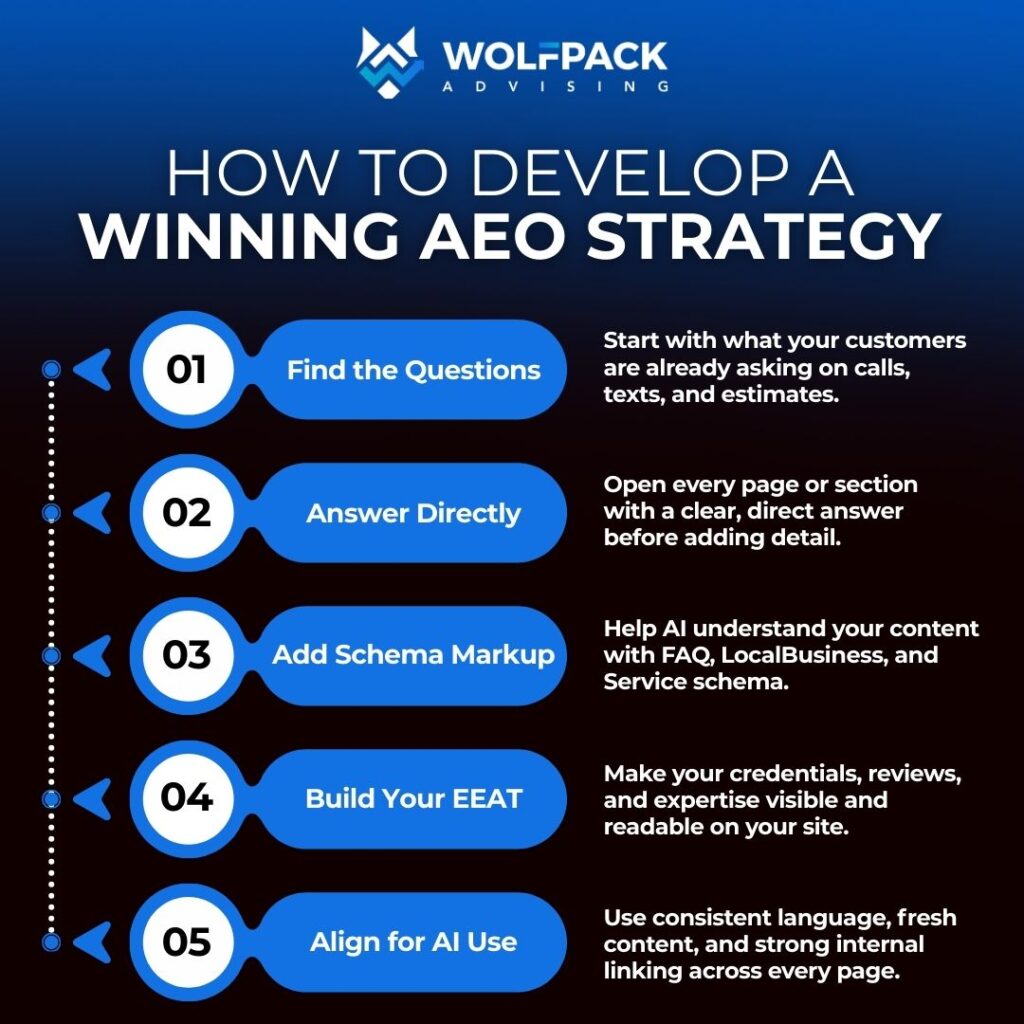
A winning AEO strategy comes down to one core idea. Make it easy for AI engines to understand what you do, who you serve, and why your content can be trusted (and referenced).
Here is how to do that in practice.
Step 1: Identify the Questions Your Customers Are Already Asking
Start with the questions that come up on calls, in texts, and during estimates. Most times, home service customers do not search in “keyword” form. They search in full sentences, especially on mobile and through conversational AI tools.
Questions like these are the foundation of a strong AEO content strategy:
- How long does a roof inspection take?
- What does a home inspector actually check?
- Is mold in my crawl space dangerous?
- How much does pest control cost per month?
These are the user queries AI platforms are being asked every day. If your site answers them clearly, you have a real shot at being the source AI uses in its response.
Step 2: Structure Your Content to Answer Directly
Each page or section should open with a clear, direct answer before adding context or detail. AI engines scan for the answer near the top of a section, then use the surrounding content to decide whether it is trustworthy enough to cite.
A few habits that support this:
- Use question-based H2 and H3 headings that reflect how people actually search
- Give the direct answer in the first one to two sentences of each section
- Follow with a brief explanation, examples, or supporting detail
- Use numbered lists and short paragraphs to keep the content easy to scan
Please note: this is not about writing for robots. Content structured this way reads better for humans. It is clear, respects the reader’s time, and is easier to act on.
Step 3: Add or Improve Schema Markup
Schema markup is code added to your pages that tells search engines and AI engines exactly what type of content they are looking at. Without it, AI systems have to guess. With it, they know.
For home service businesses, the most useful schema types to start with are:
| Schema Type | What It Does |
| FAQ schema | Marks up Q&A pairs so AI engines can pull them into search results and summaries |
| LocalBusiness schema | Confirms your name, location, service area, and contact details |
| Service schema | Connects your specific services to relevant user queries |
| Review schema | Surfaces star ratings in search results to build trust before anyone clicks |
You do not need to be a developer to add schema. Plugins like RankMath or Yoast SEO in WordPress include built-in tools for this.
Creating dedicated FAQ pages with schema markup is one of the highest-impact moves a home service business can make for AEO. It gives AI engines clear, structured content to pull from while also answering the questions your customers are already asking.
Step 4: Build or Strengthen Your EEAT Signals
EEAT stands for Experience, Expertise, Authority, and Trustworthiness. These are the signals Google and AI systems use to decide whether your content is worth citing in AI responses.
For home service businesses, EEAT is one of your biggest competitive advantages. A licensed pest control company or a certified home inspector carries real credibility. The challenge is making sure that credibility is visible on your site and readable by AI crawlers.
Ways to strengthen your EEAT signals:
- Add author bios to blog posts that mention credentials, certifications, or years of experience
- Keep your business name, address, and phone number consistent across your site, Google Business Profile, and directory listings
- Link to licenses, certifications, and industry affiliations on relevant pages
- Collect and display reviews on your site and on third-party review sites
- Write content with specific examples and practical guidance rather than generic descriptions
One more thing worth noting here. AI engines do not only pull from company websites.
They pull from review platforms, industry publications, and forums, too. Building consistent brand visibility across those channels increases your chances of being cited in AI-generated answers.
Step 5: Align Your Content With How AI Engines Interpret It
Two things matter most in this final step: entity consistency and natural language.
- Entity consistency means using the same names, terms, and descriptions for your business, services, and service areas across every page.
- If your homepage says “home inspection services” but your blog or GBP says “property inspection,” AI systems have a harder time connecting those pages. Consistency helps them understand that your content covers the same topic throughout.
- Natural language means writing the way people actually talk. Large language models are trained on conversational queries, so content that mirrors how people speak tends to perform better in AI search than content written purely around keyword targets.
- Content freshness also plays a role. AI engines often favor up-to-date information, especially in fast-moving industries. Reviewing and refreshing your most important pages regularly signals that your content is current and reliable.
Linking between related service pages and blog posts supports all of this by helping AI systems map how your content is organized and which topics are most central to your business.
How Do You Know If Your AEO Strategy Is Working?
AEO results do not always show up where traditional SEO metrics do. You may not see an immediate jump in keyword rankings, but you will start to notice other signals.
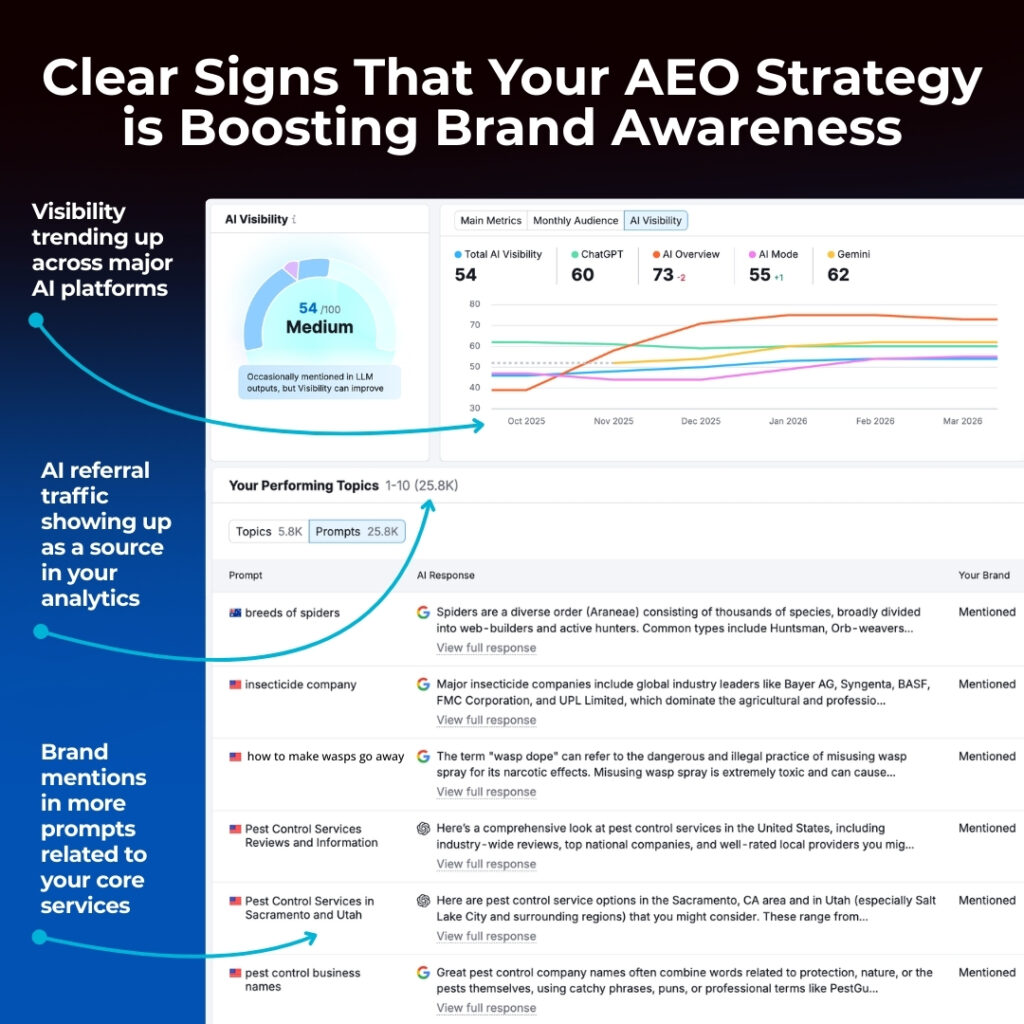
Here is what to keep track of…
| Signal | What It Looks Like |
| AI Overview appearances | Your content or brand shows up in Google AI Overview summaries |
| Featured snippets | Your page earns the highlighted answer box above traditional search results |
| Branded search lift | Visits coming from AI platforms appear in your analytics |
| Zero-click impressions | Impressions rising in Google Search Console without a matching rise in clicks |
| AI citations | Your site is referenced when running target questions through ChatGPT, Gemini, or Perplexity |
| AI referral traffic | Your business name appears in AI-generated responses and summaries |
| Brand mentions | Your business name appearing in AI-generated responses and summaries |
Traditional search traffic metrics alone will not give you a complete picture of how visible you are in AI-driven search. Monitoring brand mentions and AI citations across platforms is an important part of measuring AEO performance over time.
One more reason to pay attention: businesses that earn consistent AI citations often see higher conversion rates from that traffic compared to traditional organic search.
Users arriving from AI answers tend to be further along in their decision-making process and closer to being ready to book.
Related Questions
What is the difference between AEO and SEO?
SEO focuses on helping your pages rank in traditional search results through keywords, links, and technical optimization.
AEO gets it selected and referenced. It focuses on structuring content so AI engines can understand it and use it as a direct answer. Businesses that align both see stronger visibility across traditional search results and AI-generated answers.
How long does it take to see results from AEO?
AEO can show early signals faster than traditional SEO because AI engines crawl and re-evaluate content regularly. Some businesses begin appearing in featured snippets or AI summaries within weeks of making structural improvements.
Does AEO work for small or local businesses?
Yes, and it is especially well-suited for them. AI engines prioritize clarity and trust over company size, which means a well-structured page from a local home inspector or pest control company can outperform a national competitor when the content is more direct and useful.
Local search queries are often urgent and question-based, which is exactly the format answer engine optimization is built to capture.
Do I need to rebuild my website to use AEO?
No. Most AEO improvements happen at the content and markup level, not the site architecture level. Adding schema to existing pages, restructuring how your content answers questions, strengthening EEAT signals, and improving internal linking are all changes that can be made without a full rebuild.
If your site has technical SEO issues like slow load times, poor mobile performance, or crawl errors, those should be addressed first since they affect both SEO and AEO performance.
Check your current AI visibility for free:
Conclusion
Building a winning AEO strategy does not mean starting over. It means taking what your SEO has already built and making it work harder in the places where search is heading.
For home service businesses, that means…
- Structuring content around the real questions homeowners are asking
- Adding markup that helps AI engines trust your answers
- Building brand visibility across the platforms AI tools pull from
- Making sure the credibility you have earned in the field is visible and readable on your site
The businesses showing up in Google AI Overviews, featured snippets, and AI-generated responses right now got there by giving search engines something clear, current, and credible to work with.
If you are ready to build that into your own strategy, the WolfPack team can help you figure out exactly where to start.