

TL;DR – Site backlinks come from other websites and point to yours. Google counts it like a referral. The best ones for home services are local, and you do not need to buy a single one.
Site backlinks work like referrals. When another website links to yours, Google counts it as a vote that your business can be trusted. More good votes mean higher rankings.
WolfPack has worked with hundreds of home service companies since 2019. This question comes up all the time, often right after a cold email promises 500 backlinks for $99. Backlinks are real, but that offer is not.
Here is what a site backlink actually is, where home service businesses get their best ones, and which offers to delete.
What Is a Site Backlink?
A site backlink is a link on someone else’s website that points to yours. You do not make it. Someone else does.
If the Tampa Bay Chamber lists your pest control company and links to your homepage, that is a backlink. So is the supply house that names you as a certified applicator. So is the realtor who put you on her “who I recommend” page.
Think of your website as a résumé. Backlinks are the references at the bottom. Google calls every one of them.
You almost certainly have a few already. Most home service businesses pick them up without trying. The common ones:
- A manufacturer’s “find a contractor” page
- A chamber of commerce or BBB profile
- A sponsor page from a team or event you paid for
- A supplier or vendor listing
- A mention in a local paper or neighborhood blog
Who Needs to Build Backlinks?
Pretty much every website benefits from backlinks. If you run a local company of any size, and another business nearby does the same work you do, you need them.
This is for business owners who want to:
- Get found for the service, not just the company name
- Move up against competitors who have been there longer
- Get named when a homeowner asks ChatGPT or Google’s AI who to call
- Turn that visibility into quote requests, not just traffic
The links that get you there come from places you already have a connection to: your certifications, your chamber, and the partners who already refer work to you.
A Distinction That Matters
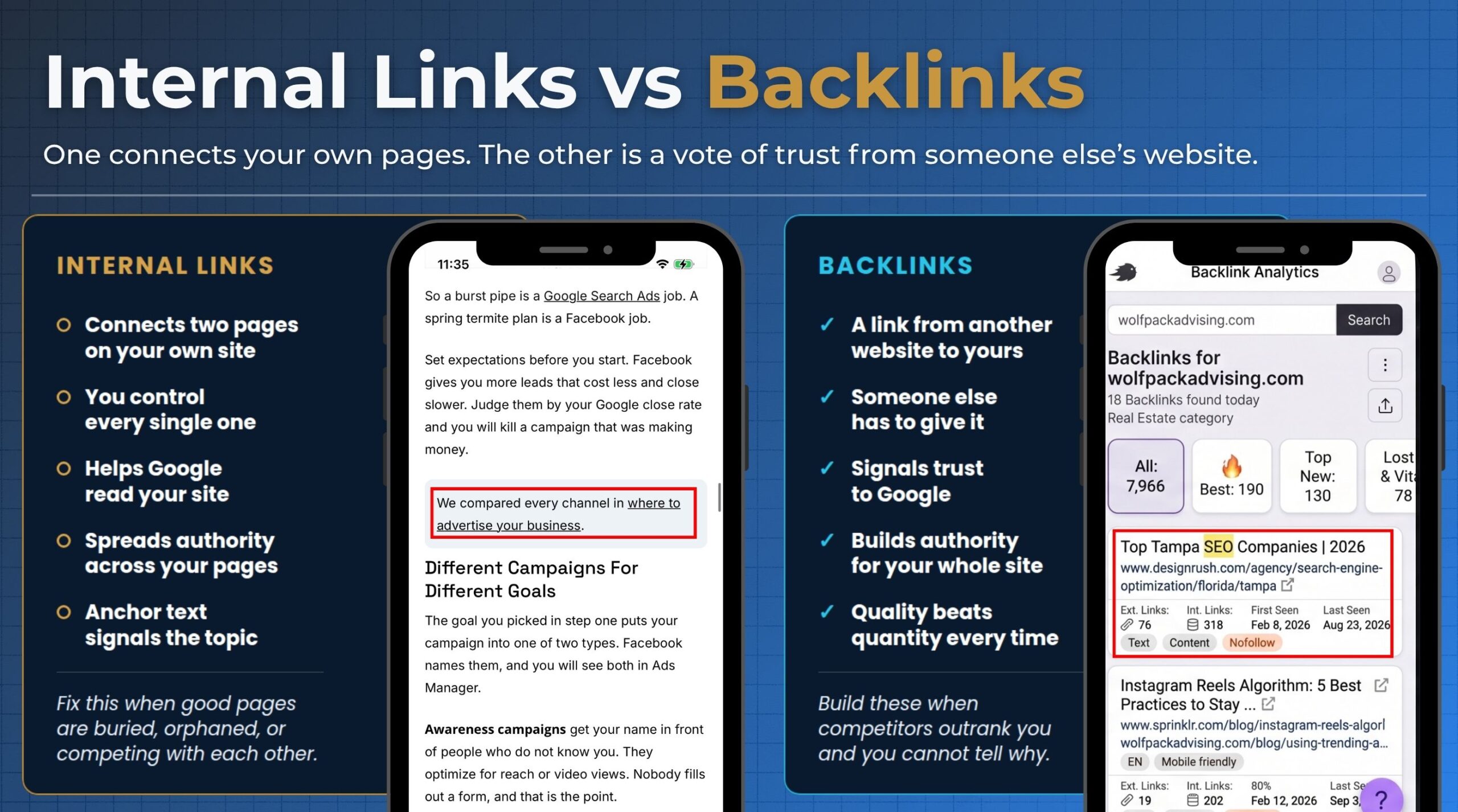
You cannot add backlinks to your own website. A link from your roofing page to your contact page is not a backlink; it’s an internal link. Those are still valuable, but Google reads them differently than true external backlinks.
The only lever you control is giving other people and businesses a reason to link back to you. That is what the rest of this post is about.
How Do Site Backlinks Help You Rank?
Google uses backlinks to figure out who other people already trust.
Google’s crawler travels the web by following links. Each link to your site tells it two things. Your site exists. Someone thought it was worth pointing at.
Anyone can claim to be the best pest control company in Hillsborough County. It counts when the chamber, the supply house, and the local paper say it instead.
Three things most owners miss:
- They send real customers. A link on a supplier’s contractor page brings actual clicks, not just ranking credit.
- They feed AI search. Google’s AI Overviews and ChatGPT cite sources that get referenced across the web. The same links help you get named.
- They lift your whole site. A strong link profile helps every page, not just the linked one. That is the idea behind increasing your domain authority the right way.
Google cares how many different websites link to you; those are your referring domains.
Fifty links from one blog is one vote, repeated. Fifty links from fifty different sites are fifty votes.
Backlink, Internal Link, or Citation?
These three get mixed up constantly. Contractors get sold one, thinking they bought another.
| Link Type | What It Is | Example | Builds Authority? |
|---|---|---|---|
| Backlink | A link from another site to yours | GAF lists you as a certified contractor and links out | Yes |
| Internal link | A link between two pages of your own site | Your roofing page links to your storm damage page | No, but it helps Google read your site |
| Citation | Your name, address, and phone listed somewhere | A Yelp or Angi listing | Partly. Helps map rankings, not the same as a link. |
Citations still matter locally. Just do not let anyone sell you a citation package and call it link building.
What Makes One Backlink Worth More Than Another?
Five things decide what a link is worth.
| Factor | What It Means | What To Aim For |
|---|---|---|
| Trust | How credible the linking site is | One link from GAF or Trane beats a thousand junk directory links |
| Relevance | Whether that site relates to your trade | A roofing supplier linking to a roofer makes sense |
| Placement | Where the link sits on the page | Inside the article beats the footer |
| Anchor text | The clickable words | “Tampa termite inspection” says more than “click here” |
| Follow status | Whether it counts as a vote | Some links carry a tag telling Google to skip them |
That last one needs a note. Links can carry a nofollow, sponsored, or ugc tag. Google’s own guidance says to mark paid placements with the sponsored attribute.
Do not panic when a tool shows a pile of nofollow links. Most social profiles use them by default. They still send traffic and still put your name in front of people.
Where Home Service Businesses Actually Get Backlinks
The strongest links for a home service business come from people who already know your work.
Here is the list that works for home services: manufacturers, trade associations, the chamber, local sponsorships, and partners you already work with.
Start at the Top & Work Down
- Manufacturer certification pages: GAF certified? Owens Corning preferred? A Trane dealer? Those brands keep a “find a contractor” page. You already did the hard part by earning the certification. Call your rep and ask to be listed.
- Your trade association directory: NRCA, PHCC, NPMA, InterNACHI, ASHI, plus your state association. Membership usually includes a linked listing.
- Chamber of commerce and BBB: Join, then check that the website field on your profile is actually filled in. Most are not.
- Local sponsorships: Little League, a 5K, a school fundraiser. When you write the check, ask them to link your website, not just post your logo.
- Partners you already work with: This is the biggest miss in home services. The inspector refers the pest control company. The realtor refers the inspector. You already send each other work. Ask three of them to add you to their resources page. Offer the same back.
- Local news and “best of” lists: Regional papers publish roundups constantly. A spot on “best roofers in Tampa” gets a link and readers ready to call.
- Reporter request platforms: Featured and Qwoted let journalists ask for expert quotes. In Florida, this is winnable. Every hurricane season and termite swarm sends reporters looking for someone who can explain things.
- Something worth linking to: None of this works if there is nothing on the other end. Real project pages with before-and-after photos give partners something to point at. That is also why blogging helps SEO more than many business owners expect.
Every one of these is a quick phone call, email, or form. None of them cost money you are not already spending. Just work down the list in order.
How to Check Your Backlinks in 5 Minutes
You already have backlinks. Checking costs nothing.
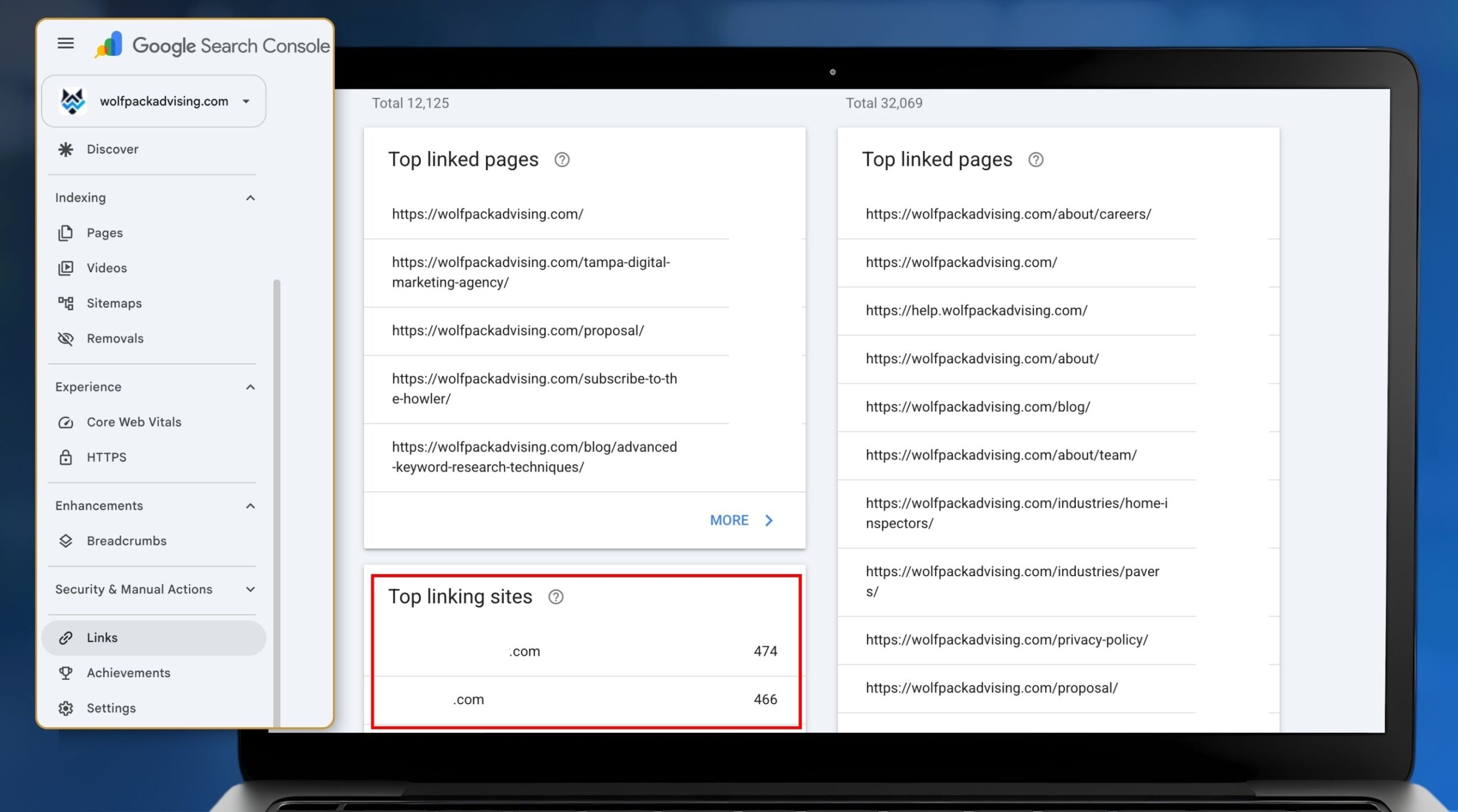
- Open Google Search Console and sign in with the account tied to your website.
- Click Links in the left menu.
- Read the top linking sites.
That list is your backlink profile. Most owners find their chamber listing, a supplier page, an old sponsorship, and a few forgotten directories.
Two things to look for… Is your biggest referral partner on that list? If not, that is one phone call. Are your certifications showing? If you are certified and the brand is missing, that is your easiest link sitting untouched.
Risky or Spammy “Backlink Offers” to Watch For
You get these emails. “500 high-quality backlinks, $99, guaranteed first page.”
Google’s spam policies define link spam as creating links mainly to manipulate rankings. The policy names buying or selling links, trading goods or services for links, excessive link exchanges, low-quality directory links, and forum comments.
Three of those catch honest people:
- Trading services for a link counts as buying one. A free roof inspection swapped for a link is a paid link in Google’s eyes.
- “Link to me, and I’ll link to you” is a scheme when it is systematic. One natural partner link is fine. A page built only to swap links is not.
- Cheap packages point at fake blog networks. When Google catches them, everything they linked to loses whatever it gained.
Usually the money just evaporates. Google ignores the links, and you have nothing. We covered the worst outcomes of how paid or manipulated backlinks harm your SEO.
Bought a package years ago? Do not lose sleep. Google filters most spam automatically now.
Related Questions to Explore
What Is the Difference Between a Backlink and an Internal Link?
A backlink comes from another website. An internal link connects two pages of your own site. Backlinks build authority. Internal links spread it around and help Google read your site. On-page and technical SEO cover how they fit together.
What Is a Referring Domain?
One website that links to you, however many links it sends. Eight links from one blog is eight backlinks from one referring domain. Variety beats volume.
Can You Rank Without Backlinks?
In a small market with weak competition, sometimes. Strong local signals and good reviews can carry niche terms. In a competitive metro, no. Your competitors have links.
Are Backlinks Still Important in 2026?
Yes. The emphasis has shifted. Volume matters less; authority and relevance matter more. Backlinks also shape whether AI tools cite your business at all, which makes them harder to skip than five years ago.
What Are Toxic Backlinks, and Should I Disavow Them?
Toxic backlinks come from spam sites and link farms. For almost every home service business, leave them alone. Google filters them out. Disavowing is an expert tool, and using it wrong removes links that were helping.
How Many Backlinks Does a Contractor Website Need?
There is no fixed number. Twenty to thirty quality local links is a realistic target for most home service markets. Ten links from manufacturers, your association, and local organizations beat two hundred directory submissions. That is the case for quality over quantity.
When to Call a Professional
Plenty of this you can do yourself, and you should. Claim the chamber listing. Call your manufacturer rep. Ask three partners. That is a free week of progress.
Bring in help when one of these is true:
- The easy links are done, and you stalled. The first ten come from relationships you have. Past that takes real outreach.
- You are losing ground in a competitive metro. You need a profile comparison against competitors, not guesswork.
- You bought links before, and something feels off. Rankings that dropped and never recovered need a diagnosis first.
- You do not have the hours. Link building is a few hours a week, every week. It is the first thing to fall off when jobs pile up.
Ask any agency three questions before signing. Where do the links come from? Are any of them paid? Will you see the list? Vague answers mean walk away.
WolfPack was started by a home inspector. Our CEO, Aaron, started at his dad’s inspection company before he started an agency to help other local brands. These profiles get built from the contractor side of the desk.
Our answer on paid backlinks has always been the same as on our SEO services page: No, never.
Conclusion
Three things worth keeping:
- Backlinks are referrals, and Google counts them. Where they come from matters more than how many you have.
- Your best links are local: manufacturers, associations, the chamber, sponsorships, and partners you already work with.
- Nobody sells a shortcut. Cheap packages do nothing or do damage.
Want the full picture? WolfPack can run a full SEO audit showing your backlink profile, how it compares to competitors, and the winnable links in your market.
Get a custom proposal; grab a time to talk. We’ll help build a strategy to reach your business goals and dominate your local market.